

 Greek
Greek  English
  Arabic
  German
  French
  Spanish
  Turkish
  Italian
  Russian
  Persian
  Bengali
  Hebrew
  Persian (Afghanistan)
  Scottish Gaelic
  Panjabi
  Croatian
  Slovenian
  Afrikaans
  Czech
Czech  Korean
  Japanese
  Portuguese




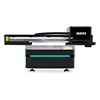
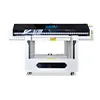
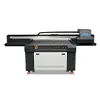
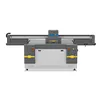
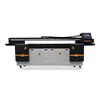
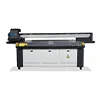
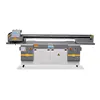

UV Printer Applications: A Complete Guide to Materials, Products and Business Opportunities
Εφαρμογές εκτυπωτών UV now cover far more than standard signs and flat panels. With the right printer, ink configuration and surface preparation, businesses can print directly on acrylic, wood, metal, glass, leather, packaging, promotional gifts, cylindrical products and many other materials.
However, being able to print on a material does not automatically mean that the application will be stable, efficient or profitable. Different materials require different ink types, coatings, fixtures, print settings and machine structures. Product size, shape, production volume and required effects must also be considered before selecting a UV printer.
This complete guide brings together our UV Printer Application & Business Opportunity Series. It is designed to help print shops, sign manufacturers, packaging companies, gift businesses, industrial manufacturers and new investors understand what a UV printer can print, how to achieve reliable results and which applications may be suitable for their business.
What Are the Main UV Printer Applications?
A UV printer uses ultraviolet light to cure specially formulated ink immediately after it is printed. Because the ink is cured on the surface instead of being absorbed deeply into the material, UV printing can be used on many non-porous and rigid products that are difficult to print with conventional inkjet systems.
The technology is especially useful for customized products, short production runs, samples, variable information and industrial decoration. It allows businesses to print full-color graphics, photographs, small text, barcodes, logos and textured effects directly onto finished or semi-finished products.
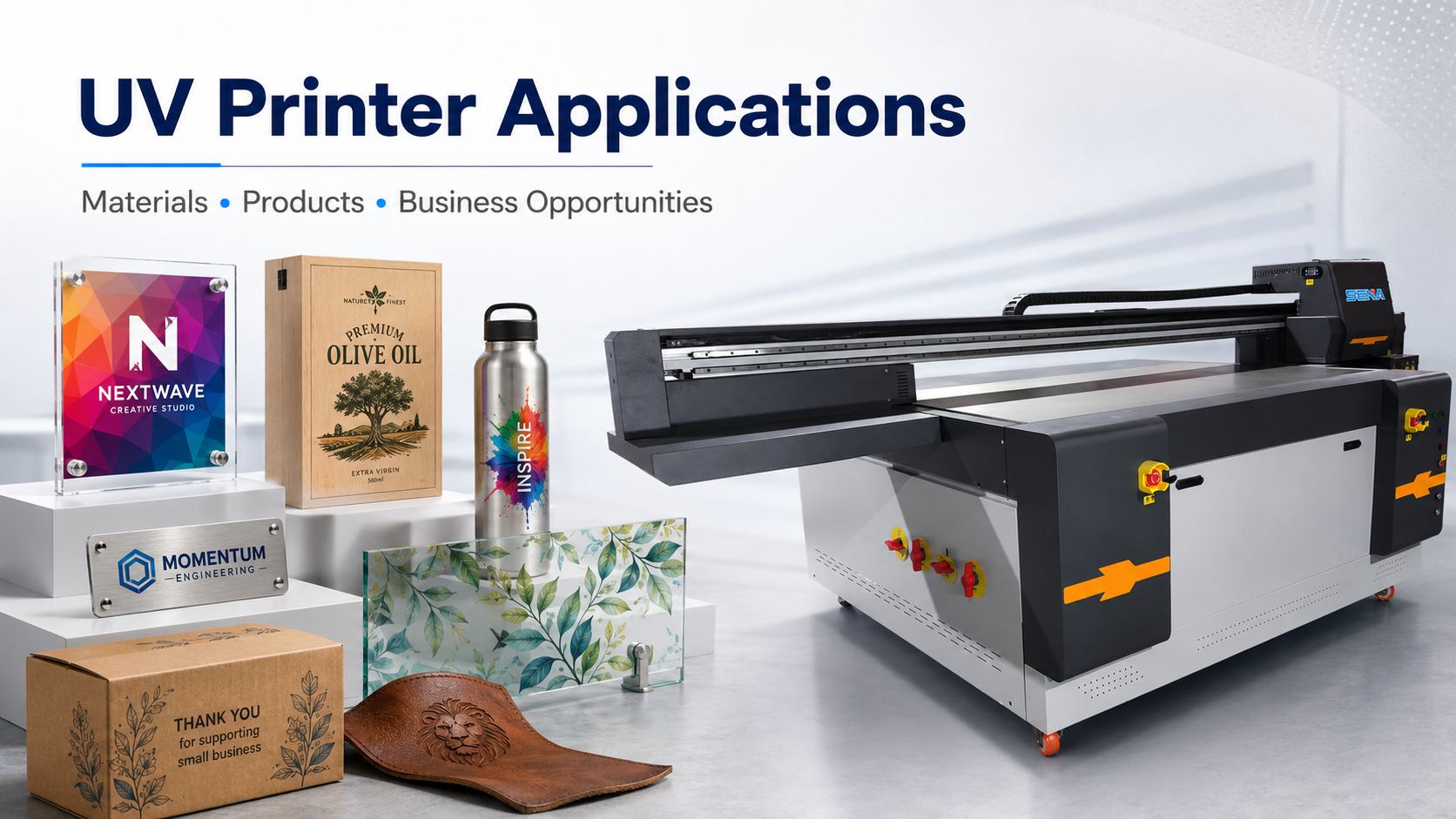
Common UV printer applications include:
- Advertising signs, display panels and directional signage
- Personalized gifts, souvenirs and promotional products
- Metal nameplates, equipment labels and industrial identification panels
- Glass doors, decorative panels and architectural glass products
- Customized packaging, corrugated boxes and product samples
- Wooden boxes, furniture panels and interior decoration products
- Leather, PU materials, table mats and flexible home products
- Bottles, cans, tubes and other regular cylindrical products
- White ink, varnish, raised texture and embossed printing effects
The best application for a specific business depends on five main factors: the material, product size, product shape, expected production volume and required print effect. These factors should be evaluated together rather than selecting a machine only according to price or maximum printing size.
What Materials Can a UV Printer Print?
UV printers can print on a wide range of rigid, transparent and flexible materials. Common UV printing materials include acrylic, wood, metal, glass, PVC, ceramic, plastic, cardboard, leather, PU, stone and coated panels.
The main challenge is not simply whether ink can be deposited on the surface. Stable production also depends on adhesion, surface cleanliness, material flatness, ink flexibility, curing strength and resistance to scratching or bending.
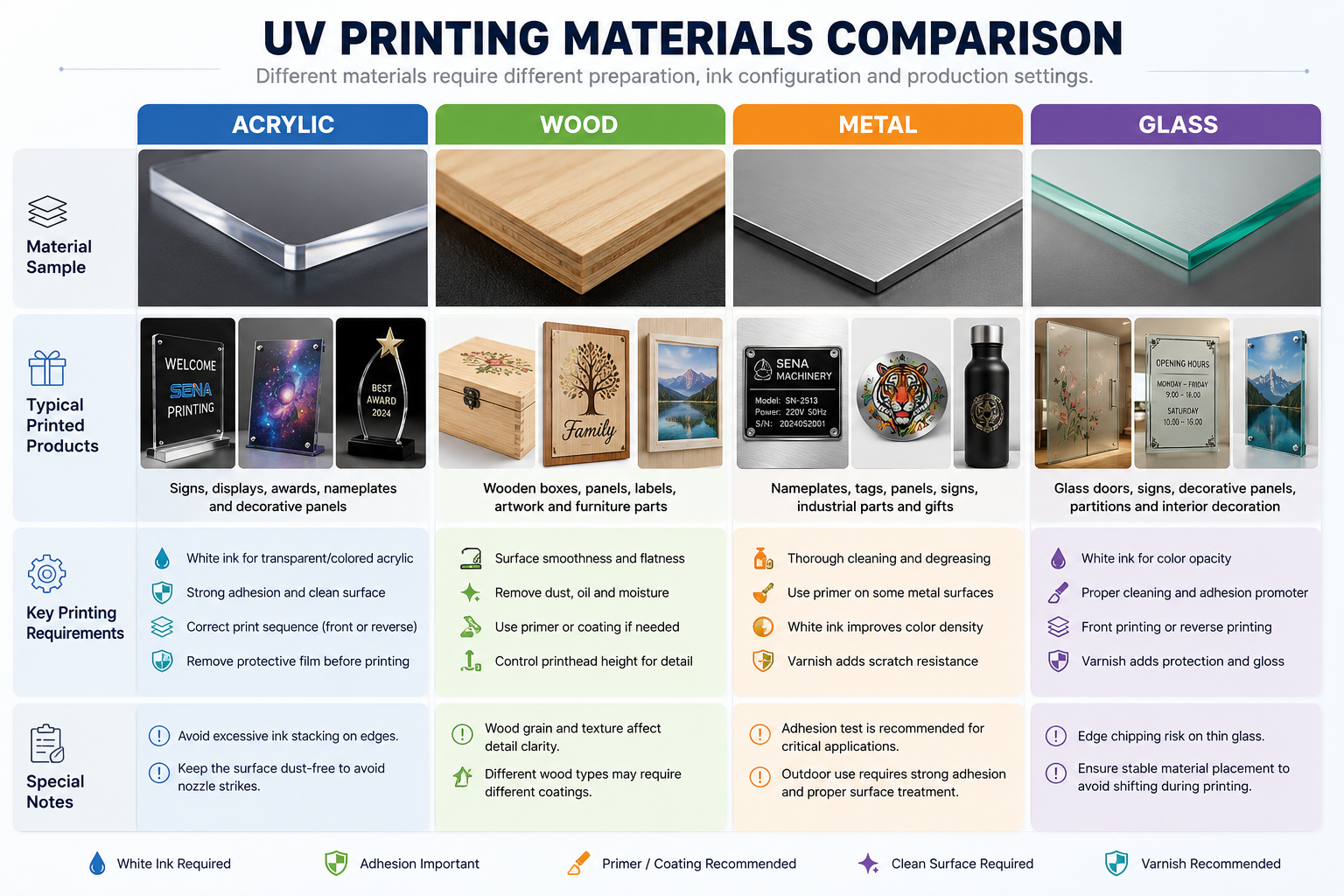
| Υλικό | Typical Products | Main Printing Requirement | Recommended Guide |
|---|---|---|---|
| Ακρυλικό | Signs, displays, awards and decorative panels | White ink, color density and adhesion | Read the acrylic guide |
| Ξύλο | Wooden boxes, panels, labels and artwork | Surface texture, dust removal and coating | Read the wood guide |
| Μέταλλο | Nameplates, tags, panels and promotional items | Cleaning, primer and scratch resistance | Read the metal guide |
| Ποτήρι | Doors, signs, decorative panels and partitions | White ink, primer and printing process | Read the glass guide |
| Leather and PU | Bags, mats, shoes and accessories | Flexible ink and bending resistance | Read the flexible material guide |
UV Printing on Acrylic
Acrylic is one of the most common materials used in UV printing. It is widely used for signs, display stands, awards, menu boards, decorative panels, nameplates and retail displays.
Transparent acrylic normally requires white ink behind the color image. Without a white layer, printed colors may look weak or transparent. Depending on the required viewing direction, the design can be printed directly on the front surface or reverse printed on the back of clear acrylic.
Surface protection films should be removed before printing, and the acrylic should be cleaned carefully to remove dust and static electricity. Some acrylic surfaces may also require an adhesion promoter.
Learn more about white ink, reverse printing, product applications and machine selection in our
complete guide to UV printing on acrylic.
UV Printing on Wood
Wood UV printing is suitable for wooden boxes, furniture panels, decorative paintings, labels, toys, signs and customized gifts. The natural appearance of wood can add value to personalized products, but its surface texture has a direct effect on printing quality.
Smooth and sealed wood usually produces sharper text and better color consistency than untreated, rough or highly absorbent wood. Dust, oil, moisture and loose fibers should be removed before printing. A primer or transparent coating may be required when the surface is porous or when stronger adhesion is needed.
For applications involving nutritional labels, barcodes or very small text, both surface flatness and printhead height must be controlled carefully.
Read our
UV printing on wood adhesion guide
to understand coating requirements, surface preparation and print-quality control.
UV Printing on Metal
UV printing on metal is commonly used for equipment nameplates, identification tags, aluminum panels, stainless-steel signs, control panels, promotional products and customized accessories.
Metal surfaces are often smooth and non-absorbent, which makes cleaning and surface preparation especially important. Oil, dust and protective residues can reduce adhesion even when the printed image initially looks acceptable. Some metals require a suitable primer before printing, particularly when the product will be scratched, exposed outdoors or cleaned regularly.
White ink can improve color density on dark metal, while varnish can add selective gloss or surface protection.
See our
practical guide to UV printing on metal
for signs, nameplates and custom products.
UV Printing on Glass
Glass UV printing is used for doors, partitions, decorative panels, signs, kitchen backsplashes, architectural glass and interior decoration. Because glass is transparent and has a smooth surface, white ink and adhesion are two of the most important considerations.
White ink can be printed behind the color image to create stronger, more accurate colors. Reverse printing can also protect the image behind the glass, but the artwork and printing sequence must be prepared correctly.
Glass should be completely clean before printing. Depending on the surface treatment and final application, a primer may be needed to improve durability.
Explore the complete process in our
UV printing on glass applications and adhesion guide.
UV Printer Applications for Custom Products and Industries
Many buyers do not search only for a material. They search for a specific product they want to manufacture, such as signs, gift items, bottles, boxes or leather accessories. For this reason, a UV printer should also be evaluated according to the product shape, order quantity and intended market.
Promotional Gifts and Personalized Products
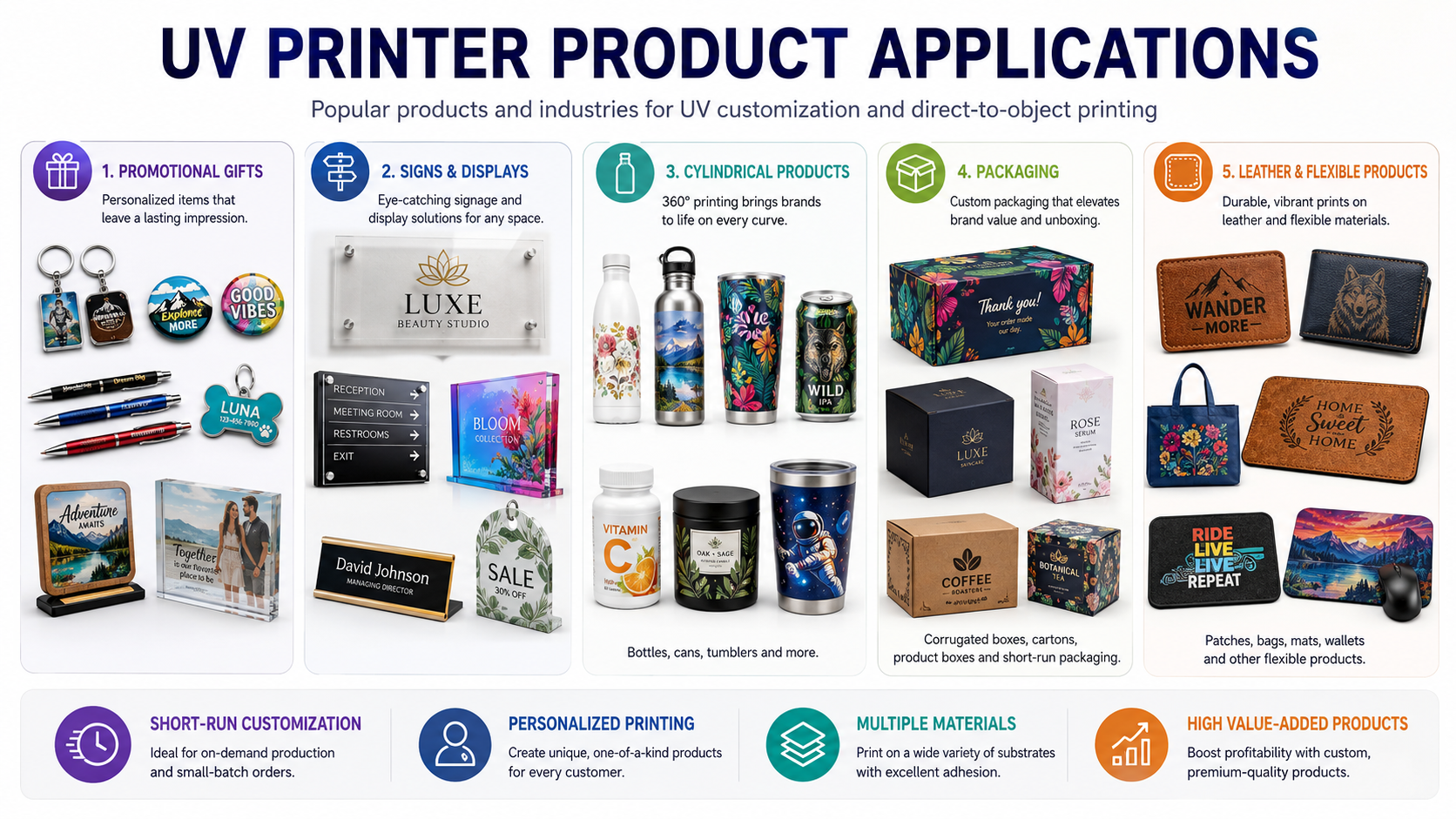
Promotional gifts are one of the most accessible UV printer business opportunities. Typical products include keychains, badges, pens, pet tags, small signs, souvenir products, gift boxes, plaques and customized accessories.
These applications are suitable for short runs and personalized orders because different names, logos, photos or designs can be printed without making traditional plates. This makes UV printing attractive for gift shops, advertising companies, online customization businesses and small production studios.
Product fixtures may be needed when printing irregularly shaped objects. Buyers should also consider the maximum material height and whether the machine platform can hold small products securely.
Discover more product ideas in our guide to
UV printing for promotional gifts and personalized products.
Cylindrical Products and Rotary UV Printing
Cylindrical UV printing allows businesses to print around bottles, cans, tubes and other regular round products. The application is not limited to drinkware. Any product with a suitable diameter, length, surface and rotation path may potentially be printed with a rotary device.
A rotary attachment supports and rotates the product while the printhead applies the image. Accurate product positioning is important because slipping or uneven rotation can distort text and graphics.
Before selecting a rotary solution, confirm the minimum and maximum product diameter, maximum length, surface taper, printable circumference and required production volume. Highly tapered or irregular products may require a specialized fixture or a different printing process.
Learn
how to print cylindrical products with a UV printer and rotary device.
Signs and Advertising Displays
Signs and displays remain among the most widely used UV printer applications. Common materials include acrylic, PVC board, aluminum composite panel, metal sheet, foam board, wood and other rigid panels.
Sign companies often need accurate brand colors, sharp small text and consistent production across different board types. A vacuum adsorption platform can help hold lightweight panels flat, while a larger printing area allows multiple products or larger boards to be printed in one job.
Small and medium UV printers are suitable for nameplates, directional signs and display pieces. Larger industrial flatbed printers are more suitable for full-size advertising boards, interior panels and higher-volume work.
Read our full guide to
UV printing for signs and displays.
Packaging and Corrugated Boxes
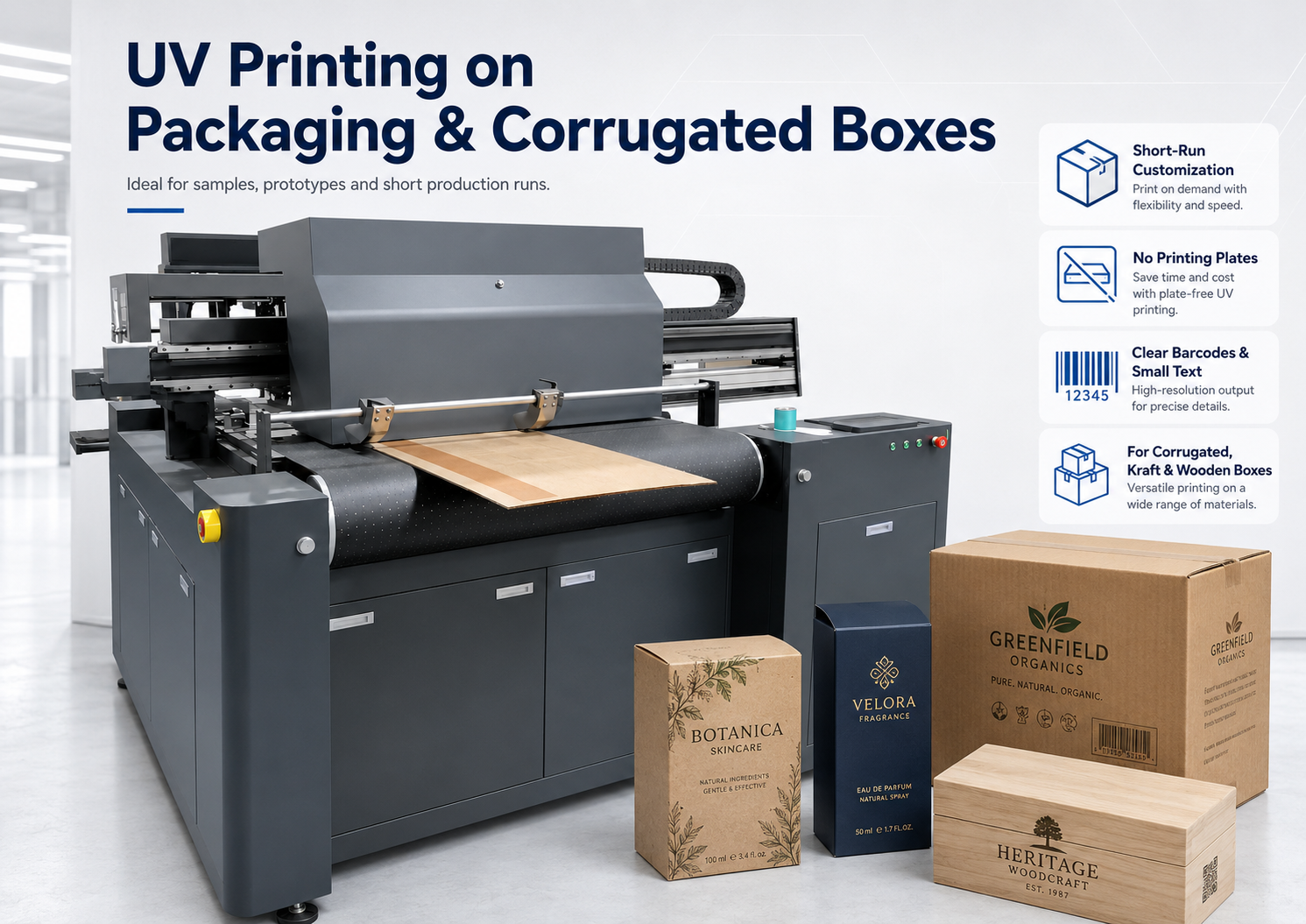
UV printing can be used for packaging samples, corrugated boxes, folding cartons, wooden boxes and short-run branded packaging. It is especially useful when customers need small quantities, product testing, seasonal designs or variable information.
Direct digital printing removes the need to prepare a separate printing plate for every design. Businesses can print logos, product instructions, barcodes, serial information and full-color graphics directly from a digital file.
A flatbed UV printer can be suitable for samples and small batches of flat boxes. A dedicated box or corrugated printer may be more efficient for larger quantities, faster feeding and continuous production.
See our
short-run guide to UV printing on packaging and corrugated boxes.
Leather and Flexible Materials
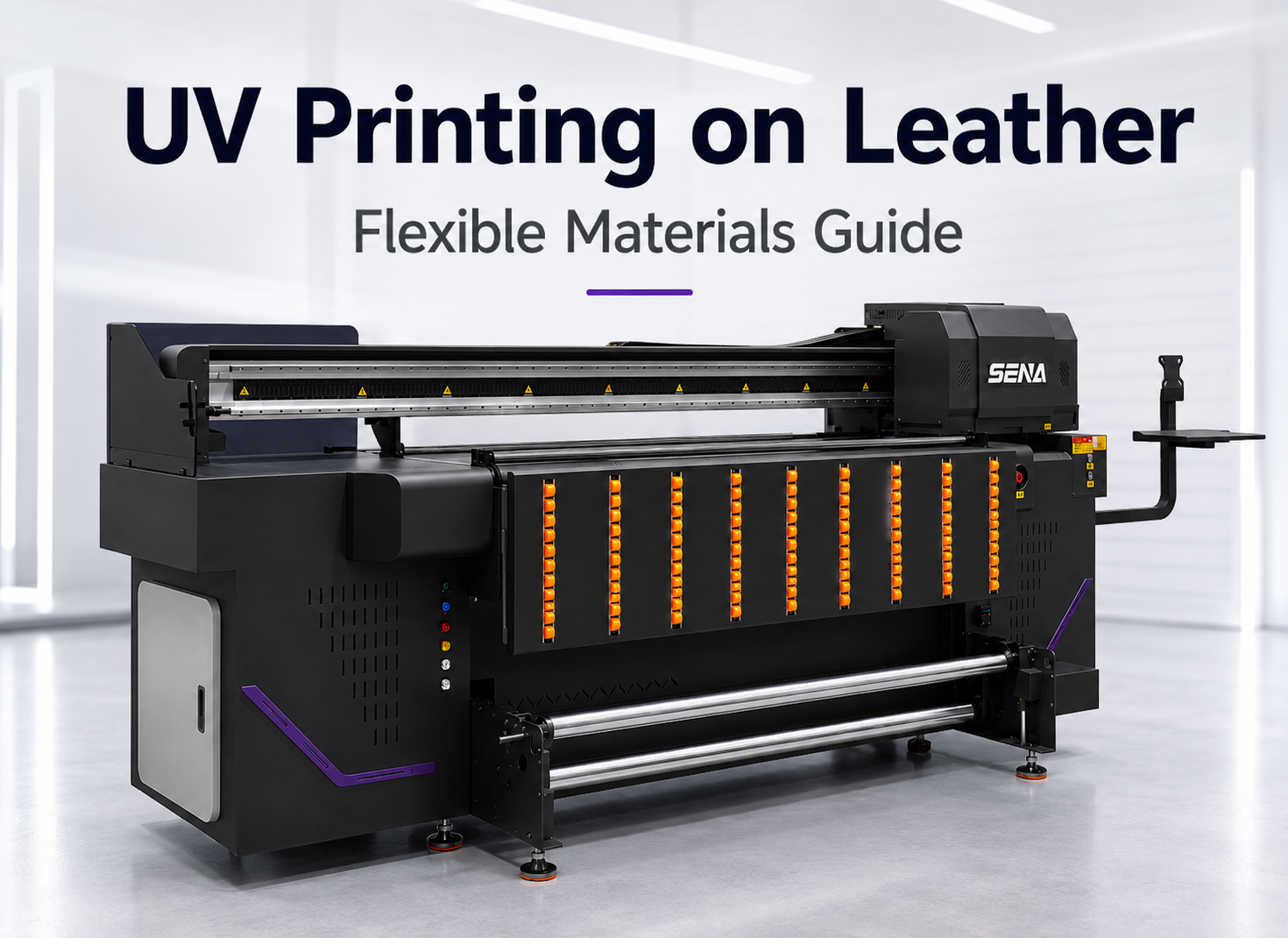
Leather and flexible material printing is used for bags, shoes, PU products, table mats, floor mats, home decoration and customized accessories. These applications require more attention than rigid-material printing because the printed surface may be bent, rolled or stretched after production.
Standard rigid UV ink may crack when a flexible product is folded. Flexible UV ink is designed to provide better bending resistance, although the final result still depends on the material, degree of deformation and ink-layer thickness.
Flatbed printers may be suitable for individual leather pieces and small sheets. Belt or conveyor printers are generally more suitable for longer, softer or roll-type materials because they support continuous feeding and help keep the material flat during printing.
Learn what buyers should consider in our guide to
UV printing on leather and flexible materials.
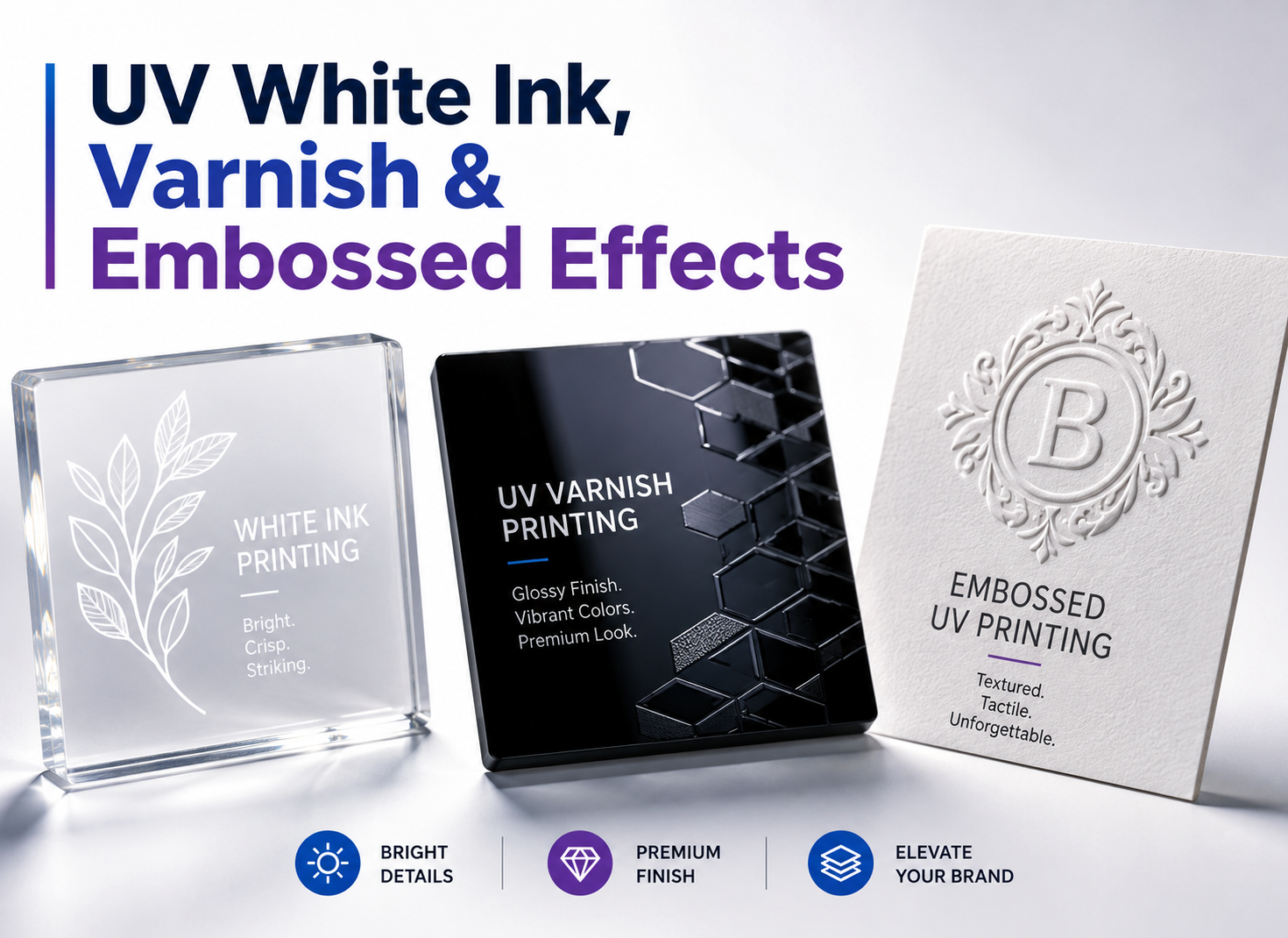
White Ink, Varnish and Embossed UV Printing Effects
A UV printer is not limited to standard CMYK color printing. White ink, varnish and layered printing can create effects that improve visibility, texture and product value.
White Ink for Transparent and Dark Materials
White ink is important when printing on transparent, colored or dark materials. It can be printed under the color image to create an opaque background and prevent the material color from affecting the final design.
It is commonly used on glass, clear acrylic, black acrylic, metal, dark wood and colored plastic. The correct printing sequence may be color-white, white-color or color-white-color, depending on the product and viewing direction.
Varnish for Gloss and Surface Contrast
Varnish can be applied to selected areas or across the complete image. Spot varnish is often used to highlight logos, text, patterns or premium product details. It can also create contrast between glossy and matte-looking areas.
Varnish should not automatically be considered a replacement for industrial protective coating. Its durability depends on ink compatibility, surface preparation, curing and the product’s final environment.
Embossed and Raised Printing Effects
Embossed effects can be created by printing multiple layers of white ink or varnish. These layers build height and create a visible or touchable texture.
Raised printing can increase the value of decorative panels, gift products, signage, labels and personalized artwork. However, additional layers increase printing time and ink consumption. The artwork, layer count and production speed should therefore be tested before accepting large orders.
White Ink Maintenance
White pigment is heavier than standard color ink and can settle when the printer is not maintained correctly. A reliable white-ink circulation or agitation system helps reduce settling, but daily maintenance, nozzle checks and correct shutdown procedures are still necessary.
Read our
complete guide to white ink, varnish and embossed UV printing
for process selection and maintenance advice.
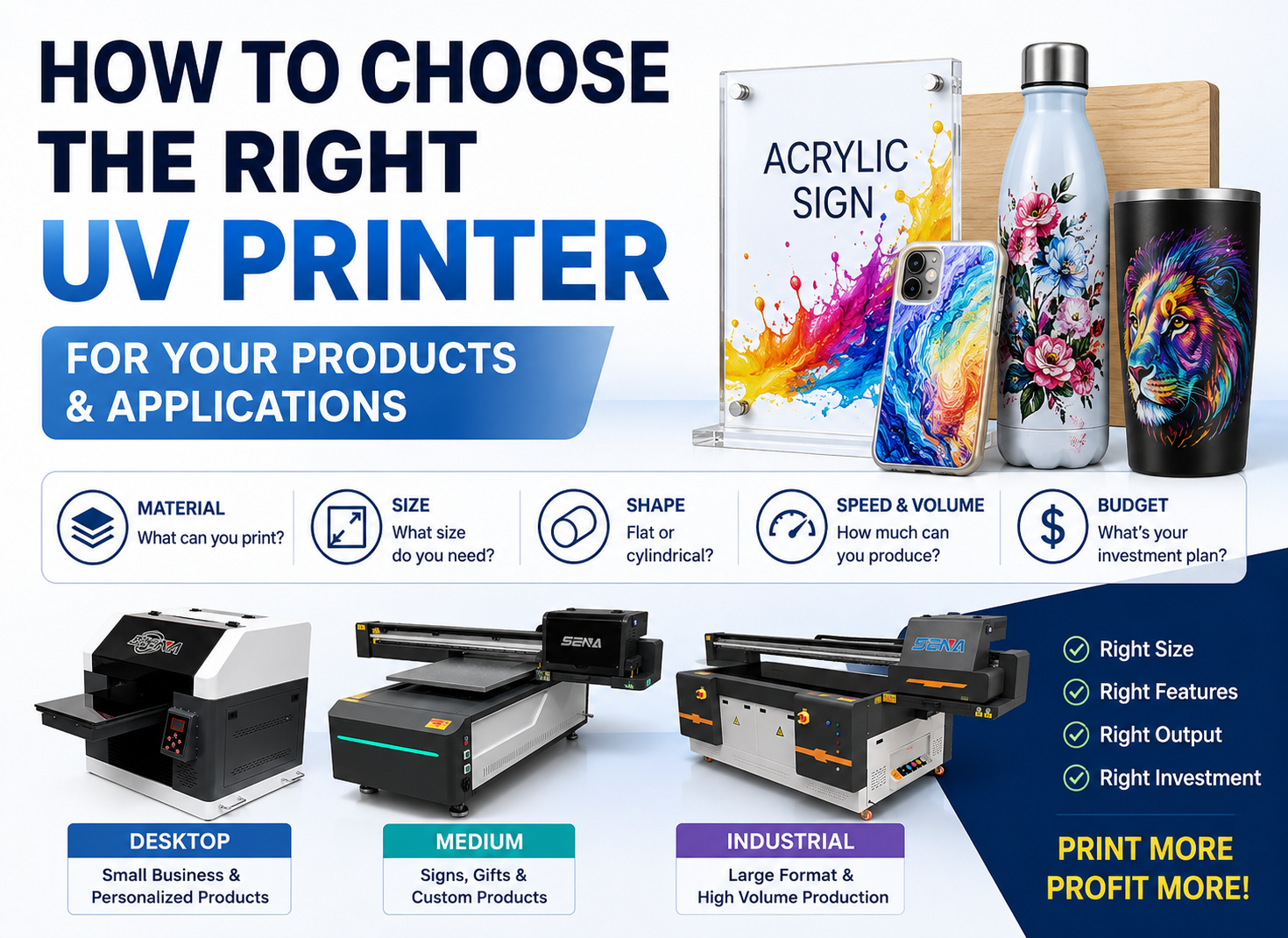
How to Choose the Right UV Printer for Your Applications
Selecting the right machine begins with the products you plan to print. A larger printer is not always the best solution, and the cheapest machine may not support the required material, height, production speed or special effect.
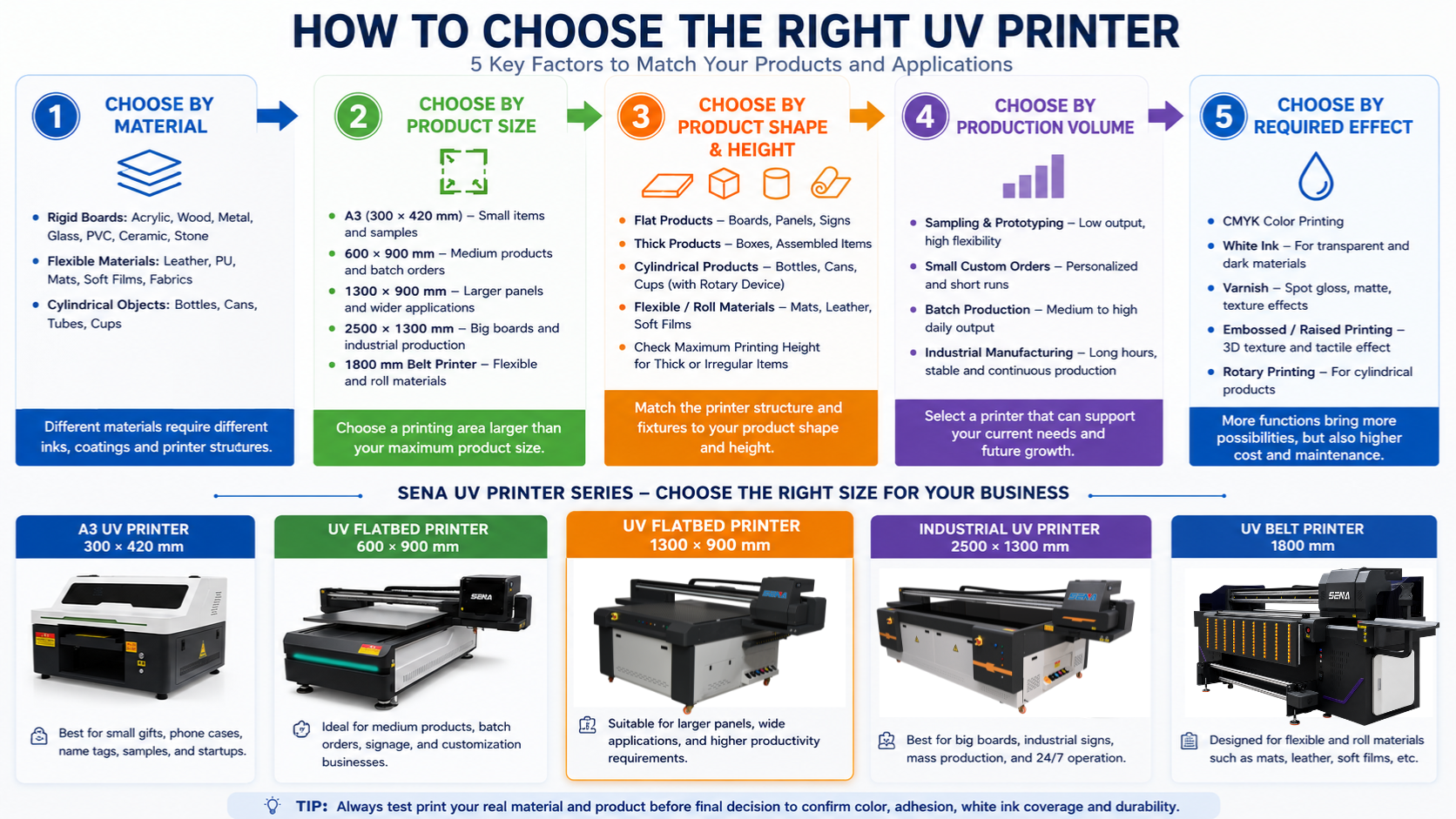
1. Choose by Material
Rigid boards, flexible sheets, transparent products and cylindrical objects may require different printer structures and ink systems. A standard flatbed printer is suitable for many rigid materials, while flexible or roll-type products may require a conveyor machine. Cylindrical products require a compatible rotary device.
2. Choose by Product Size
The printing area should be larger than the maximum product size, with enough space for positioning and fixtures. Common machine categories include:
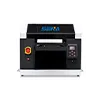
- A3 desktop UV printers for small gifts, tags and samples
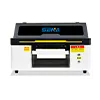
- 60 × 90 cm UV printers for medium-sized customized products
- 130 × 90 cm UV printers for larger panels and batch production
- 250 × 130 cm industrial UV printers for boards and production environments
- 1800 mm flexible material printers for mats, leather and continuous materials
3. Choose by Product Shape and Height
Confirm whether the product is flat, thick, curved, cylindrical or flexible. Maximum printing height is important for boxes, assembled products and irregular items. A rotary attachment should only be selected after confirming the product diameter, length and surface shape.
4. Choose by Production Volume
A small desktop printer may be suitable for samples, personalized gifts and low daily output. Medium machines can support wider product ranges and small-batch manufacturing. Industrial machines normally provide a larger platform, stronger structure, faster production and better suitability for long working hours.
5. Choose by Required Printing Effect
Confirm whether you need CMYK only, CMYK plus white, white plus varnish, raised effects or rotary printing. Additional ink channels and special effects can increase product possibilities, but they also increase maintenance requirements and production complexity.
Follow our
complete UV printer selection guide
to compare materials, sizes, machine types and production requirements.
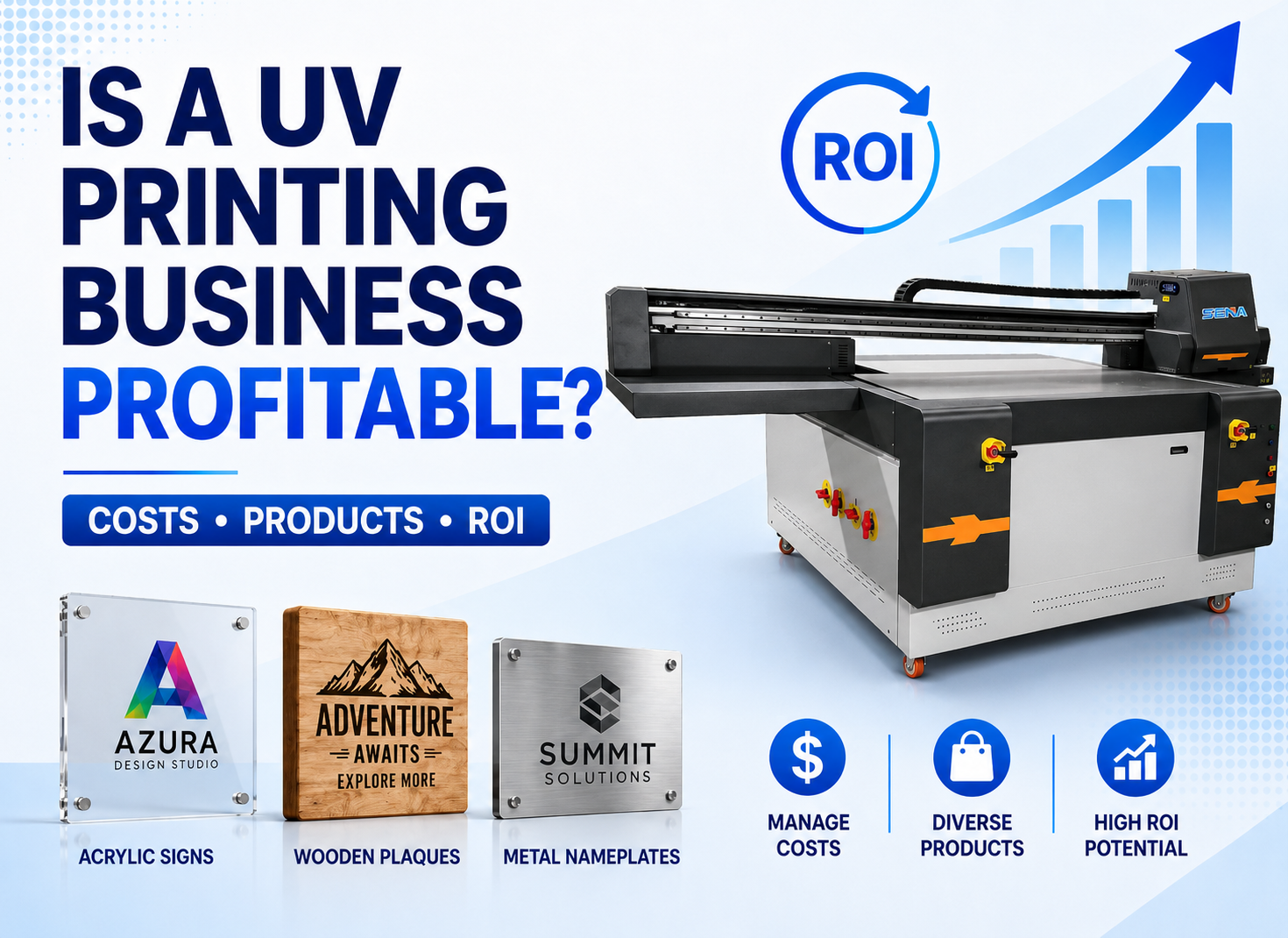
Is a UV Printing Business Profitable?
A UV printing business can be profitable when the machine is matched to a clear product category and a realistic source of customer orders. Profitability does not come only from owning a printer. It depends on product positioning, local demand, selling price, operating cost, quality control and machine utilization.
Main Startup and Operating Costs
Common costs include:
- The UV printer and optional rotary or positioning fixtures
- UV ink, cleaning liquid and maintenance supplies
- RIP software and design preparation
- Blank products and printing materials
- Primer or coating for selected materials
- Replacement filters, dampers, wipers and other consumable parts
- Packaging, labor, electricity and shipping
- Marketing, samples and customer acquisition
Product Selection Affects Profitability
Businesses usually achieve better results when they focus on products with clear demand and added value. Personalized gifts, specialized signs, industrial nameplates, packaging samples and custom interior decoration can offer more differentiation than competing only on low-price general printing.
Small products may have low material costs but require more positioning and order management. Large panels may have higher selling prices but require more workspace, material handling and shipping. The most profitable application is therefore different for each business.
Important Profitability Factors
- Average selling price per product or square meter
- Blank material cost
- Ink and coating consumption
- Printing speed and labor time
- Rejected-product rate
- Daily order quantity
- Machine maintenance and downtime
- Competition and customer demand in the target market
Avoid calculating return on investment only from maximum printer speed. Real output also includes file preparation, material cleaning, product positioning, test printing, unloading and quality inspection.
Read our detailed analysis of
UV printing business costs, products and ROI
before planning your investment.
UV Printer Application Comparison Table
The following table provides a quick comparison of common UV printer applications, recommended equipment and major production challenges.
| Εφαρμογή | Typical Products | Προτεινόμενος τύπος εκτυπωτή | Important Function | Main Challenge | Suitable Business |
|---|---|---|---|---|---|
| Ακρυλικό | Signs, awards and displays | Flatbed UV printer | Λευκό μελάνι | Transparency and adhesion | Sign and display companies |
| Ξύλο | Boxes, panels and artwork | Flatbed UV printer | Vacuum platform | Texture and absorption | Gift and furniture businesses |
| Μέταλλο | Nameplates, tags and panels | Flatbed UV printer | White ink and primer | Surface adhesion | Industrial marking companies |
| Ποτήρι | Doors, signs and panels | Flatbed or glass printing solution | Λευκό μελάνι | Adhesion and transparency | Glass processors and decorators |
| Promotional Gifts | Tags, badges and souvenirs | Desktop or medium flatbed printer | Fixtures and white ink | Positioning small products | Gift shops and customization studios |
| Cylindrical Products | Bottles, cans and tubes | UV printer with rotary device | Synchronized rotation | Slipping and image distortion | Gift and packaging businesses |
| Συσκευασία | Boxes, cartons and samples | Flatbed or corrugated printer | Variable digital printing | Feeding and surface flatness | Packaging suppliers and brands |
| Leather and Flexible Materials | Bags, mats and home products | Belt printer or flatbed printer | Flexible ink | Cracking after bending | Leather and home-product manufacturers |
Which UV Printer Application Is Right for Your Business?
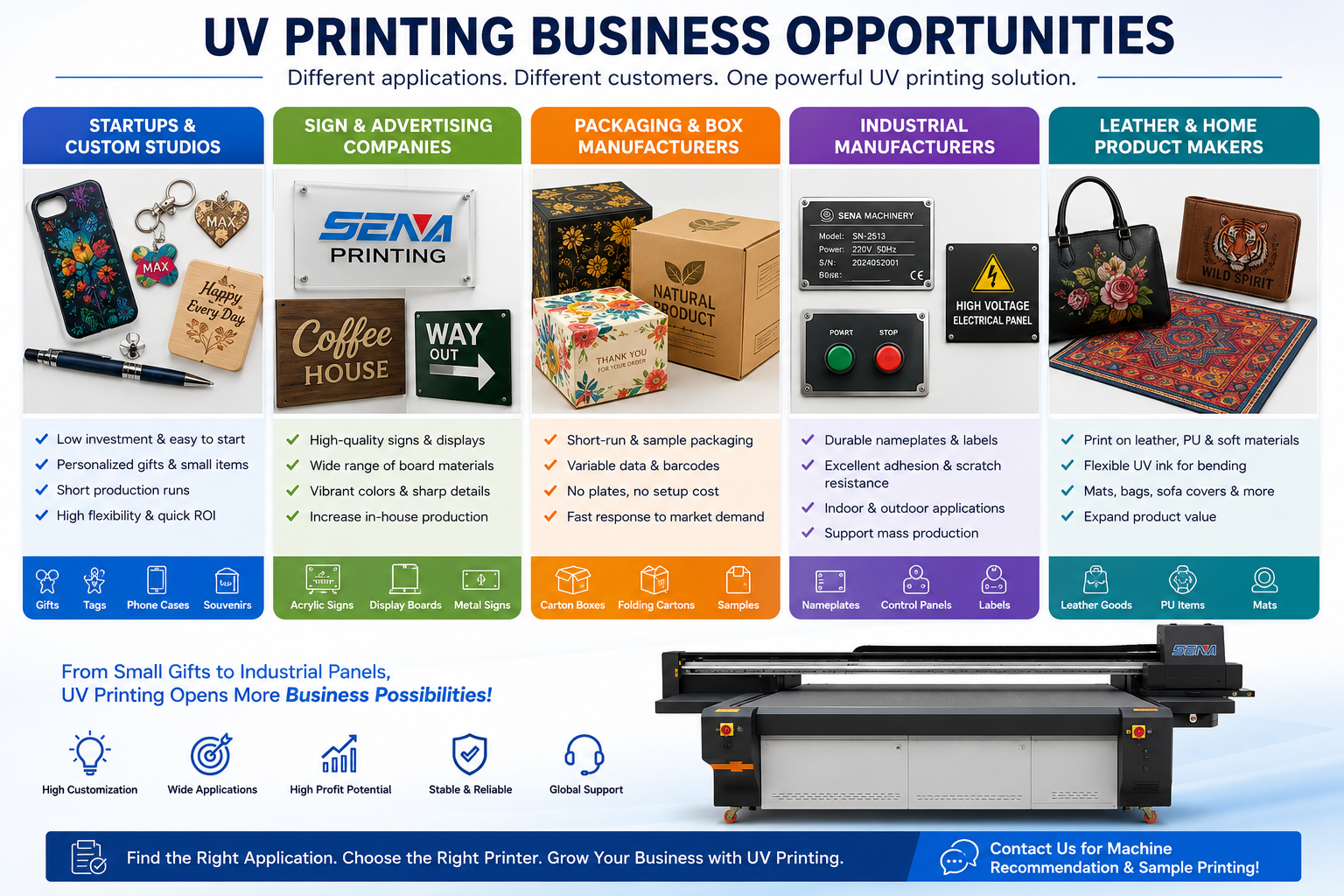
For Startups and Small Customization Studios
Small personalized products, acrylic signs, metal tags, wooden gifts and promotional items can be practical starting categories. They support short orders and allow businesses to test different designs without carrying large quantities of finished inventory.
For Sign and Advertising Companies
Acrylic, PVC, aluminum composite panels, metal signs and display boards are natural extensions for businesses already serving advertising customers. A UV printer can reduce outsourcing and support faster sampling and short-run production.
For Packaging Companies
Packaging companies can use digital printing for samples, short runs, seasonal packaging, regional product versions and variable data. The machine should be selected according to box size, material thickness and expected daily production.
For Industrial Manufacturers
Metal identification plates, equipment labels, control panels, component markings and glass panels can be suitable industrial applications. These customers should place greater emphasis on adhesion testing, repeatability, spare-part supply and production stability.
For Leather and Home-Product Manufacturers
Leather, PU, table mats, floor mats and flexible decorative products may require flexible ink and a conveyor structure. The expected amount of bending, rolling or stretching should be tested before mass production.
The best way to identify a suitable application is to begin with a real product rather than a general machine specification. Confirm the material, maximum dimensions, shape, required effect and expected daily quantity before requesting a printer recommendation.
Frequently Asked Questions About UV Printer Applications
What materials can a UV printer print?
A UV printer can print on many materials, including acrylic, wood, metal, glass, PVC, plastic, ceramic, cardboard, leather, PU and stone. Printing suitability depends on surface condition, adhesion requirements, material flexibility and the printer’s ink configuration.
Does every material require a coating before UV printing?
No. Some materials provide acceptable adhesion after proper cleaning, while others require a primer or coating. Glass, smooth metal and certain plastics often need adhesion testing. The coating should always be matched to the material and ink.
Can a UV printer print on glass and metal?
Yes. UV printers can print on both glass and metal. Reliable results require a clean surface, correct printhead height, suitable curing settings and, when necessary, a primer. White ink is also useful on transparent glass and dark metal.
Can a UV printer print on flexible materials?
Yes, but the ink and printer structure must be appropriate. Flexible UV ink provides better resistance to bending than rigid ink. Long or soft materials may also require a conveyor or belt-feeding printer rather than a standard flatbed machine.
What is the difference between flatbed and rotary UV printing?
Flatbed UV printing is mainly used for flat sheets, panels and products placed on a platform. Rotary printing uses a device that rotates a regular cylindrical product during printing. Bottles, cans and tubes may require a rotary attachment.
Do I need white ink and varnish?
White ink is recommended for transparent, colored and dark materials because it creates an opaque base under the color image. Varnish is optional and is used for selective gloss, contrast and raised effects. The correct configuration depends on the products you plan to sell.
Which UV printer is suitable for a small business?
A small business should select a machine according to its largest product, material type, product height and expected order quantity. A3 desktop printers can be suitable for small gifts and samples, while medium flatbed printers offer more space and a wider application range.
Is a UV printing business profitable?
It can be profitable when the business has suitable products, stable customer demand and good cost control. Profitability depends on selling price, material cost, production efficiency, rejected-product rate, maintenance and the number of orders produced each month.
Start with Your Material and Product
The number of possible Εφαρμογές εκτυπωτών UV continues to expand, but successful production begins with a specific material and product. Before choosing a machine, determine what you want to print, how large and thick the product is, whether it is flat or cylindrical, how much it will bend and how many pieces you expect to produce each day.
A sample-printing test can help confirm color, adhesion, small-text clarity, white-ink coverage and surface resistance before equipment selection. It also helps identify whether a primer, fixture, flexible ink, varnish or rotary device is required.
To receive a more accurate UV printer recommendation, provide the following information:
- The material you want to print
- The maximum product length, width and height
- Whether the product is flat, cylindrical or flexible
- The required color, white ink, varnish or embossed effect
- Your expected daily production volume
- A photograph or physical sample of the product
Not Sure Which UV Printer Fits Your Products?
Send us your material, product dimensions and production requirements. Our team can recommend a suitable machine configuration and arrange a sample-printing test.