

 Japanese
  English
  Arabic
  German
  French
  Spanish
  Turkish
  Italian
  Russian
  Persian
  Bengali
  Hebrew
  Persian (Afghanistan)
  Scottish Gaelic
  Panjabi
  Croatian
  Slovenian
  Greek
Greek  Afrikaans
  Czech
Czech  Korean
  Portuguese






UV Printing on Glass: Applications, Adhesion and Printing Process Explained
Glass has become one of the most popular materials in modern architecture, interior decoration, commercial signage and personalized gifts. From decorative wall panels to office partitions and retail displays, glass products are increasingly customized with vibrant graphics and branding.
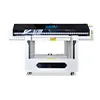
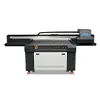
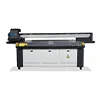
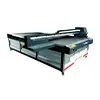
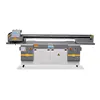
With a professional glass UV printer, businesses can achieve direct printing on glass without traditional screen printing or transfer films. UV ink cures instantly under ultraviolet light, producing sharp images, vivid colors and excellent production efficiency for short-run or customized orders.
However, successful UV printing on glass requires more than simply placing a glass panel on the printer. Surface preparation, white ink configuration, printing direction and adhesion all influence the final quality.
In this guide, you’ll learn which types of glass can be printed, when to use white ink, the difference between front and reverse printing, and how glass printing can create profitable business opportunities.
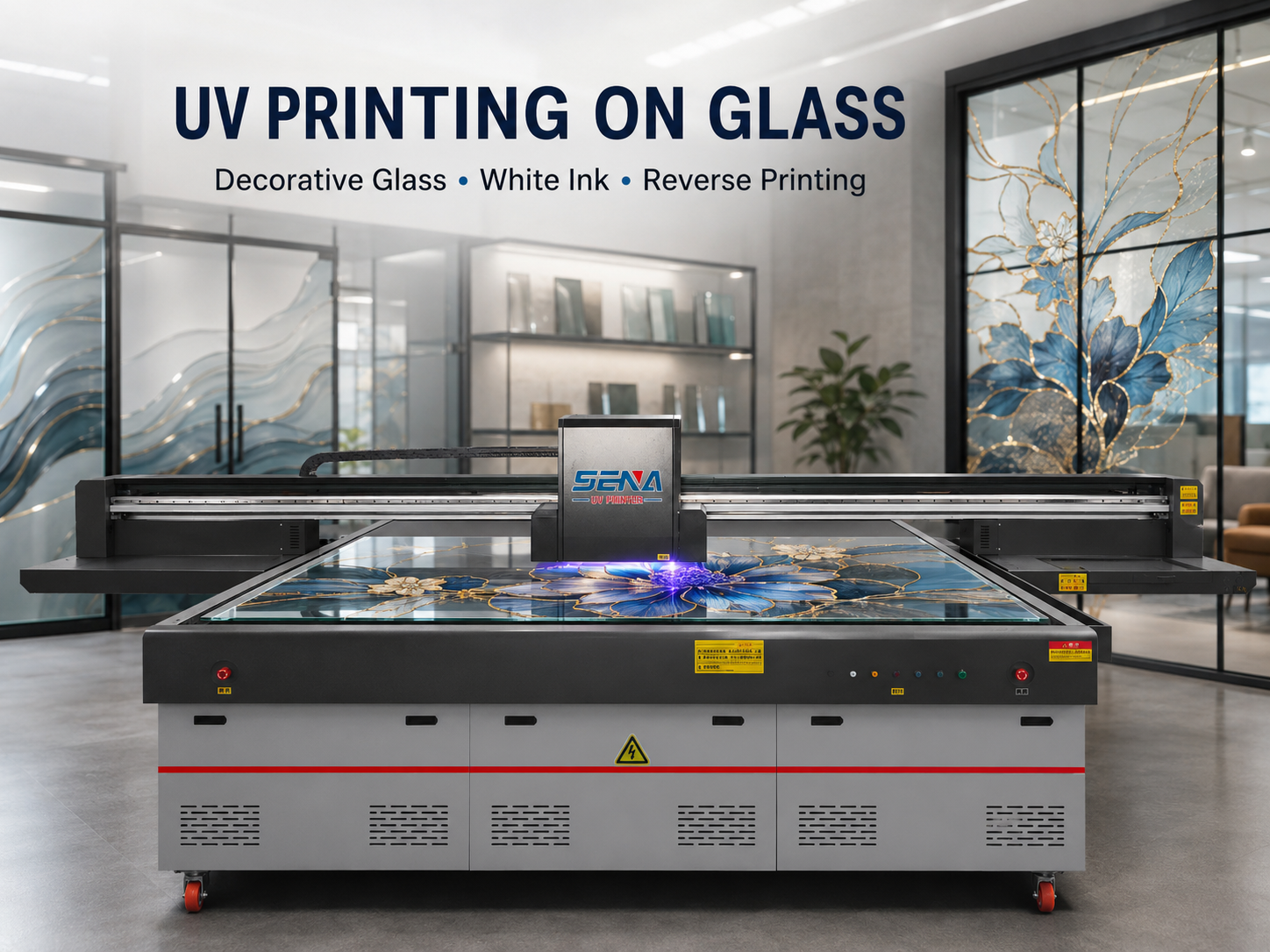
Can a UV Printer Print Directly on Glass?
Yes. A UV flatbed printer can print directly on many kinds of glass as long as the surface is properly prepared. Unlike porous materials such as wood, glass has a smooth, non-absorbent surface, which means ink adhesion becomes one of the most important factors during production.
Common printable glass materials include:
- Clear float glass
- Tempered glass
- Frosted glass
- Laminated glass
- Mirror glass
- Decorative architectural glass
- Glass shelves
- Glass tabletops
Different glass manufacturers use different coatings and treatments. Although two pieces of glass may appear identical, their ink adhesion can vary significantly. Therefore, professional suppliers always recommend sample testing before starting mass production.
Compared with screen printing, digital UV printing offers greater flexibility because every print can be different without creating new screens. This makes it ideal for customized production, prototype development and small batch orders.
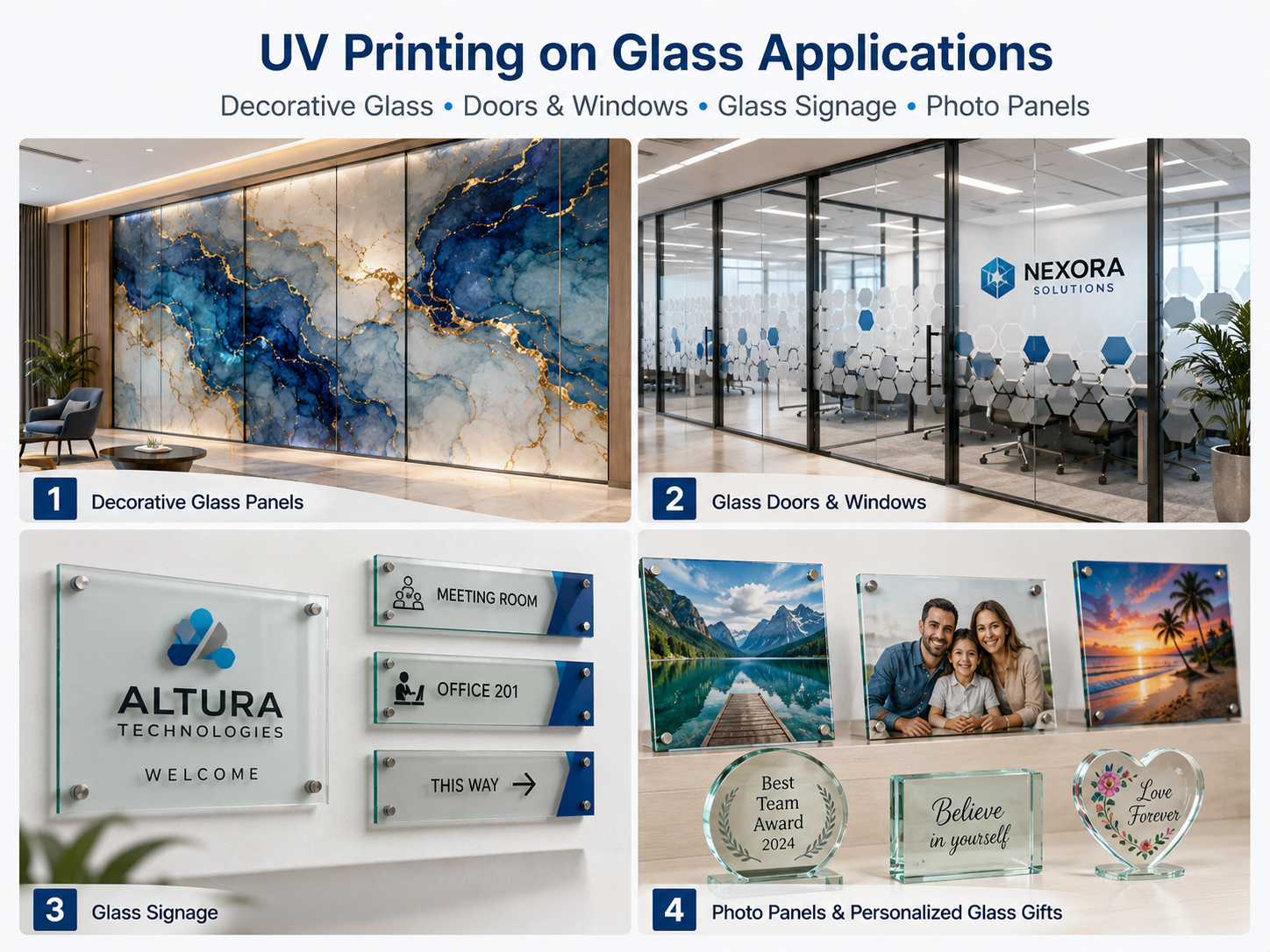
Popular Applications of UV Printing on Glass
Glass printing is no longer limited to decorative artwork. Today, businesses across construction, advertising and interior decoration use UV printing to create personalized products with high visual quality.
Decorative Glass Panels
Hotels, restaurants, shopping malls and luxury homes frequently use decorative glass as feature walls or partitions. UV printing allows designers to reproduce high-resolution artwork, textures and branding directly on glass panels.
Glass Doors and Windows
Office partitions, storefront windows and conference rooms often require customized graphics or privacy designs. A glass UV printer can produce logos, frosted effects and decorative patterns without changing the structure of the glass.
Glass Signage
Corporate signs, office nameplates, directory boards and retail displays can all be produced using direct UV printing. White ink enables bright graphics even on transparent or tinted glass.
Photo Panels and Personalized Gifts
Customized photo panels, wedding decorations and personalized souvenirs have become popular products for online sellers and gift businesses. UV printing makes one-off customization simple and cost-effective.
Why White Ink Is Essential for Glass Printing
Because glass is transparent, color ink alone often appears dull or partially transparent. White ink serves as an opaque foundation that blocks light from passing through the material and helps colors appear vibrant.
Without white ink, printed graphics may lose brightness and contrast, especially when viewed from the opposite side of the glass or installed against a bright background.
Common white ink configurations include:
- White underbase beneath CMYK colors
- Spot white for selected graphic areas
- White-only printing for minimalist designs
- White + CMYK + varnish for premium decoration
For decorative architectural glass, designers sometimes intentionally leave transparent areas unprinted while applying white ink only behind logos or artwork. This combination creates elegant visual effects that are difficult to achieve using traditional printing methods.
Proper white ink circulation and maintenance are also important. Since white pigment is heavier than color ink, continuous stirring and circulation help maintain stable print quality during long production runs.
White ink creates an opaque base that improves color brightness, contrast and visibility on transparent glass.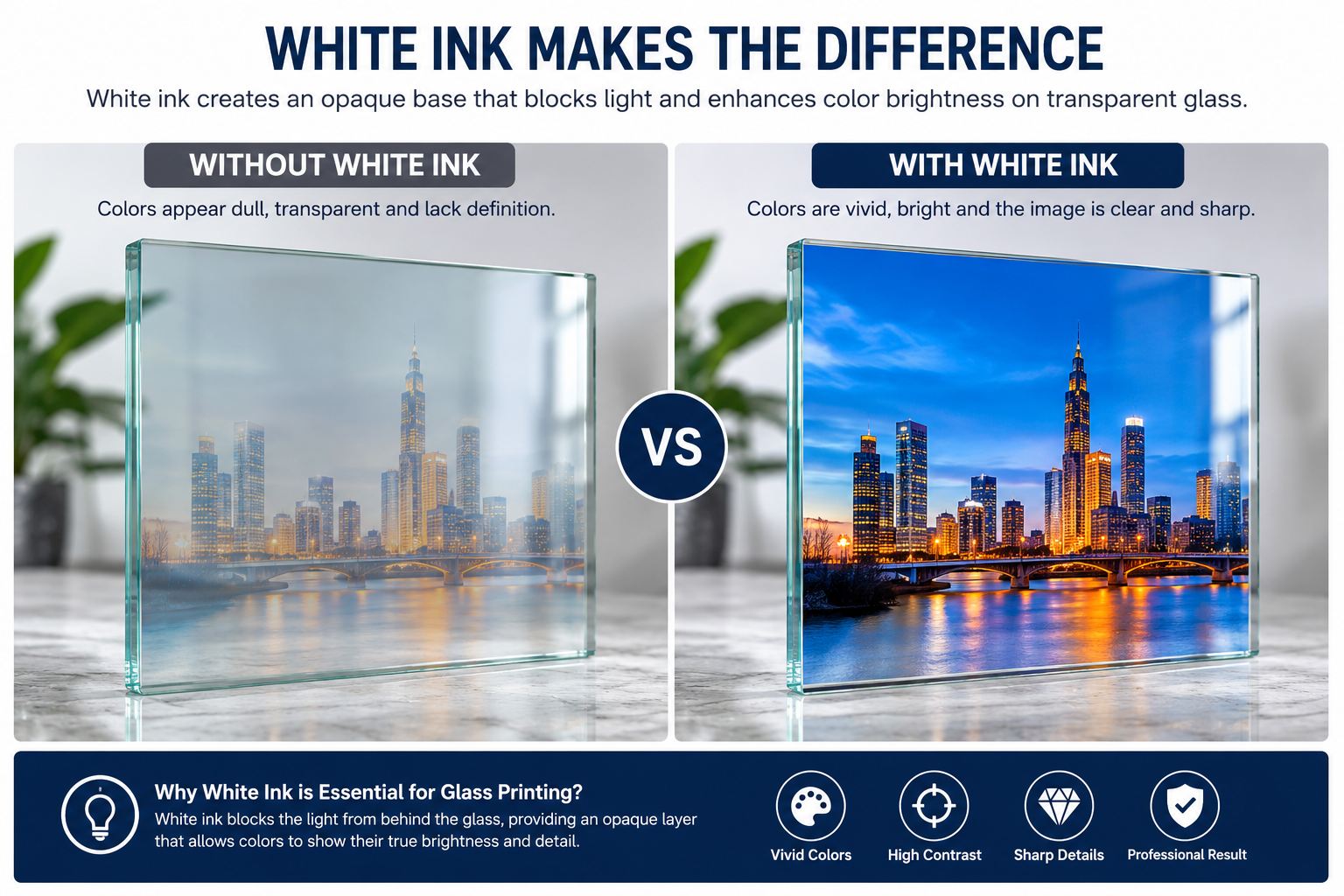
Front Printing vs. Reverse Printing
One of the most important decisions in UV printing on glass is choosing between front printing and reverse printing. Although both methods use the same printer and UV ink, they are designed for different applications and produce different visual effects.
Front Printing
Front printing means the image is printed directly on the viewing side of the glass. This method is simple, cost-effective and suitable for products that are not exposed to frequent contact or abrasion.
Typical applications include:
- Decorative glass panels
- Promotional displays
- Personalized gifts
- Indoor artwork
Reverse Printing
Reverse printing is commonly used for transparent glass. The color image is printed first, followed by a white ink layer. After installation, the image is viewed through the front of the glass while the ink remains protected on the back.
This printing method offers several advantages:
- Better scratch resistance
- Longer service life
- More vibrant colors on transparent glass
- Professional appearance for commercial applications
Reverse printing is widely used for office partitions, glass doors, shopping malls, hotels and architectural decoration because the printed image is protected from daily wear.
How to Improve Ink Adhesion on Glass
Since glass has a smooth and non-porous surface, proper adhesion is one of the most critical factors for successful printing. Several simple steps can significantly improve printing reliability.
Clean the Glass Surface
Dust, fingerprints and oil can reduce ink adhesion. Before printing, clean the glass thoroughly using an appropriate cleaner and a lint-free cloth.
Use Glass Primer When Necessary
Some types of glass can be printed directly, while others require a primer to increase ink bonding strength. Whether primer is necessary depends on the glass coating, surface treatment and final application.
Adjust UV Curing Properly
UV lamp power should be matched to the ink and printing speed. Insufficient curing may reduce durability, while excessive curing can sometimes affect adhesion on certain coated glass surfaces.
Perform Adhesion Tests
Always test actual production materials before mass production. Simple tape tests and scratch tests help verify whether the printed image meets customer requirements.
For demanding industrial applications, manufacturers may also perform standardized coating adhesion tests according to
ISO 2409
.
Front printing places the ink on the viewing surface, while reverse printing protects the image behind the glass.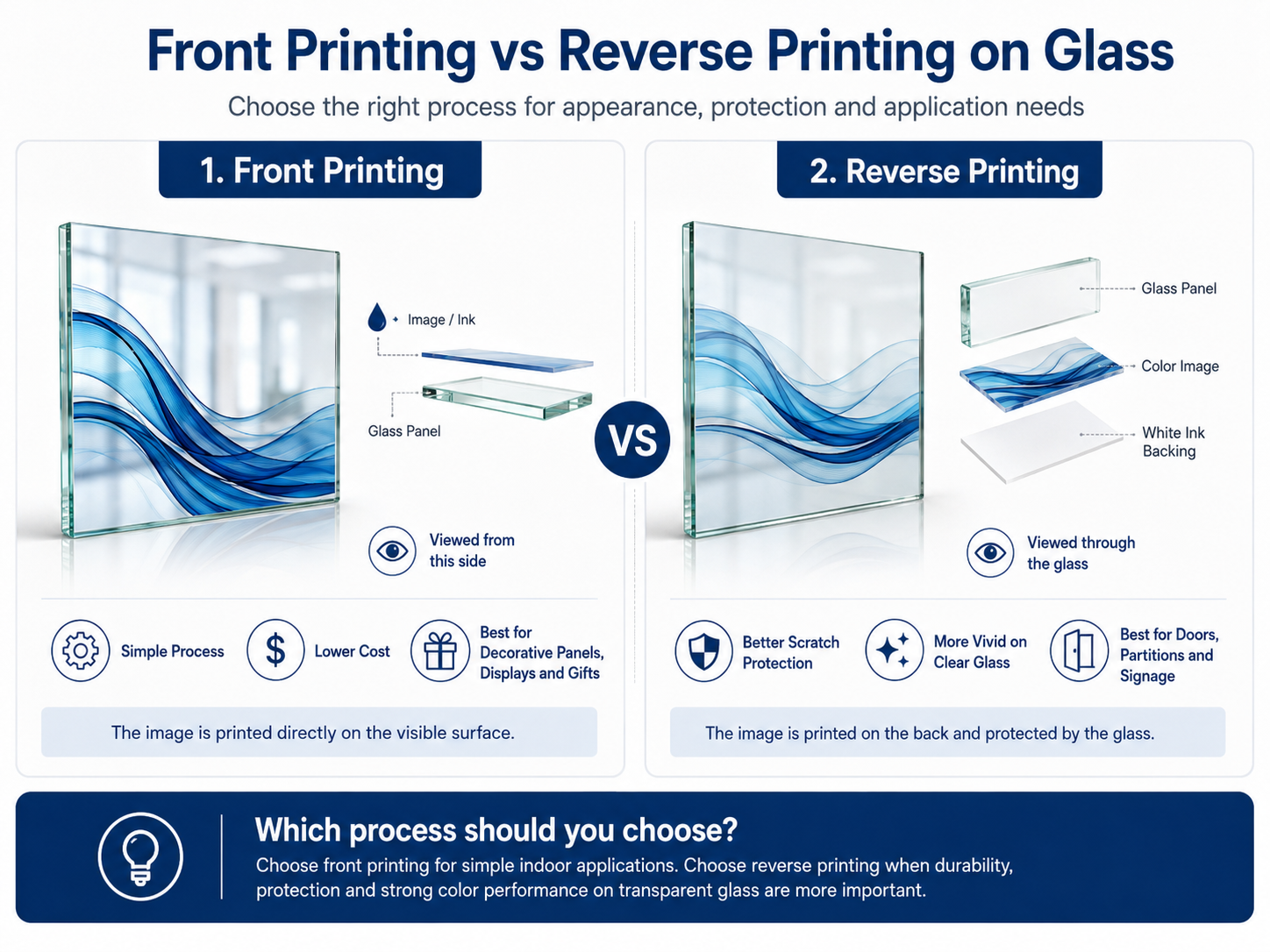
Indoor vs. Outdoor Glass Applications
Glass printing requirements vary depending on where the finished product will be installed.
Indoor applications such as decorative walls, office partitions and display panels mainly focus on appearance, color accuracy and design flexibility.
Outdoor applications, including building signage and exterior decorative glass, require higher resistance to sunlight, moisture, temperature changes and cleaning chemicals. For these projects, proper adhesion, high-quality UV ink and protective coatings become increasingly important.
Understanding the final installation environment helps determine the most suitable printing process before production begins.
Is Glass UV Printing a Good Business Opportunity?
Glass printing continues to grow as architects, interior designers and manufacturers demand more customized products. Compared with traditional printing methods, digital UV printing allows businesses to accept short-run orders without expensive setup costs.
This application is especially suitable for:
- Glass processing companies
- Sign manufacturers
- Interior decoration businesses
- Advertising companies
- Furniture manufacturers
- Kitchen and bathroom suppliers
- Personalized gift businesses
Because every project can have different graphics, dimensions or branding, UV printing creates added value through customization rather than mass production alone.
How to Choose the Right Glass UV Printer
Choosing the right printer depends on your product size, production capacity and target market. Before purchasing equipment, consider the following factors:
- Maximum printing size
- White ink circulation system
- Printhead resolution
- Vacuum platform stability
- 最大材料厚さ
- Automatic height measurement
- Reliable RIP software
- Technical support and spare parts availability
Whether you produce decorative glass panels or industrial signage, selecting a reliable
UVフラットベッドプリンター
can improve both print quality and production efficiency.
よくある質問
Can UV printers print tempered glass?
Yes. Tempered glass can be printed successfully, but adhesion should always be tested because different manufacturers may use different surface treatments.
Is white ink always necessary?
White ink is strongly recommended for transparent or colored glass whenever accurate color reproduction is required.
Does every glass product require primer?
Not always. Some coated glass provides good adhesion without primer, while untreated surfaces may require additional surface preparation.
Can UV printed glass be used outdoors?
Yes, provided that appropriate inks, surface preparation and protective measures are used according to the application requirements.
Related Articles
Interested in other printable materials? You may also like:
Start Your Glass Printing Project with SENA
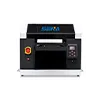
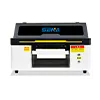
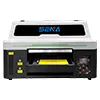
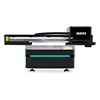
SENA UV flatbed printers are designed for printing on glass, acrylic, metal, wood and many other rigid materials. Whether you produce decorative glass panels, office partitions or customized signage, we can recommend the right solution based on your production requirements.
Send us your glass samples, product dimensions and artwork. Our engineers will evaluate your application and provide professional printing recommendations along with free sample testing.
View UV Flatbed Printers
Request a Free Sample Test