

 Spanish
  English
  Arabic
  German
  French
  Turkish
  Italian
  Russian
  Persian
  Bengali
  Hebrew
  Persian (Afghanistan)
  Scottish Gaelic
  Panjabi
  Croatian
  Slovenian
  Greek
Greek  Afrikaans
  Czech
Czech  Korean
  Japanese
  Portuguese






High-Margin Pricing Models for Short Runs & Prototyping
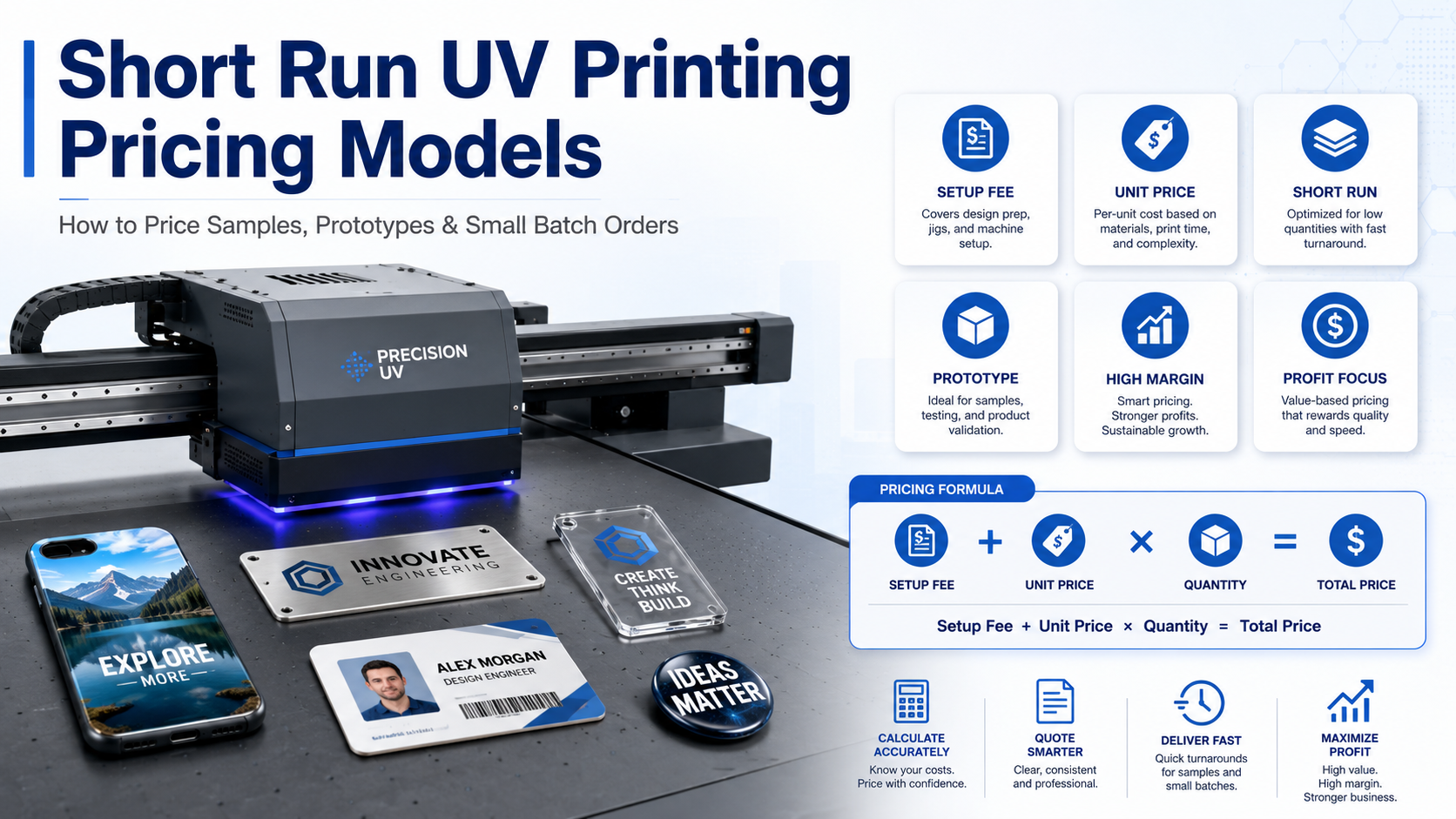
Short run UV printing can produce higher margins than many large-volume jobs, but only when the quote includes setup time, artwork preparation, production risk, customer communication, and delivery urgency. A ten-piece order may use little ink, yet it can occupy the operator, RIP software, printer, platform, and quality-control process for a meaningful amount of time.
Pricing a prototype or small custom order by ink cost alone usually creates weak margins. A better approach separates fixed setup costs from variable production costs, chooses the correct pricing unit, and charges clearly for services that add value. This guide explains seven practical pricing models, when to price per piece or per square meter, and how to calculate two very different UV printing jobs.
Key takeaway: The smaller and more customized the order, the more important the setup fee becomes. Price the complete job process, not only the material and ink.
Why Short Run UV Printing Can Deliver Higher Margins
Short-run customers are not only buying printed area. They are paying for flexibility, speed, personalization, and lower inventory risk. A brand may need ten samples before approving a larger order. A design studio may require one prototype to confirm color and positioning. A local business may need personalized gifts for an event with a fixed deadline.
Customers Pay for Flexibility
UV printing supports low minimum quantities, fast design changes, variable data, personalized names, and direct printing on finished products. These benefits help customers test a market, shorten product development, avoid excess stock, and react quickly to new opportunities.
A sample may influence a purchasing decision worth thousands of dollars. It is therefore a decision-making tool, not merely one printed item. Your price should reflect the technical support, production access, and speed you provide.
Small Quantity Does Not Mean Low Value
A one-off or ten-piece order often requires nearly the same file checking, RIP setup, material positioning, nozzle inspection, color confirmation, and customer communication as a larger order. The printing time may be shorter, but the preparation work remains. Small orders need a higher unit price because setup costs are divided across fewer pieces.
Why Simple Cost-per-Square-Meter Pricing Fails
Area pricing works for standardized boards, signs, and panels, but it is often unsuitable for personalized gifts, prototypes, irregular products, or jobs that need individual positioning. A metal nameplate and a wood panel may use similar ink per square meter, but their handling time and production risk are different.
The Hidden Work Behind Every Small Order
Before printing, the team may check resolution, repair artwork, create a white ink layer, prepare varnish data, confirm dimensions, build a fixture, measure product height, position each item, and produce a test print. After printing, the job may require inspection, cleaning, photographs, packaging, and shipment coordination.
These tasks are not represented by ink consumption. Use a setup fee, minimum order charge, minimum machine charge, or minimum billable area to protect the business from low-value jobs that consume an hour of production time.
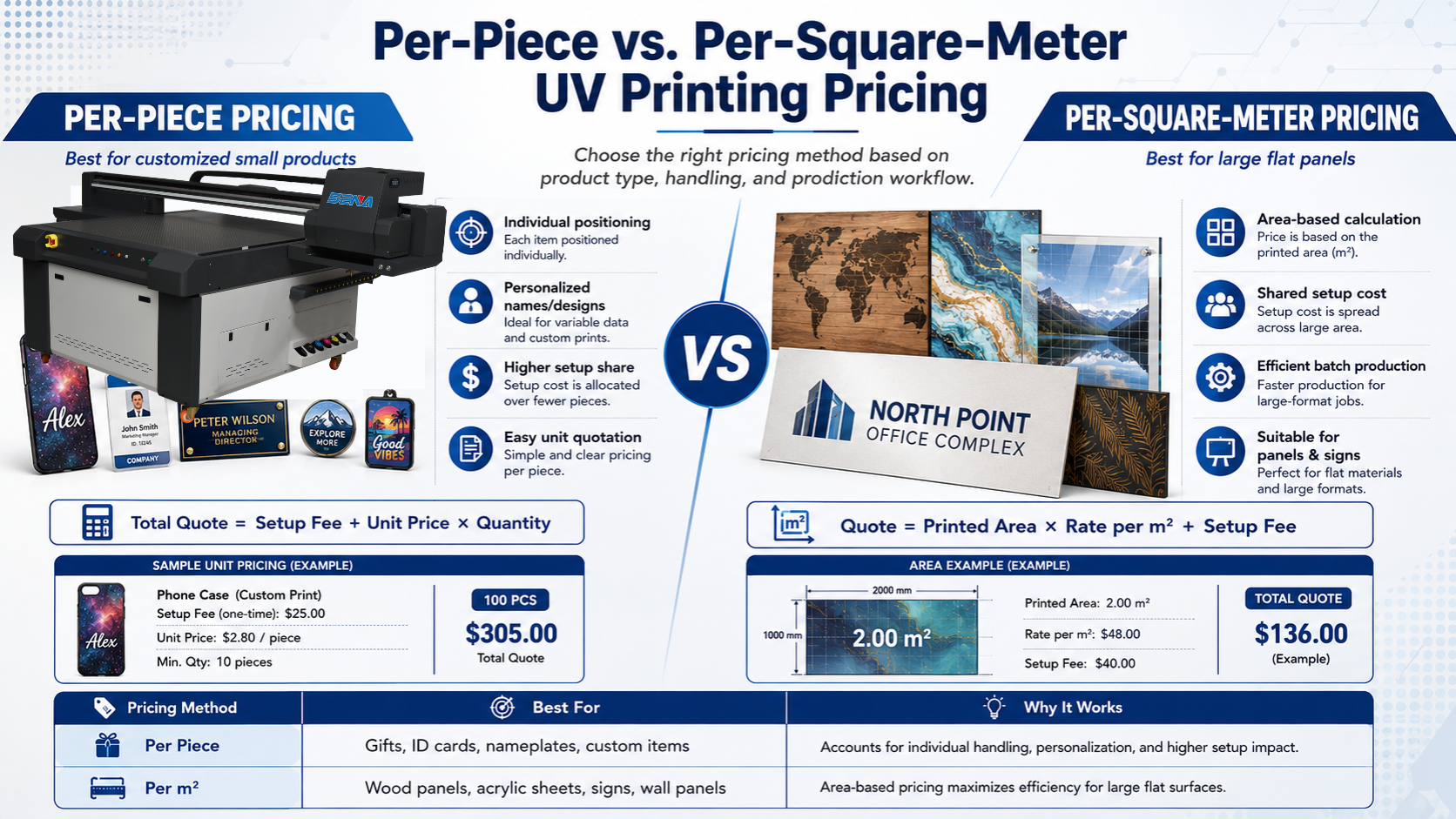
Per-Piece Pricing vs. Area-Based Pricing
| Método | Mejor para | Reason |
|---|---|---|
| Per piece | Phone cases, cards, gifts, badges, nameplates | Each item needs handling or positioning |
| Per m² | Wood, acrylic, glass, metal sheets, signs | Production is driven by printed area |
| Setup plus unit price | Customized short runs and prototypes | Separates fixed work from output |
| Project price | Complex designs or premium effects | Reflects complexity and risk |
Build the True Job Cost Before Adding Profit
Calculate the true job cost before selecting a selling price. Prototype orders have extra uncertainty because the customer may revise the artwork, change the product, request additional tests, or expect a result that was never clearly defined.
Fixed Job Costs
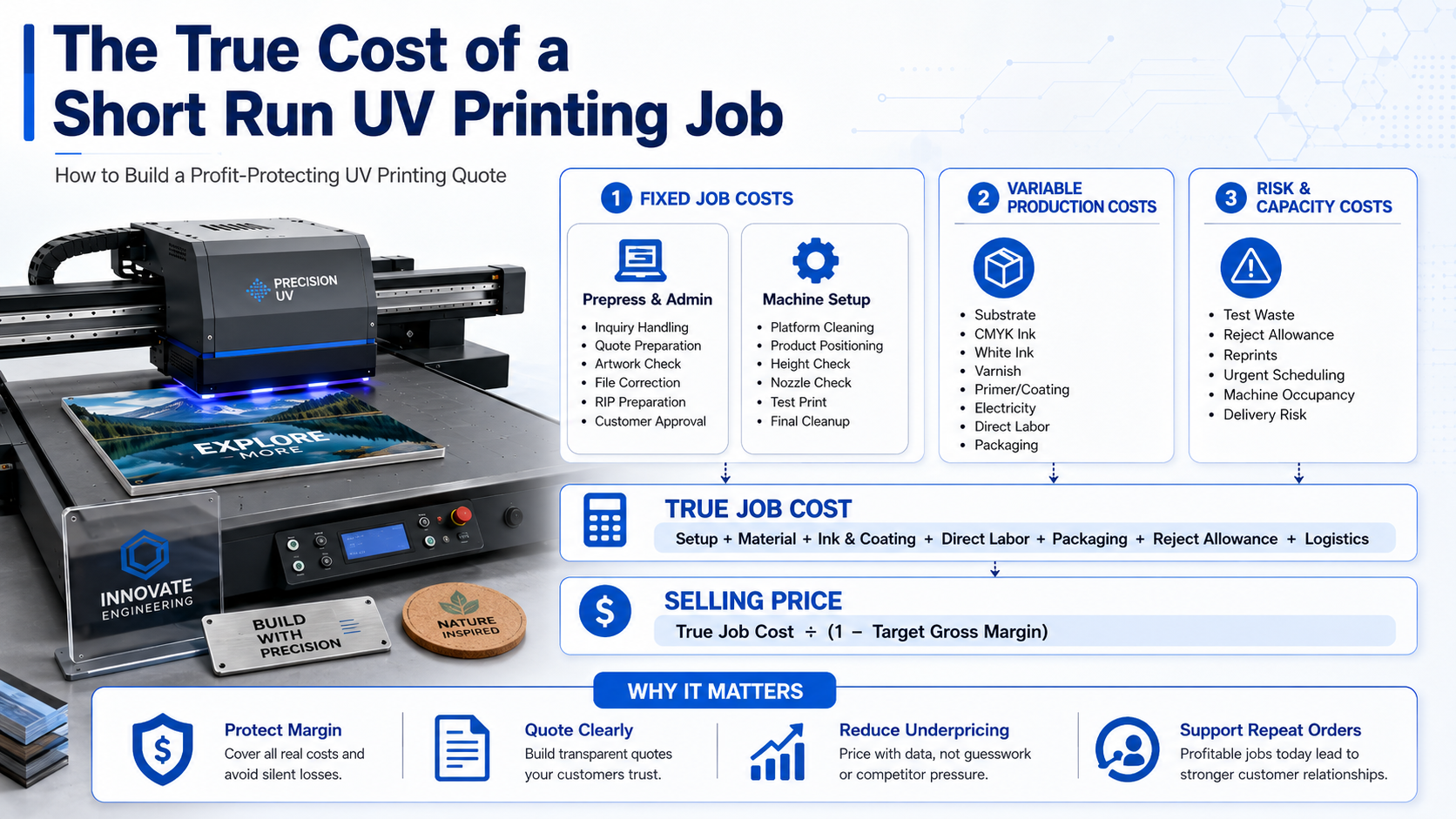
Fixed costs occur once per job. They may include inquiry handling, quotation preparation, artwork inspection, file correction, white ink or varnish channel creation, customer approval, RIP preparation, fixture installation, nozzle checks, platform cleaning, test printing, and final cleanup.
Track the average time required. If a short job needs 45 minutes of prepress and setup, include that labor and machine access even when the printing itself takes only ten minutes.
Variable Production Costs
Variable costs increase with quantity or area. They include substrates, CMYK ink, white ink, varnish, primer, electricity, direct labor, packaging, labels, and consumables. For customer-supplied products, include a handling allowance and define responsibility for damaged or unsuitable items.
Risk and Capacity Costs
Short runs often have a higher waste percentage. One rejected piece in a ten-piece order is a 10% loss. Add a reject allowance based on actual records. Also consider the cost of interrupting a large batch, reserving a machine for an urgent sample, or processing repeated revisions.
For a wider cost analysis, read our guide to the total cost of ownership for a UV flatbed printer.
UV Printing Pricing Formula
True Job Cost =
Setup + Material + Ink and Coating + Direct Labor + Packaging + Reject Allowance + Logistics
Selling Price = True Job Cost ÷ (1 − Target Gross Margin)
If the true cost is $100 and the target gross margin is 40%, the selling price is $166.67. Multiplying $100 by 1.40 gives $140, but that produces only a 28.6% gross margin. Do not confuse markup with margin.
7 Proven Pricing Models for Short Run UV Printing
1. Setup Fee Plus Per-Piece Price
This is the most practical model for personalized products. The setup fee covers file checking, RIP preparation, positioning, test printing, and basic communication. The unit price covers the blank item, printing, handling, inspection, and packaging.
Total Quote = Setup Fee + Unit Price × Quantity
Use it for gifts, phone cases, ID cards, nameplates, badges, keychains, and customized accessories. Show the setup fee separately so customers understand why the first order costs more than an unchanged repeat order.
2. Tiered Per-Piece Pricing
Create quantity bands such as 1–10, 11–50, 51–100, and 101 or more pieces. Reduce only the costs that become more efficient with quantity. Keep design, special fixtures, testing, and variable-data preparation separate. Fifty products with fifty different names may still require substantial file work.
3. Area-Based Pricing With a Minimum Charge
This model suits wood panels, acrylic sheets, glass, metal signs, and decorative boards.
Quote = Printed Area × Rate per m² + Setup Fee + Add-On Services
Set a minimum charge or minimum billable area. Adjust the rate for ink coverage, print layers, primer, material preparation, print quality, and required speed.
4. Complexity-Based Pricing
Standard CMYK printing is usually faster than CMYK plus white ink, varnish, or embossed texture. A complexity multiplier makes the difference measurable.
Final Production Price = Base Price × Complexity Multiplier
An internal guide might use 1.00 for CMYK, 1.15 for CMYK plus white, 1.30 for white plus varnish, and 1.40–1.60 for raised texture. These are examples only. Build your own factors from actual print time, ink use, and failure rates.
5. Rush and Priority Pricing
Rush fees compensate for schedule disruption, overtime, faster approval, and delivery risk. Offer clear service levels such as standard, priority, and emergency production. Confirm material availability, curing, finishing, and carrier pickup before accepting the deadline.
6. Prototype-to-Production Credit
Charge the normal sample fee, then credit part or all of it toward a qualifying production order. Require the same product, material, approved design, and print specification. Set a minimum quantity and time limit. Shipping, new artwork, special fixtures, and third-party charges should remain separate.
7. Package and VIP Pricing
Frequent prototype customers may prefer a monthly or prepaid package. It can include a fixed number of samples, reduced repeat setup fees, limited artwork revisions, priority scheduling, and volume-based production rates. This model suits agencies, design studios, product developers, and distributors, but usage limits must be clear.
Before finalizing these models, review the hidden UV printing costs that can reduce profit, including white ink circulation, test waste, reprints, standby power, and inefficient layouts.
Value-Added Charges Customers Can Understand
Additional fees are easier to accept when connected to a visible service. Instead of hiding every cost in one unit price, show which activities require extra time, skill, materials, or risk.
Artwork and File Preparation
Separate basic file checking from design work. Charge for background removal, vector conversion, layout rebuilding, variable-data preparation, white ink layers, varnish channels, and complete artwork creation.
Color and Print Effects
Custom color matching, multiple tests, primer, white ink, varnish, and embossed effects consume extra ink, passes, operator time, and quality control. Use a fixed surcharge for simple jobs or a complexity multiplier for larger projects.
Production and Delivery Add-Ons
Charge separately for fixtures, individual packaging, serial numbers, barcodes, protective film, rush production, special cartons, and international courier service. A three-level offer can simplify the choice:
- Essential: Approved artwork, standard CMYK, normal lead time, bulk packaging.
- Enhanced: File adjustment, white ink, improved packaging, priority inspection.
- Premium: Design support, color matching, varnish or embossing, individual packaging, priority production.
How to Convert Prototype Orders Into Production Orders
Use Sample Credits Instead of Free Samples
Free samples often attract low-intent inquiries. A paid sample confirms interest and covers preparation. A conditional credit keeps the offer attractive without making the prototype appear worthless.
Set Clear Credit Conditions
State the validity period, minimum production quantity, approved design, eligible product, and maximum credit. Apply the credit to production charges rather than shipping, customs, special tooling, or additional revisions.
Offer a Quantity Ladder
Quote a trial quantity, small production run, standard production run, and distributor quantity. Customers can see how the setup cost is spread across more pieces. Save approved RIP files, fixture settings, color profiles, and production notes so repeat orders require less setup.
Machine size also affects loading efficiency. See our guide to UV printer capacity and pricing strategy.
Two Short Run UV Printing Pricing Examples
These figures are illustrative. Actual pricing depends on labor, materials, ink coverage, machine configuration, quality requirements, reject rates, and local market conditions.
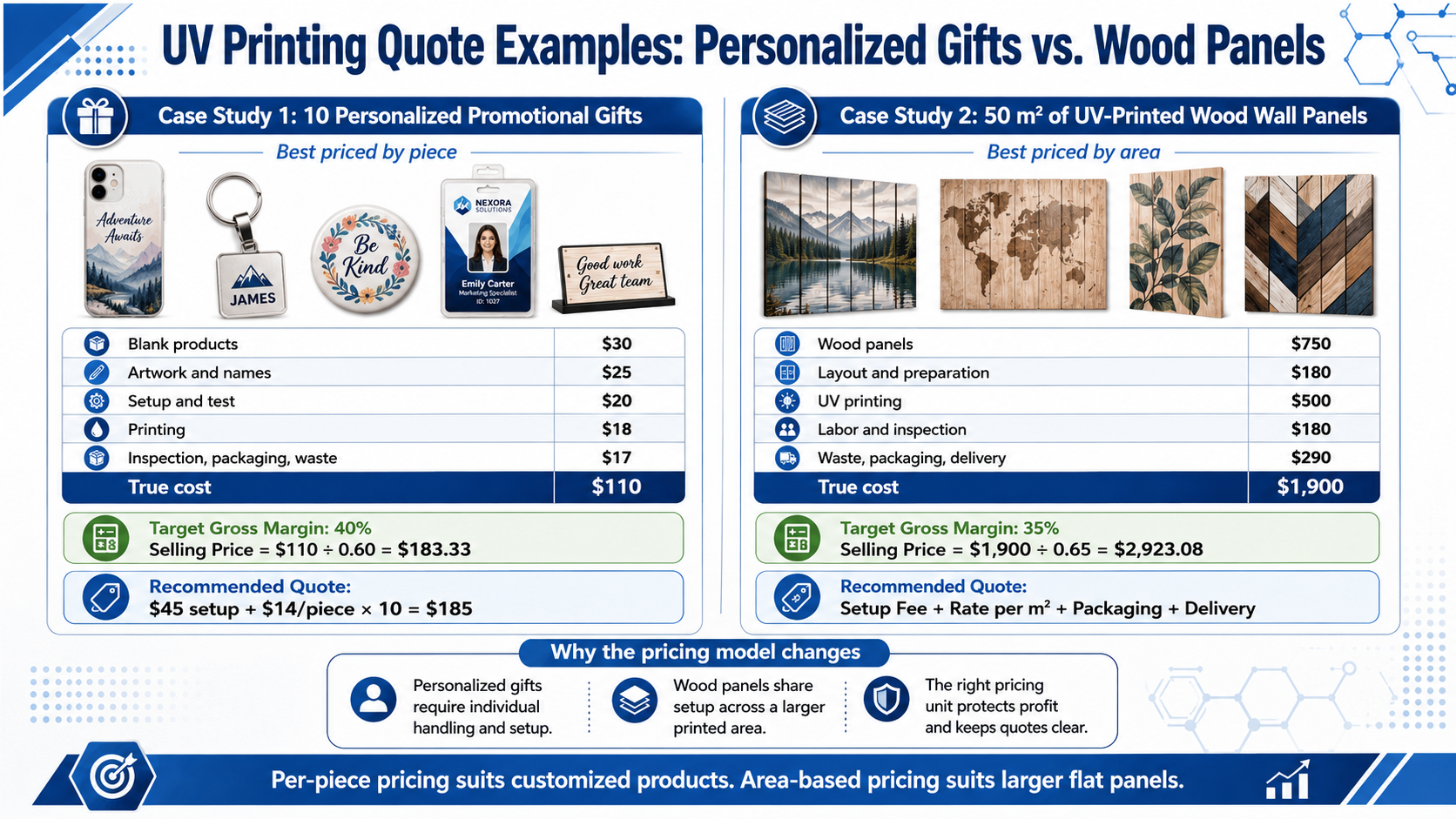
Case 1: 10 Personalized Promotional Gifts
The order includes ten flat products with ten names, basic artwork preparation, white ink, individual positioning, one test piece, inspection, and packaging.
| Cost Item | Ejemplo |
|---|---|
| Blank products | $30 |
| Artwork and names | $25 |
| Setup and test | $20 |
| Impresión | $18 |
| Inspection, packaging, waste | $17 |
| True cost | $110 |
At a 40% target gross margin, the price is $110 ÷ 0.60 = $183.33. A clear quote could show a $45 setup and personalization fee plus $14 per piece, totaling $185. This protects the fixed work while making the offer easy to understand.
Case 2: 50 m² of UV-Printed Wood Wall Panels
This order uses one design divided across multiple panels and includes layout, primer, CMYK and white ink, labor, waste allowance, protective packaging, and delivery.
| Cost Item | Ejemplo |
|---|---|
| Wood panels | $750 |
| Layout and preparation | $180 |
| Impresión UV | $500 |
| Labor and inspection | $180 |
| Waste, packaging, delivery | $290 |
| True cost | $1,900 |
At a 35% target gross margin, the price is $1,900 ÷ 0.65 = $2,923.08. This project is better priced by area because the panels share one workflow and the fixed setup cost is spread across 50 m². The gift order is better priced by piece because each item requires individual data and handling.
UV Printing Quote Template and Pricing Calculator
Information Required Before Quoting
Collect the product, material, dimensions, quantity, printed area, artwork condition, ink configuration, white ink coverage, varnish or embossing requirements, completion date, packaging method, shipping destination, and approval process.
Your internal calculator should include setup time, labor, material, ink, coating, reject allowance, machine-hour cost, packaging, logistics, and target margin. Keep the internal cost sheet separate from the customer-facing quote.
Recommended Quote Structure
- Project description and print specification
- Setup, design, or prototype fee
- Quantity and unit rate, or area and rate per m²
- White ink, varnish, primer, fixture, and color-matching charges
- Packaging, shipping, production time, payment terms, and quote validity
- Sample-credit conditions and responsibility for customer-supplied items
A general break-even pricing calculator can help verify whether the selling price covers fixed and variable costs. Use it as a business reference, not as a replacement for a UV-print-specific cost sheet.
For a wider view of revenue and return, read Is a UV Printing Business Profitable? Costs, Products and ROI Explained.
Preguntas frecuentes
How much should I charge for a one-off UV print?
Start with a minimum setup charge. Add the product, artwork, ink configuration, printing time, handling, packaging, reject allowance, and target margin. Do not price a one-off print only by ink usage.
Should UV printing be priced per piece or per square meter?
Use per-piece pricing for individually positioned or personalized products. Use per-square-meter pricing for larger flat panels where production is driven mainly by area. Use project pricing for complex work.
Is a setup fee necessary for digital UV printing?
Yes. Digital printing removes plate-making, but not file checking, RIP setup, testing, positioning, height adjustment, customer approval, nozzle checks, or cleaning.
How should I price white ink, varnish, and embossed effects?
Charge for additional ink layers, print passes, machine time, labor, and failure risk. Use a surcharge or complexity multiplier based on actual production data.
Should the sample fee be refunded after a bulk order?
Offer a conditional credit instead. Define the minimum quantity, time limit, approved design, eligible product, and maximum credit. Keep shipping and new revisions separate.
How much should I charge for rush UV printing?
Base the fee on overtime, schedule changes, faster proofing, material sourcing, and delivery risk. Confirm feasibility before promising the deadline.
Conclusion: Protect Margin Without Losing Customers
A profitable short run UV printing business does not depend on offering the lowest price. It depends on separating setup work, variable production cost, risk, value-added services, and urgency into a repeatable model. Calculate the true job cost first, then apply the target margin.
Clear quotations build trust because customers understand what they are paying for. They can compare service levels rather than only the lowest unit price, while your business protects the margin needed for reliable production and long-term support.
Need a UV Printer for Short Runs or Prototype Production?
Send us your product size, material, expected quantity, print effects, and daily production target. Our team can recommend a suitable UV printer configuration for personalized products, samples, short runs, and future batch production.