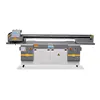
Many buyers experience the same frustration when purchasing a UV printer.
The sample looks perfect — sharp details, vibrant colors, smooth gradients, and excellent surface finish.
But after the machine arrives, the actual printing quality often becomes very different:
- Colors are inconsistent
- Small text becomes blurry
- Gradients look rough
- Glass printing shows color deviation
- Batch printing becomes unstable
- The quality slowly decreases over time
So why does this happen?
In this article, we will explain the real reasons why UV printing quality changes between samples and real production — and how buyers can avoid costly mistakes before purchasing a UV printer.

Why Do UV Printing Results Change So Much?
Many people believe print quality depends only on the printer itself.
In reality, UV printing quality is influenced by multiple technical factors, including:
- ICC color profile calibration
- Printhead precision
- Ink quality
- Material surface treatment
- RIP software settings
- Operator experience
- Production stability
Even if two machines use the same printhead, the final printing results can still look completely different.
7 Factors That Affect UV Printing Quality
1. ICC Color Profiles Are Not Properly Matched
Different materials require different ICC color profiles.
For example:
- Glass requires different color calibration than acrylic
- Metal surfaces reflect light differently
- Wood absorbs ink differently
Many low-cost suppliers use default settings instead of professional ICC calibration, which often causes serious color inconsistency during production.
2. Printhead Precision and Waveform Settings
Printhead tuning directly affects:
- Text sharpness
- Gradient smoothness
- Ink droplet accuracy
- Image clarity
Improper waveform settings can cause blurry edges, ink overspray, and poor image detail.
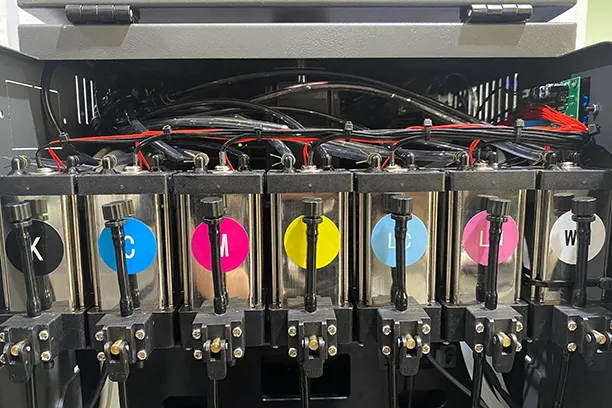
3. Ink Quality Directly Affects Stability
Low-quality UV ink often causes:
- Color deviation
- چسبندگی ضعیف
- Weak durability
- Frequent nozzle clogging
Stable ink performance is especially important for long-term batch production.
Important: A beautiful sample print is easy. Maintaining the same quality across hundreds of products is much harder.
4. Material Surface Treatment Matters
The same printer can produce very different results on different materials.
| مواد |
Common Printing Issue |
| شیشه ای |
Color shift and poor adhesion |
| اکریلیک |
Static electricity affecting ink placement |
| چوب |
Ink absorption inconsistency |
| فلز |
Reflection affecting color appearance |
Professional surface treatment and coating processes are essential for stable printing quality.
5. RIP Software and Operator Experience
Many buyers underestimate the importance of RIP software configuration.
In reality, experienced operators can significantly improve:
- Color consistency
- سرعت چاپ
- Detail sharpness
- Ink consumption efficiency
A good machine without proper operation settings can still produce poor results.
6. Factory Samples Are Usually Printed Under Ideal Conditions
This is one of the biggest reasons buyers feel disappointed after receiving a machine.
Many factory samples are printed using:
- Slow printing speed
- Higher ink consumption
- Multiple print passes
- Manual color adjustments
- Carefully selected materials
However, real production environments prioritize speed, efficiency, and continuous operation.
That is why actual production quality may look different from sample demonstrations.
7. Continuous Production Stability Is More Important Than One Perfect Sample
Professional buyers should not focus only on a single beautiful sample.
The real question is:
Can the printer maintain stable quality after printing 100, 500, or even 1000 pieces continuously?
Long-term stability is the true test of a professional UV printer.
Real Customer Case: Blurry Text on Acrylic Sheets
One customer reported that small text printed perfectly during sample testing, but became blurry during mass production.
After inspection, the problem was caused by:
- Incorrect printhead waveform settings
- Static electricity on acrylic sheets
- Improper ink curing configuration
After adjusting the RIP settings and improving material grounding, the printing quality became stable again.

How to Verify Real UV Printing Quality Before Buying
Before purchasing a UV printer, buyers should ask suppliers the following questions:
- Can you provide unedited printing videos?
- Can you print on my actual materials?
- Can you show batch production consistency?
- What RIP software do you use?
- Which ICC profiles are included?
- How do you test color consistency?
- Can you provide long-term production samples?
These questions help buyers evaluate the true production capability of a UV printer supplier.
نتیجه گیری
A good-looking UV printing sample is easy.
Consistent real-world production quality is much more difficult.
Before investing in a UV printer, buyers should focus not only on image quality, but also on:
- Color consistency
- Long-term stability
- Material compatibility
- پشتیبانی فنی
- Production reliability
Understanding these factors can help businesses avoid expensive purchasing mistakes and achieve better long-term printing performance.
Need Real Printing Tests on Your Materials?
We can help evaluate your actual materials, production requirements, and printing quality expectations before purchase.
Contact Us for Sample Testing →


 Persian
  English
  Arabic
  German
  French
  Spanish
  Turkish
  Italian
  Russian
  Bengali
  Hebrew
  Persian (Afghanistan)
  Scottish Gaelic
  Panjabi
  Croatian
  Slovenian
  Greek
Greek  Afrikaans
  Czech
Czech  Korean
  Japanese
  Portuguese