Evite que sua consulta atrase a resposta, insira seu WhatsApp/WeChat/Skype junto com a mensagem, para que possamos contatá-lo o mais rápido possível
Responderemos em até 24 horas. Se for um caso urgente, adicione WhatsApp: +8613011708220, or WeChat: +86 13011708220. Or call +86 13011708220 diretamente.
*Respeitamos sua confidencialidade e todas as informações são protegidas. Usaremos suas informações somente para responder à sua consulta e nunca enviaremos e-mails ou mensagens promocionais não solicitados.
You are preparing to import a UV flatbed printer from overseas. The supplier sends you a PDF titled “CE Certificate,” the machine has a CE logo on the nameplate, and the sales representative says it can be exported to Europe. Is that enough?
Not necessarily.
UV printer CE certification is often treated as if it were a single certificate that a manufacturer buys from a testing company. In reality, product compliance is broader. Depending on the printer design and target market, manufacturers and importers may need to consider machinery safety, electromagnetic compatibility, electrical safety, technical documentation, declarations, labeling, hazardous-substance restrictions, and other requirements.
The situation becomes more complicated when the same UV printer may be sold in the European Union, Great Britain, the United States, Canada, Australia, or other markets. CE, UKCA, and FCC do not mean the same thing, and they should not be treated as interchangeable certificates.
This guide explains what UV printer buyers should check before ordering, which compliance documents may be relevant, how to identify warning signs in supplier documentation, and what is changing in the European machinery regulatory framework in 2027.
Important: This article provides general compliance information for UV printer buyers and manufacturers. The exact legal requirements depend on the machine configuration, intended use, components, destination market, and current regulations. For a specific import or conformity decision, consult a qualified compliance professional or the relevant authority.
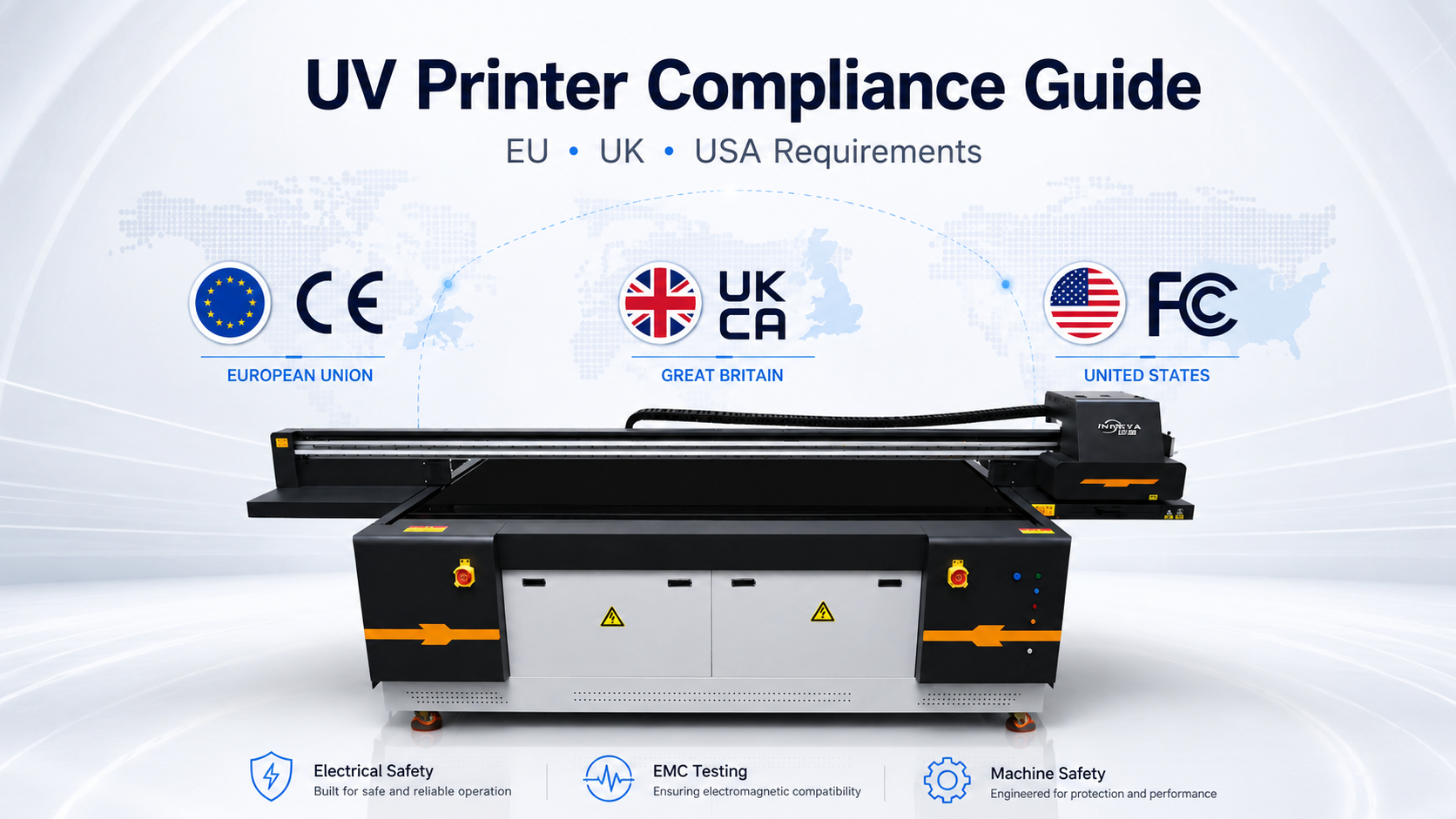
UV printer compliance requirements vary between the EU, Great Britain, and the United States.
Does a UV Printer Need CE Certification?
If a UV printer is placed on the EU market and falls within legislation requiring CE marking, the manufacturer must ensure that the product satisfies the applicable requirements before the CE mark is affixed.
However, asking only, “Does this UV printer have a CE certificate?” is usually too simple.
A better question is:
Which EU requirements apply to this exact UV printer, and what evidence supports its conformity?
CE marking is not simply a decorative label or a universal approval issued by one European authority. The manufacturer normally needs to identify the applicable legislation, evaluate the product, prepare technical documentation, draw up the appropriate EU Declaration of Conformity, and affix the CE mark when the relevant requirements have been satisfied.
CE Is a Compliance Process, Not Just a Certificate
Many buyers receive a one-page document carrying a large CE logo and assume that the compliance process is complete. Such a document may be useful evidence, but buyers should understand the difference between a test report, a third-party certificate, technical documentation, and the manufacturer’s formal Declaration of Conformity.
For many products, CE marking is based on manufacturer responsibility. A notified body is required only where the applicable legislation and conformity assessment procedure specifically require one.
Who Has Responsibilities?
Compliance does not concern only the factory that built the printer. Manufacturers, authorised representatives, importers, and distributors may have different responsibilities depending on how the machine is placed on the market.
For an importer, this means that receiving a PDF from a supplier should not be the end of the verification process.
Which EU Requirements May Apply to a UV Printer?
A UV flatbed printer combines mechanical movement, electrical systems, digital controllers, UV curing components, motors, power supplies, sensors, and software. As a result, several regulatory areas may need to be considered.
The exact applicability should always be determined for the specific machine rather than assumed from the words “UV printer.”
1. Machinery Safety
Large UV flatbed and conveyor printers contain moving parts that can create mechanical hazards. The print carriage travels repeatedly across the machine, platforms may move vertically, and industrial models may include conveyors, vacuum systems, access panels, and other powered mechanisms.
A risk assessment should therefore consider issues such as:
moving carriage hazards;
pinch and crush points;
unexpected machine movement;
emergency-stop functions;
protective covers and guards;
safe access for maintenance;
operator instructions and warning labels.
For a buyer, the important question is not whether the machine “looks safe,” but whether safety has been considered systematically during design and conformity assessment.
2. Electromagnetic Compatibility
Modern UV printers contain many electrical and electronic components, including servo motors, printhead control boards, switching power supplies, UV LED power systems, computers, sensors, and communication interfaces.
These systems can generate electromagnetic disturbances and can also be affected by disturbances from other equipment.
Electromagnetic compatibility, commonly called EMC, therefore matters both for legal compliance and for reliable daily operation.
Relevant evaluation may include electromagnetic emissions and immunity. The exact tests and standards depend on the equipment classification and applicable regulatory framework.
3. Electrical Safety
Electrical safety is especially important for medium and large UV printers because they may operate from substantial mains power and contain multiple internal power supplies.
Typical safety considerations include:
protection against electric shock;
protective grounding;
insulation;
wiring and terminals;
temperature rise;
overcurrent protection;
safe access to electrical cabinets.
The EU Low Voltage Directive covers electrical equipment designed for certain voltage ranges, including 50–1000 V AC and 75–1500 V DC. However, the relationship between machinery legislation and electrical legislation must be assessed for the specific machine. Buyers should therefore avoid assuming that every UV printer requires an identical combination of directives.
RoHS is another term frequently used in UV printer quotations. It restricts certain hazardous substances in electrical and electronic equipment within its scope.
However, buyers should not automatically assume that every industrial UV printer falls into exactly the same RoHS category. The legislation contains scope rules and exclusions, including provisions relating to certain large-scale stationary industrial tools and other equipment.
For this reason, a professional supplier should determine whether RoHS applies to the exact product rather than simply adding “RoHS” to every quotation.
What Changes for UV Printers in 2027?
European machinery compliance is entering an important transition period.
The current Machinery Directive 2006/42/EC is being replaced by Regulation (EU) 2023/1230 on machinery. The new Machinery Regulation is scheduled to apply from 20 January 2027.
This matters to buyers purchasing industrial equipment during 2026 and 2027 because the applicable legal framework may depend on when and how the product is placed on the EU market.
Machinery Directive vs Machinery Regulation
The new regulation keeps many familiar concepts, including risk assessment, technical documentation, conformity assessment, declarations, instructions, and CE marking, while modernising the legal framework.
It also addresses modern machinery issues more directly, including software and digital documentation.
If you are purchasing a UV printer for delivery close to the 2027 transition, ask the supplier which machinery legislation will apply to the machine when it is placed on the market and whether the declaration and technical documentation have been updated accordingly.
CE Certificate vs Test Report vs Declaration of Conformity
One of the biggest sources of confusion in UV printer purchasing is that several completely different documents may all be described by sales teams as “the CE certificate.”
Document
What It Means
What Buyers Should Check
CE Marking
Indicates that the manufacturer states the product conforms to applicable EU requirements requiring CE marking.
Formal manufacturer declaration identifying the product and applicable legislation.
Model, manufacturer, legislation, standards, date and signature.
Test Report
Records results from specific safety, EMC, or other testing.
Model, configuration, standards, laboratory and test scope.
Technical Documentation
Supports the conformity assessment and product design.
Whether it corresponds to the actual production machine.
Third-Party Certificate
May provide supporting evidence depending on the assessment route.
Issuer, scope, product model and relevance.
Why a One-Page “CE Certificate” Is Not Enough
Suppose you are buying a 2500 × 1300 mm UV flatbed printer, but the document sent by the supplier identifies another printer family or a completely different model. A CE logo at the top of the page does not resolve that mismatch.
The supporting documentation should make sense as a complete package.
Model identification, manufacturer information, applicable legislation, standards, test evidence, and the declaration should be consistent with the machine being purchased.
Does a UV Printer Need UKCA Marking?
The UK market is another area where old online articles frequently cause confusion.
After Brexit, UKCA was introduced as the conformity marking system for Great Britain. However, current UK policy allows continued recognition of CE marking for many regulated product sectors in Great Britain.
This means it is no longer accurate to make the blanket statement that every UV printer entering England, Scotland, or Wales must replace CE marking with UKCA.
Great Britain and Northern Ireland Are Different
Buyers should distinguish between:
Great Britain: England, Scotland and Wales;
Northern Ireland: subject to a different product regulatory framework.
The correct conformity route depends on the product category and applicable legislation.
Instead of asking a supplier only, “Do you have UKCA?”, ask:
“Which conformity route does this exact printer use for the UK market, and what documentation supports it?”
This produces a much more useful answer.
Does a UV Printer Need FCC Certification in the USA?
FCC compliance is another subject where terminology is often oversimplified.
A UV printer contains digital electronics capable of generating radio-frequency energy. Depending on the design, it may therefore be subject to FCC requirements for radio-frequency devices, including rules applicable to unintentional radiators.
However, FCC compliance does not always mean obtaining one universal “FCC certificate.”
FCC Part 15 and Digital Equipment
FCC Part 15 regulates certain radio-frequency devices. For equipment within scope, conducted and radiated emissions may need to comply with applicable limits.
A machine intended primarily for commercial or industrial environments may be evaluated differently from equipment marketed for residential use.
Class A vs Class B
Class A digital devices are generally associated with commercial, industrial, or business environments, while Class B requirements address equipment marketed for residential environments and use more restrictive emission limits.
Industrial UV flatbed printers are commonly installed in sign factories, customization workshops, packaging facilities, furniture factories, and industrial production environments. Nevertheless, a supplier should determine the correct classification based on the actual product and marketing conditions rather than automatically calling every UV printer “Class A.”
SDoC vs Certification
FCC equipment authorization rules provide different procedures depending on the device. One route is the Supplier’s Declaration of Conformity (SDoC); another is Certification.
For equipment using SDoC, there are also requirements concerning the responsible party and compliance information.
Therefore, a US buyer should ask:
“What FCC equipment authorization requirements apply to this printer configuration?”
This is more accurate than simply asking whether the factory owns an “FCC certificate.”
What Tests Are Commonly Relevant to UV Printer Compliance?
The exact test program depends on the printer and market, but several areas commonly deserve attention.
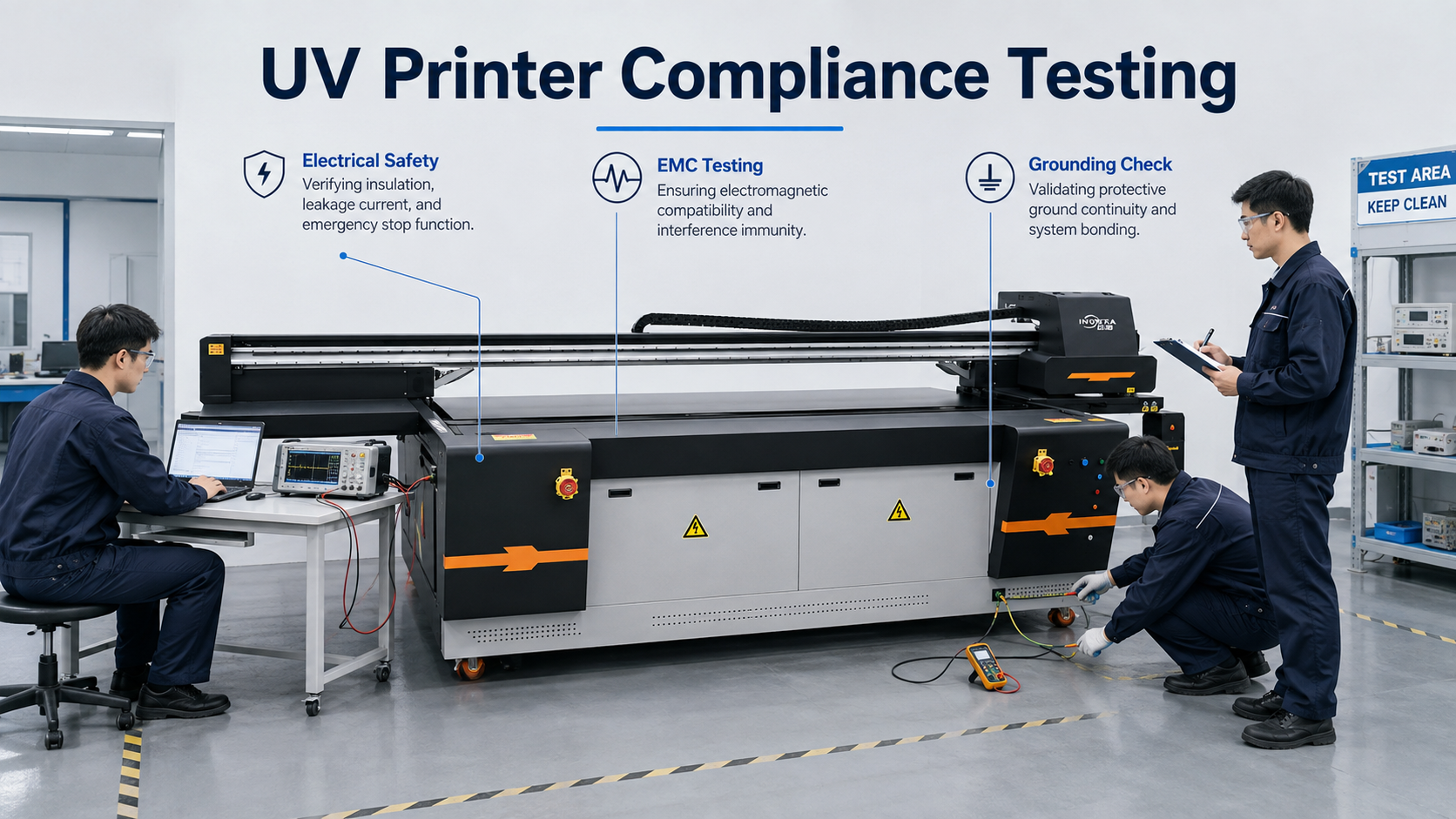
Electrical safety, EMC and machine safety are important parts of UV printer compliance evaluation.
Electrical Safety Testing
protective earth continuity;
insulation and dielectric strength;
electrical protection;
wiring and terminal safety;
abnormal operation where relevant.
EMC Testing
Depending on the applicable standards, testing may evaluate areas such as:
conducted emissions;
radiated emissions;
electrostatic discharge immunity;
electrical fast transients;
surge immunity;
radio-frequency immunity.
Mechanical Safety Evaluation
For an industrial UV flatbed printer, the assessment should consider foreseeable risks from the moving carriage, lifting system, conveyor, covers, service access, and emergency-stop system.
UV Light and Operational Safety
UV LED curing systems are essential to UV printing, but exposure hazards should be considered in the overall risk assessment. Shielding, warning labels, operating instructions, and maintenance procedures may all form part of safe machine design.
What Compliance Documents Should You Request Before Buying?
A serious UV printer buyer should create a document checklist before paying the final balance.
1. EU Declaration of Conformity
Where applicable, check whether the declaration clearly identifies:
the manufacturer and address;
the machine type and model;
applicable EU legislation;
relevant standards where used;
the person authorised to sign;
the date and signature.
2. Relevant Test Reports
Do not look only at the cover page. Check whether the tested product actually matches your printer.
If you are buying a different size, electrical configuration, controller, UV lamp system, or product family, ask the supplier to explain how the report covers your configuration.
3. Machine Nameplate
Before shipment, request a clear photograph of the final machine nameplate.
Useful information may include:
manufacturer;
model;
serial number;
rated voltage;
frequency;
power information;
required conformity marking where applicable.
4. User Manual and Safety Instructions
A professional industrial printer should be accompanied by instructions appropriate to its installation, operation, cleaning, emergency procedures, and maintenance.
5. Electrical Documentation
For larger models such as 1390, 1610, 2513, or conveyor UV printers, electrical diagrams and installation specifications are particularly useful for electricians and service engineers.
6. RoHS or Material Documentation Where Applicable
If RoHS or another restricted-substance requirement applies, request documentation relevant to the actual product rather than a generic declaration covering unrelated equipment.
Environmental compliance also extends to consumables. See our guide to choosing low-VOC UV ink for questions related to SDS, REACH, workplace safety, and ink chemistry.
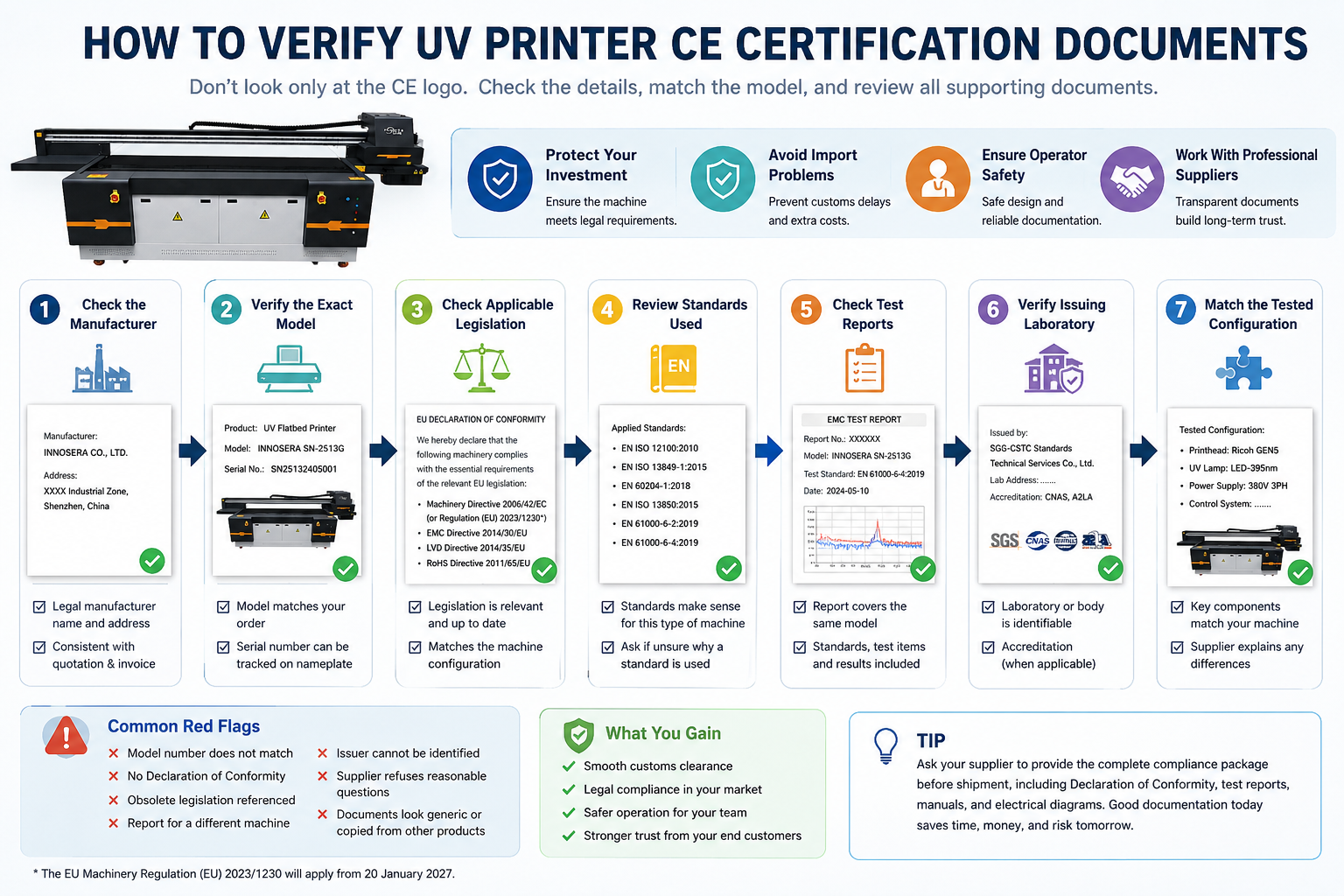
How to Verify UV Printer CE Certification Documents
Buyers do not need to become certification engineers, but several simple checks can identify many obvious problems.
Verify the manufacturer, model, legislation, standards and supporting reports instead of checking only the CE logo.
Step 1: Check the Manufacturer
The company named in the documents should correspond with the legal manufacturer of the machine. If names differ, ask why.
Step 2: Check the Exact Model
Compare the model on the quotation, nameplate, declaration, manual, and test documentation.
Step 3: Check the Applicable Legislation
Make sure the documents refer to legislation relevant to the product and are not simply old templates copied from another machine.
Step 4: Review the Standards
Standards should make sense for the type of equipment and testing performed. If you do not understand why a standard appears, ask the supplier or compliance laboratory.
Step 5: Check the Laboratory or Issuer
Confirm that the laboratory or certificate issuer is identifiable and that document numbers can be traced where appropriate.
Step 6: Compare the Tested Configuration With Your Machine
This is especially important when a manufacturer sells many UV printers that share components but differ in size, motors, power systems, printheads, or curing systems.
A product-family approach may sometimes be valid, but the supplier should be able to explain the relationship rather than simply sending a report for an unrelated printer.
7 Red Flags When Reviewing UV Printer Compliance Documents
The model does not match. Your quotation says one model, but the report identifies another.
The manufacturer name is different. No clear explanation is provided for the difference.
There is no relevant declaration. The supplier sends only a certificate image.
The legal references are outdated. Old documents are reused without reviewing current requirements.
The report covers a very different machine. Size, electrical system, or product type does not correspond.
The issuer cannot be identified. There is no reliable information about who performed the evaluation.
The supplier refuses reasonable questions. A professional supplier should be able to explain what its compliance documents cover.
How Much Does UV Printer Certification Cost?
There is no universal price for UV printer certification.
It is also important to distinguish between CE marking itself and the costs of achieving and documenting conformity. There is no single official EU price that manufacturers simply pay to obtain a CE logo.
Actual compliance costs may depend on:
printer size and complexity;
electrical design;
applicable legislation and standards;
laboratory testing required;
whether a notified body is required;
product-family testing strategy;
design modifications after failed tests;
wireless or communication modules;
documentation and consulting requirements.
This is why buyers should be cautious when compliance is presented as an extremely cheap certificate added to the order with no testing, technical review, or product-specific documentation.
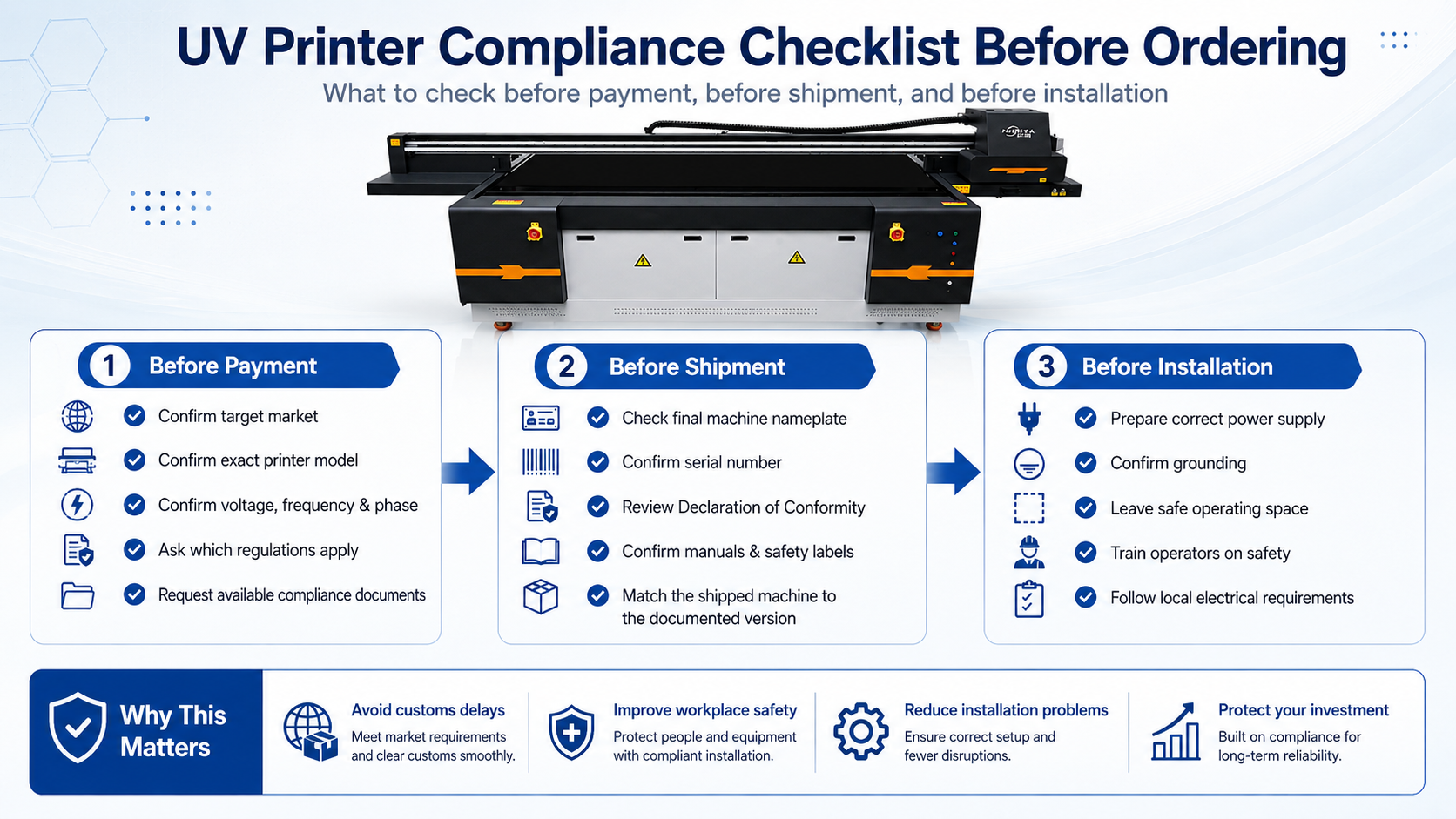
UV Printer Compliance Checklist Before Ordering
Compliance should be checked before payment, shipment and installation—not after the machine arrives.
Before Paying the Deposit
Confirm the destination country.
Confirm the exact UV printer model.
Confirm voltage, frequency and phase.
Ask which product regulations apply.
Request available conformity documentation.
Before Shipment
Check the final machine nameplate.
Confirm serial number and electrical rating.
Review the Declaration of Conformity where applicable.
Confirm manuals and safety information.
Check whether the supplied machine configuration matches the documented version.
Before Installation
Prepare the correct power supply and breaker.
Confirm protective grounding.
Provide safe operating space around the machine.
Train operators in emergency-stop and maintenance procedures.
Follow local electrical and workplace safety requirements.
If you are still choosing between printer sizes, read our guide to choosing the right UV printer before finalising the electrical and compliance requirements.
Frequently Asked Questions About UV Printer CE Certification
Does every UV printer need CE certification?
Not every UV printer worldwide requires CE marking. CE requirements are related to products placed on markets where the relevant EU conformity legislation applies. The exact requirements depend on the product design and destination market.
Is a CE certificate enough to import a UV printer into Europe?
A one-page document titled “CE Certificate” should not be treated as the complete conformity package. Buyers should consider the Declaration of Conformity, applicable legislation, product-specific technical evidence, labeling, instructions, and supporting test documentation.
How can I verify a UV printer CE certificate?
Start by checking the legal manufacturer, exact model, applicable legislation, standards, document date, test laboratory or issuer, and whether the tested machine corresponds to the machine you are purchasing.
Does a UV printer need UKCA marking in the UK?
Not necessarily. Great Britain currently continues to recognise CE marking for many regulated product sectors. The correct route depends on the product and applicable UK rules. Northern Ireland follows a different product-marking framework.
Does a UV printer need FCC certification in the USA?
UV printers containing digital electronics may be subject to FCC radio-frequency requirements, but “FCC compliance” does not always mean obtaining one specific certificate. Depending on the equipment, an applicable authorization route may include Supplier’s Declaration of Conformity or Certification.
Does CE certification include EMC testing?
If EMC legislation applies to the product, electromagnetic compatibility must be addressed as part of the applicable conformity process. The exact test program depends on the equipment and standards selected.
Does a UV printer need RoHS compliance?
RoHS applies to electrical and electronic equipment within its scope, but the legislation also contains exclusions and specific definitions. Whether a particular industrial UV printer is within scope should be determined from the actual machine and intended application.
How much does UV printer CE certification cost?
There is no universal price. Costs depend on the machine, applicable legislation, testing scope, laboratory, conformity assessment route, documentation, and whether design changes are required after testing.
Final Thoughts: Do Not Buy a UV Printer Based on a Logo Alone
A CE, UKCA, or FCC logo can be useful, but a logo alone does not tell you whether an industrial UV printer has been correctly evaluated for your market.
The safest purchasing approach is to verify the exact machine, exact destination market, applicable requirements, Declaration of Conformity, test evidence, nameplate, electrical specifications, and safety documentation before shipment.
For professional buyers, compliance should be treated in the same way as printhead configuration, printing speed, ink cost, and after-sales support: it is part of the total purchasing decision.
If you are evaluating a UV flatbed or conveyor printer for Europe, the UK, or the United States, contact our team to request the available compliance documents and electrical specifications for the exact printer model you are considering.


 Portuguese
  English
  Arabic
  German
  French
  Spanish
  Turkish
  Italian
  Russian
  Persian
  Bengali
  Hebrew
  Persian (Afghanistan)
  Scottish Gaelic
  Panjabi
  Croatian
  Slovenian
  Greek
Greek  Afrikaans
  Czech
Czech  Korean
  Japanese