

 Russian
  English
  Arabic
  German
  French
  Spanish
  Turkish
  Italian
  Persian
  Bengali
  Hebrew
  Persian (Afghanistan)
  Scottish Gaelic
  Panjabi
  Croatian
  Slovenian
  Greek
Greek  Afrikaans
  Czech
Czech  Korean
  Japanese
  Portuguese





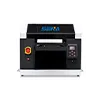
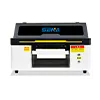

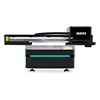

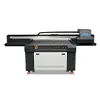
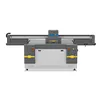
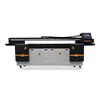
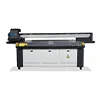
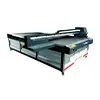
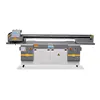






UV Printer White Ink Circulation System Explained: Why It Matters for Stable Printing
А UV printer white ink circulation system is one of the most important—but often misunderstood—parts of a UV printer. Many buyers focus heavily on the printhead model, printing resolution or maximum speed, yet some of the most frustrating daily problems come from white ink rather than CMYK.
Typical complaints include missing white nozzles, weak white opacity after the printer sits overnight, repeated cleaning, unstable white output during long jobs, clogged filters, ink starvation and white ink that prints normally after cleaning but quickly becomes unstable again.
The cause is not always a damaged printhead.
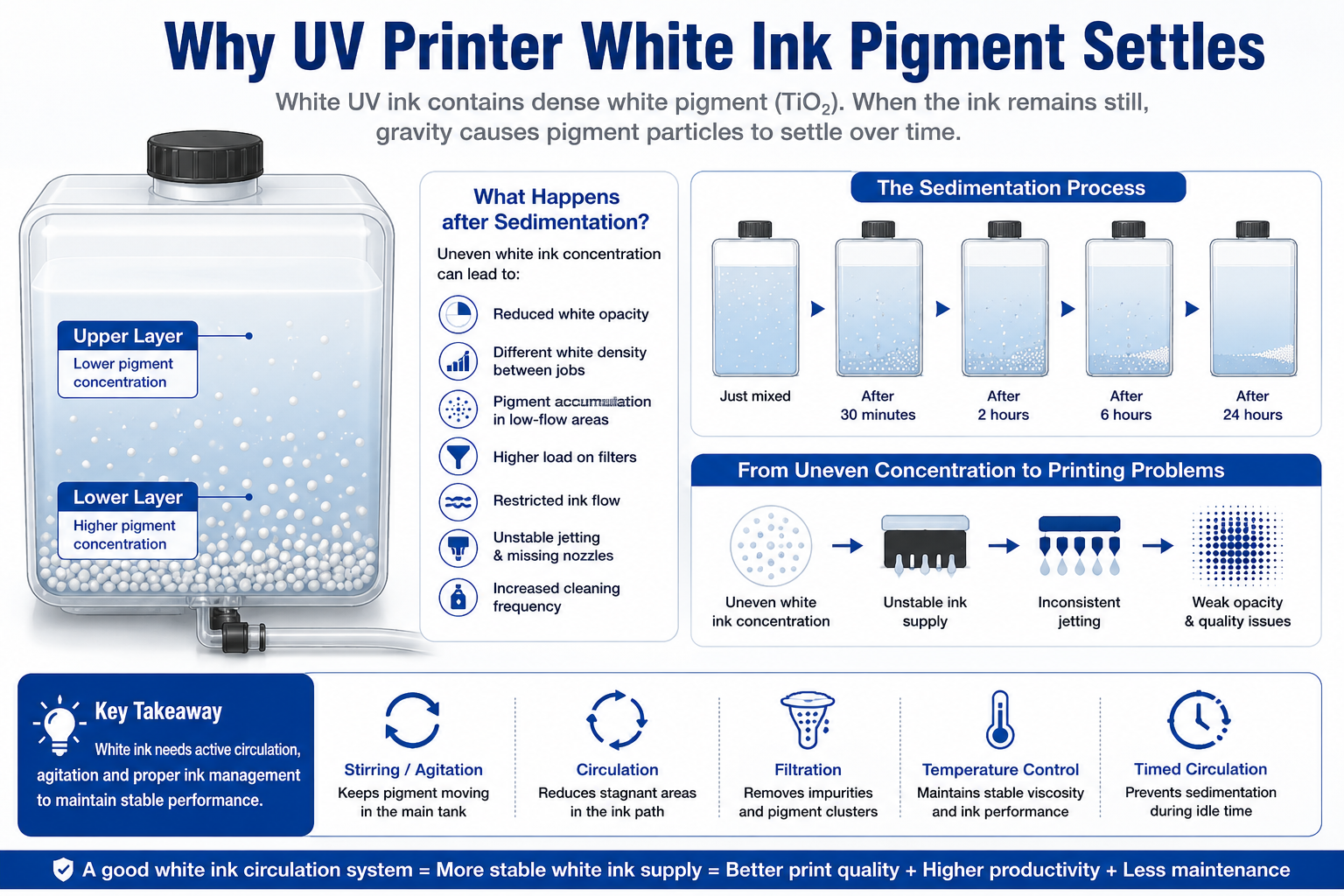
White UV ink contains a high concentration of dense white pigment to create opacity on acrylic, glass, metal, wood, PVC and other dark or transparent materials. These pigment particles naturally tend to settle when ink remains still. If the printer does not manage white ink correctly throughout the ink path, pigment concentration can become uneven and ink flow can become unstable.
A good white ink system therefore does much more than circulate ink inside a main tank. It combines agitation, circulation, filtration, pressure control, temperature stability and automatic idle management to keep white ink as consistent as possible from the storage tank to the printing zone.
This guide explains how white ink circulation works, the difference between main-tank, secondary-tank and near-head circulation, common white ink failures, and what buyers should check before choosing a UV printer.
Why Is UV White Ink More Difficult Than CMYK?
White ink behaves differently from standard CMYK because opacity requires a large amount of white pigment. Titanium dioxide, often referred to as TiO₂, is commonly used in white ink because of its strong light-scattering and covering properties.
The same property that makes it effective as a white pigment also creates a technical challenge: the pigment is much denser than the liquid vehicle surrounding it.
Why White Pigments Settle
When white ink remains stationary, gravity gradually encourages pigment particles to move downward. Well-formulated ink is designed to keep the pigment dispersed for as long as practical, but no industrial ink-supply system should assume that heavily pigmented white ink can remain completely motionless forever without consequences.
The process can be simplified as:
White Pigment → Idle Time → Sedimentation Risk → Uneven Pigment Concentration → Unstable Ink Supply → Nozzle and Density Problems
If this continues, the upper part of an ink reservoir or tube may contain relatively less pigment while the lower area becomes more concentrated.
What Happens After Sedimentation?
Uneven white ink concentration can contribute to several production problems:
- Reduced white opacity
- Different white density between jobs
- Pigment accumulation in low-flow areas
- Higher load on filters
- Restricted ink flow
- Unstable jetting
- Missing nozzles
- Increased cleaning frequency
- Potential printhead blockage
This is why white ink stability should be viewed as an ink-management problem, not simply a printhead problem.
For more background on nozzle reliability, see our guide to extending UV printhead life.
What Is a UV Printer White Ink Circulation System?
A white ink circulation system moves white ink through selected parts of the printer’s ink-supply path either continuously or at programmed intervals.
The purpose is not to claim that circulation completely eliminates sedimentation. Instead, circulation helps reduce stagnant areas, maintain more uniform pigment dispersion and stabilize the conditions under which white ink reaches the printhead.
A basic system may circulate only the main white ink tank. A more advanced system may also manage a secondary tank or near-head ink path. Some printhead and machine architectures can support circulation much closer to, or through, the printhead ink path itself.
This distinction matters.
“This printer has white ink circulation” is not enough information. The real question is: where exactly does the white ink circulate?
The answer can have a major impact on white ink stability during long production runs and after idle periods.
How Does a White Ink Circulation System Work?
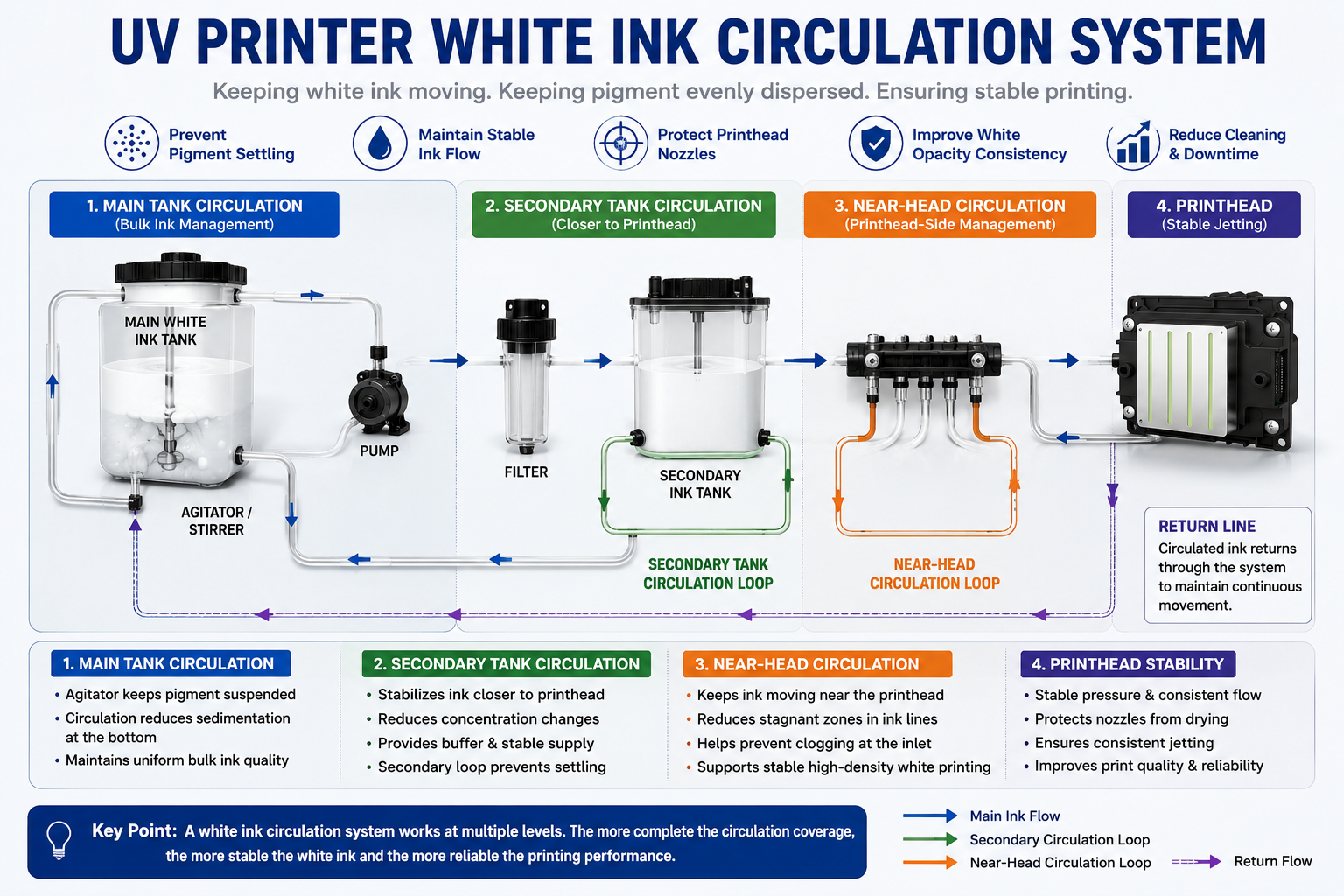
A typical white ink supply path may include several components:
Main White Ink Tank → Stirring / Agitation → Pump → Filter → Secondary Tank → Near-Head Ink Path → Printhead
A return line may then create a circulation loop through selected sections of the system.
The exact architecture varies by printer manufacturer, machine size, printhead type and white ink configuration.
Main Components
- Main ink tank: stores the bulk white ink.
- Agitator: keeps pigment moving inside the reservoir.
- Ink pump: moves ink through the supply or circulation path.
- Filter: helps remove contamination or unwanted aggregates before ink reaches sensitive components.
- Secondary tank: buffers ink closer to the printhead and can help stabilize supply.
- Pressure-control system: helps maintain suitable ink pressure at the printhead.
- Return line: allows ink to move back through the circulation loop.
- Автоматизация: determines when and how long circulation or agitation operates.
A stable system depends on these components working together rather than simply installing a stronger pump.
Main Tank Circulation: The First Level
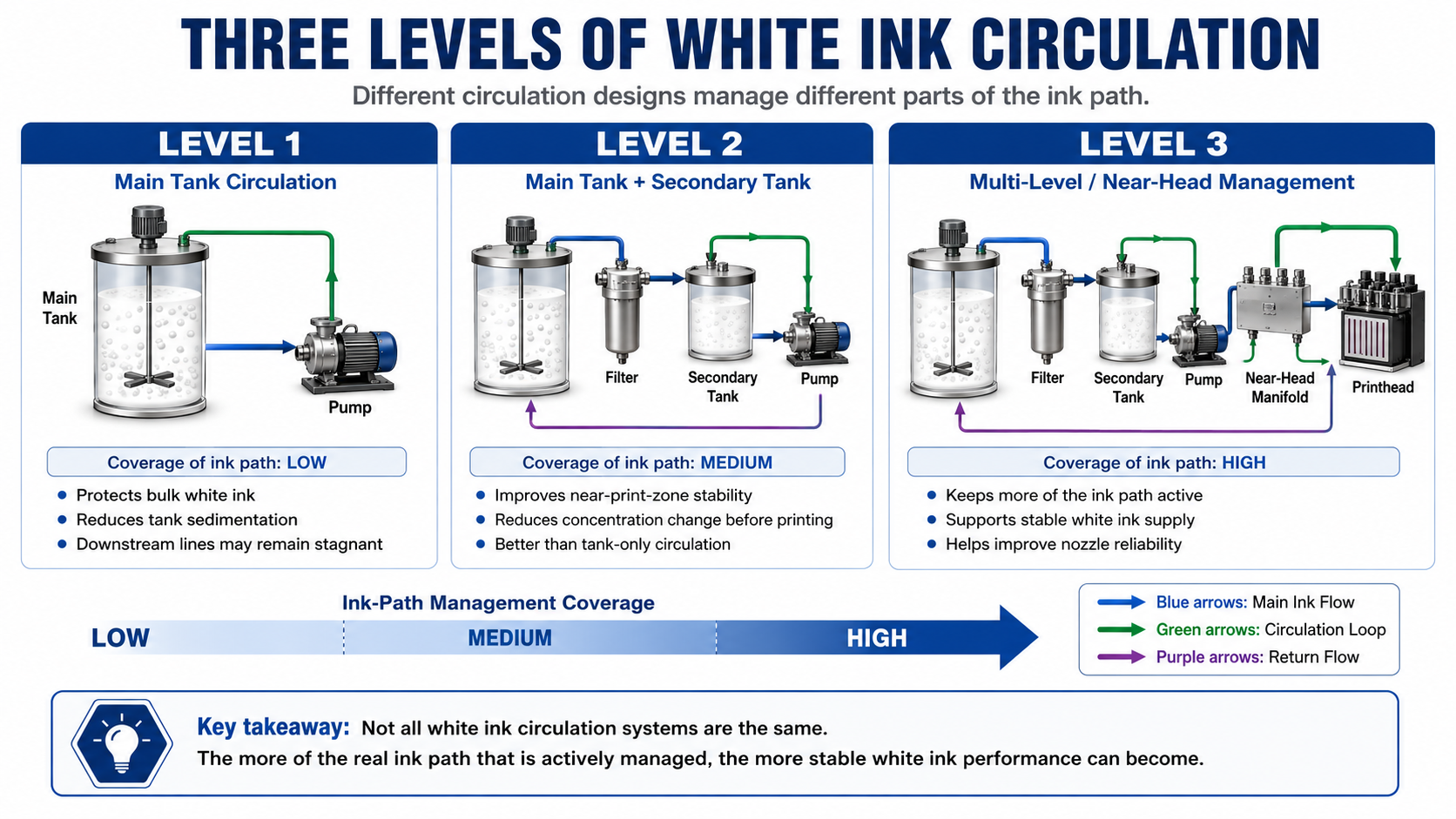
The simplest white ink circulation system works mainly around the primary ink reservoir.
A pump moves white ink from the main tank through a short loop and returns it to the same reservoir. Some systems also combine this with mechanical or magnetic stirring.
Main-tank circulation helps:
- Reduce pigment accumulation at the bottom of the bulk ink tank
- Maintain more uniform pigment concentration in stored ink
- Improve consistency after periods of inactivity
- Reduce the risk of highly concentrated pigment being drawn from the bottom of the tank
This is useful, but it has an important limitation.
Once ink leaves the main tank, it may still travel through:
- Long ink tubes
- Filters
- Connectors
- Secondary tanks
- Dampers
- Printhead inlet lines
If these sections remain relatively stagnant, circulating only the main tank does not actively manage the entire white ink path.
This leads to one of the most important principles in white ink system design:
Tank circulation is useful, but tank circulation alone is not full-path white ink management.
Secondary Ink Tank Circulation: Closer to the Printhead
Many larger UV printers use a secondary ink tank, sometimes called a sub-tank, positioned closer to the carriage or printhead.
The secondary tank can serve several purposes:
- Buffer ink near the printhead
- Maintain stable ink availability
- Support negative-pressure control
- Reduce the distance over which the printhead depends directly on the main supply tank
- Allow additional white ink circulation near the printing zone
If white ink is circulated within or around the secondary tank, sedimentation risk can be managed closer to the printhead than with main-tank circulation alone.
However, buyers should not assume that every machine with a secondary tank automatically circulates white ink through it.
Important questions include:
- Does the secondary tank have its own circulation loop?
- How is its liquid level controlled?
- How is negative pressure stabilized?
- What happens during long idle periods?
- Does the ink remain stagnant between the sub-tank and printhead?
For commercial 6090, 1390 and larger flatbed printers, these details can become increasingly important as daily printing hours and white ink consumption rise.
Near-Head Circulation: Why Circulation Location Matters
The closer white ink gets to the printhead, the more important local ink stability becomes.
Even if the main tank is perfectly mixed, ink may still pass through a long section of tubing before reaching the nozzle plate. If that section contains stagnant zones or very low flow, pigment concentration may change over time.
A near-head circulation system attempts to keep white ink moving closer to the actual printing area.
A simplified path might look like:
Secondary Tank → Filter / Ink Line → Near-Head Loop → Return Line
Near-head circulation can reduce the amount of white ink that remains stationary immediately before the printhead. This is particularly useful in machines that:
- Print high white-ink coverage
- Operate for long shifts
- Use multiple white heads
- Frequently switch between active production and idle time
- Produce transparent or dark substrates that require strong white layers
The important point is not simply “more circulation is better.” The important point is how much of the actual ink path is being actively managed.
Near-Head Circulation vs Internal Printhead Recirculation
These two terms are often confused.
Near-Head Circulation
Near-head circulation moves ink through tubing or a manifold close to the printhead inlet. The ink may return before entering the internal printhead ink path.
Internal Printhead Recirculation
True internal recirculation requires a printhead architecture designed to support ink flow through, or very close to, internal channels associated with the nozzle system.
Not every printhead supports this architecture, and not every printer that advertises “white ink circulation” provides true internal printhead recirculation.
Therefore, buyers should avoid assuming that:
White ink circulation = internal printhead circulation.
The easiest way to verify the system is to request an ink-path diagram from the manufacturer.
Ask:
“Does the white ink circulate only in the tank, through the secondary tank, to the printhead inlet, or through an internal printhead circulation path?”
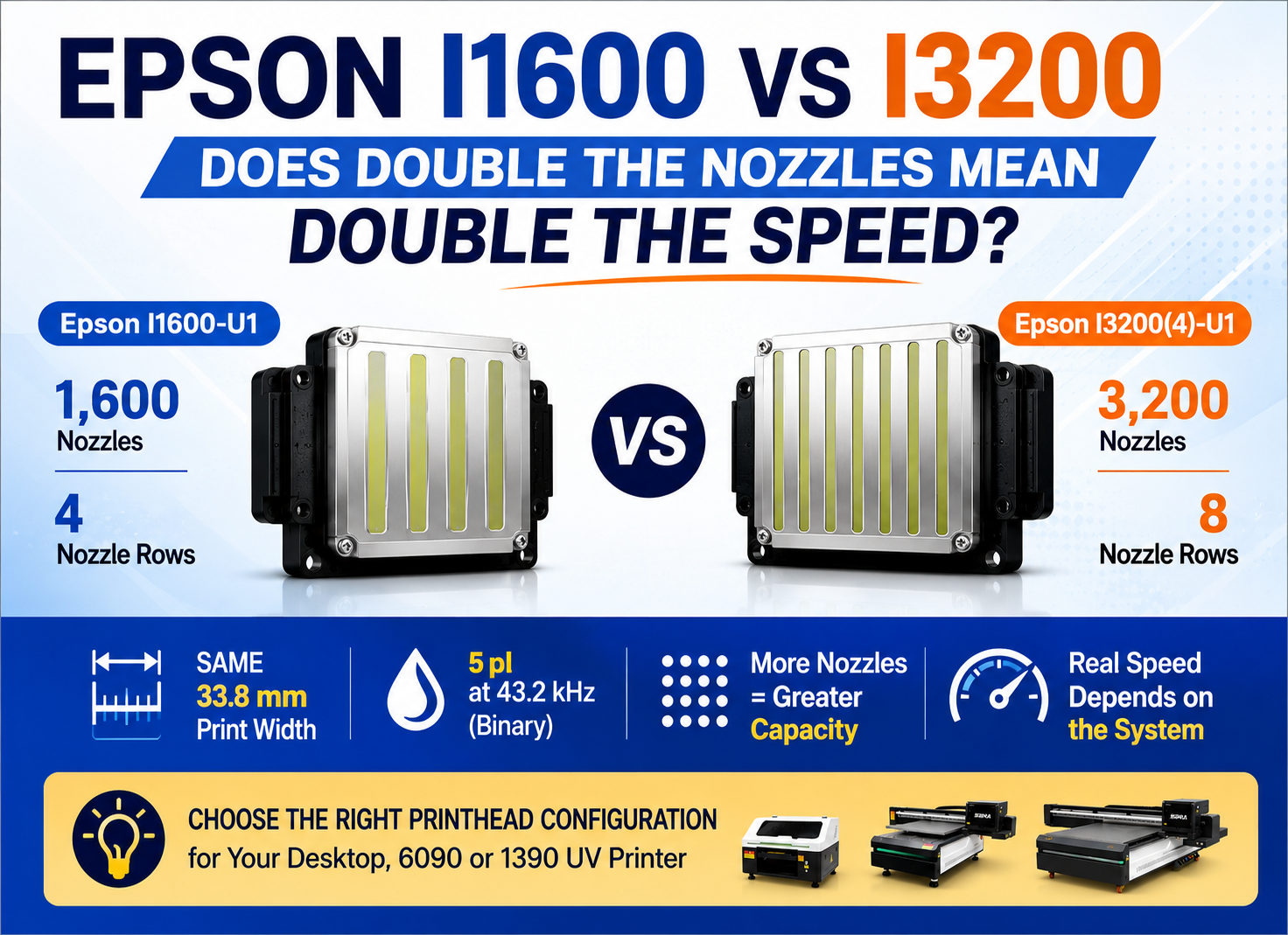
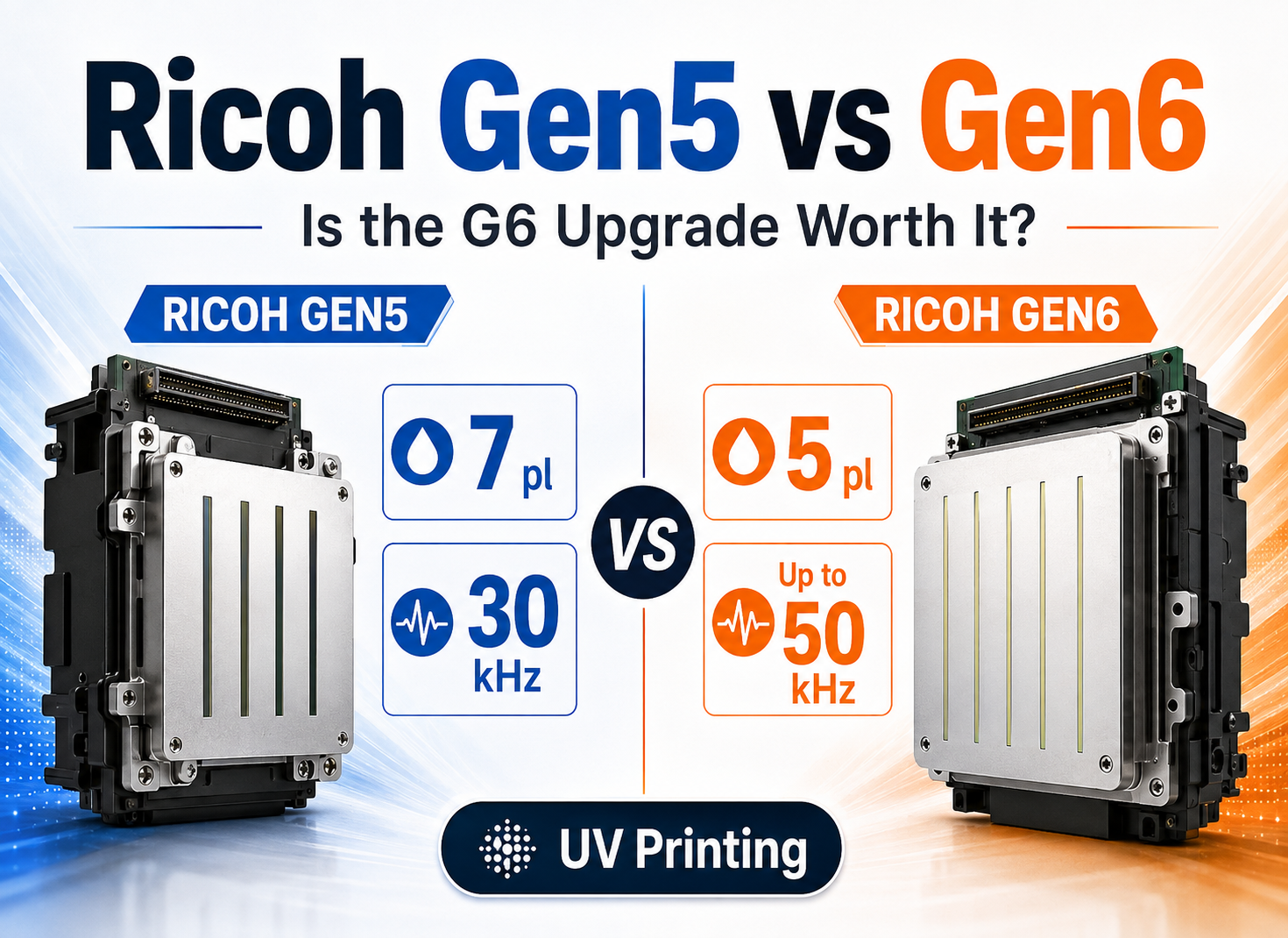
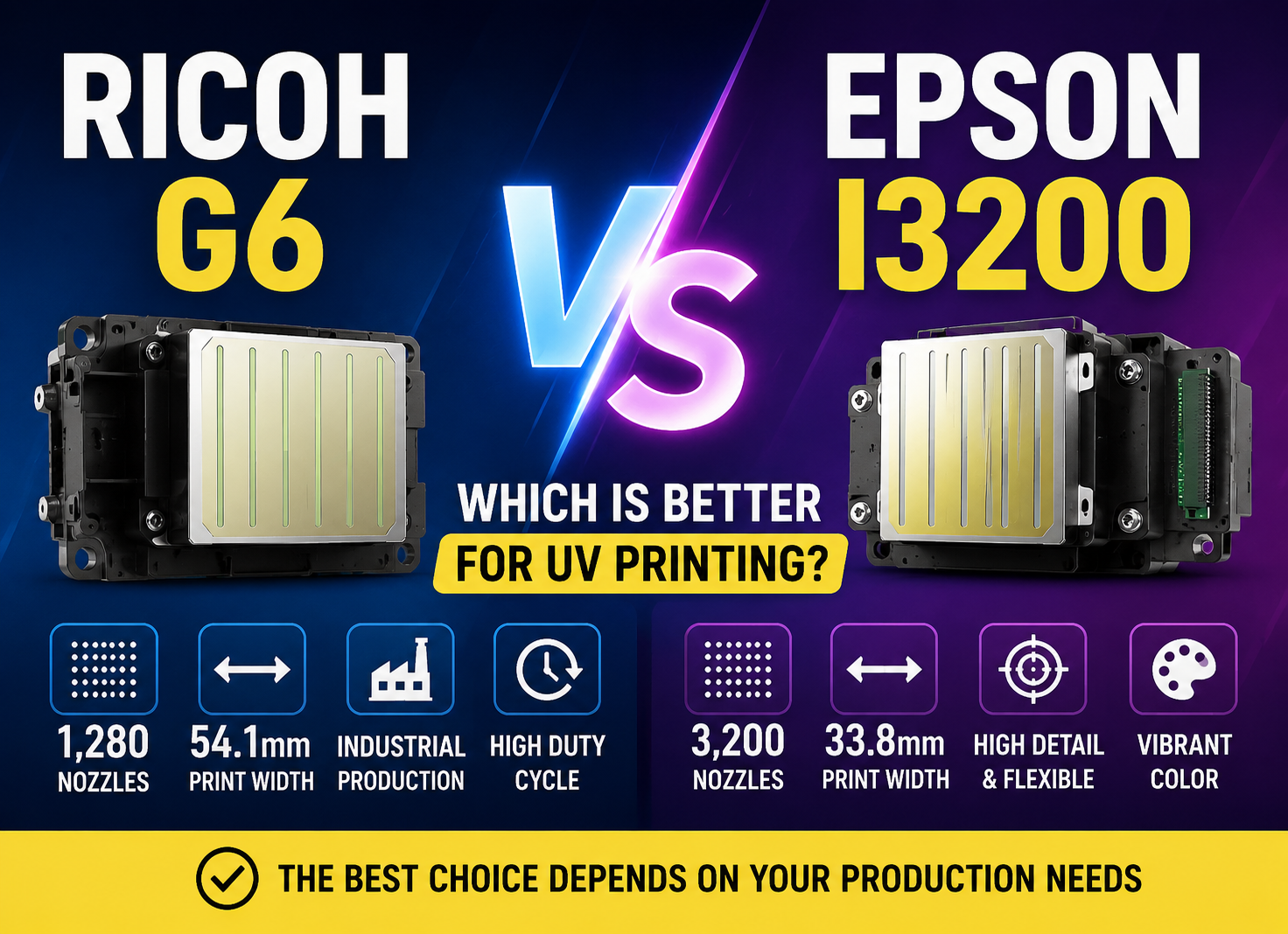
If you are also comparing different printhead architectures, see our Epson I1600 vs I3200 UV printhead comparison и Ricoh Gen5 vs Gen6 comparison.
Why White Ink Still Needs Agitation Even with Circulation
Agitation and circulation solve related but different problems.
Agitation primarily works inside the ink reservoir. A stirring motor, rotating paddle, magnetic mixer or other mechanism keeps pigment moving inside the main white ink tank.
Circulation moves ink through part of the ink-supply path.
This difference is important.
A machine may have circulation but poor tank agitation. In that case, highly concentrated pigment can still accumulate at the bottom of the storage tank before entering the circulation system.
Another machine may have a good stirrer but no circulation beyond the tank. In that case, the bulk ink remains mixed while downstream ink lines remain relatively inactive.
The most useful way to remember the difference is:
Stirring protects the reservoir; circulation protects the ink path.
For printers that use white ink every day, both functions can contribute to better consistency.
Why Filtration Is Critical in White Ink Systems
White ink filtration plays an important role because the ink contains a high pigment load and must pass through extremely small printhead channels and nozzles.
A suitable filter can help capture:
- Contamination introduced during filling or maintenance
- Foreign particles from the ink-supply system
- Unwanted pigment aggregates
- Debris from aging tubing or components
However, filtration is a balance.
A filter that becomes excessively restricted can create:
- Pressure loss
- Reduced ink flow
- Ink starvation during high-coverage printing
- Unstable white output
- Additional load on the ink pump
This is why users should not simply install the “finest possible filter.” Filter specification should match the ink, printhead and printer manufacturer’s requirements.
A white ink problem that appears to be a printhead failure can sometimes originate from a partially blocked filter upstream.
Does White Ink Need Temperature Control?
Temperature affects ink viscosity, and viscosity affects how easily ink moves through pumps, tubes, filters and printhead channels.
When white ink becomes colder, viscosity may increase. Higher viscosity can increase flow resistance and change pressure behavior.
When ink becomes warmer, viscosity decreases and jetting characteristics can also change.
The goal is therefore not simply to make white ink “hotter.”
Stable and appropriate temperature is more important than maximum temperature.
A production environment with large temperature swings can make white ink behavior less repeatable between morning, afternoon and night shifts.
Depending on the machine design, temperature management may involve:
- Ink-tank heating
- Sub-tank temperature management
- Printhead-integrated heating
- Environmental control
- Software-controlled warm-up procedures
The correct operating range should always follow the printer and ink manufacturer’s recommendations rather than a universal temperature copied from another machine.
Continuous vs Timed White Ink Circulation
White ink does not necessarily need to circulate at maximum flow every minute of the day.
Different UV printers use different strategies.
Continuous Circulation
A continuous system keeps white ink moving while the machine is operating.
Potential advantages include:
- More constant ink movement
- Less time for pigment to settle in the active loop
- Good support for high-utilization production
However, continuous operation also requires proper pump durability, pressure control and system design.
Timed or Periodic Circulation
Other machines use programmed circulation cycles.
The printer may circulate or stir white ink:
- At startup
- Before printing
- Every predetermined interval
- During idle periods
- After a long pause
- Before automatic maintenance
Periodic circulation can reduce unnecessary pump operation while still preventing long periods of stagnation.
There is no universal circulation interval that is correct for every UV printer. The best timing depends on the ink formulation, tank volume, pump design, printhead, ambient environment and expected idle period.
View manufacturer information about automatic white ink circulation
Common White Ink Problems and What They Usually Mean
| Symptom | Possible Cause | What to Check |
|---|---|---|
| White appears weaker after idle time | Pigment settling or insufficient agitation | Tank stirring, circulation timing, ink condition |
| Missing white nozzles | Air, sediment, clogged nozzle, unstable supply | Nozzle test, damper, filter, ink line, cap station |
| White returns after cleaning but fails again | Ink-flow or pressure problem | Filter, pump, negative pressure, tubing and circulation |
| White density changes during long jobs | Concentration or ink-supply instability | Circulation, sub-tank level, temperature and pressure |
| Ink starvation at high white coverage | Restricted flow or insufficient supply | Filter restriction, pump output, tube diameter, pressure |
| Frequent white cleaning required | Maintenance, circulation or nozzle condition issue | Ink path, cap station, circulation, humidity and cleaning process |
For additional troubleshooting, see our UV printer missing nozzles and banding troubleshooting guide.
White Ink Clogging Is Not Always a Printhead Problem
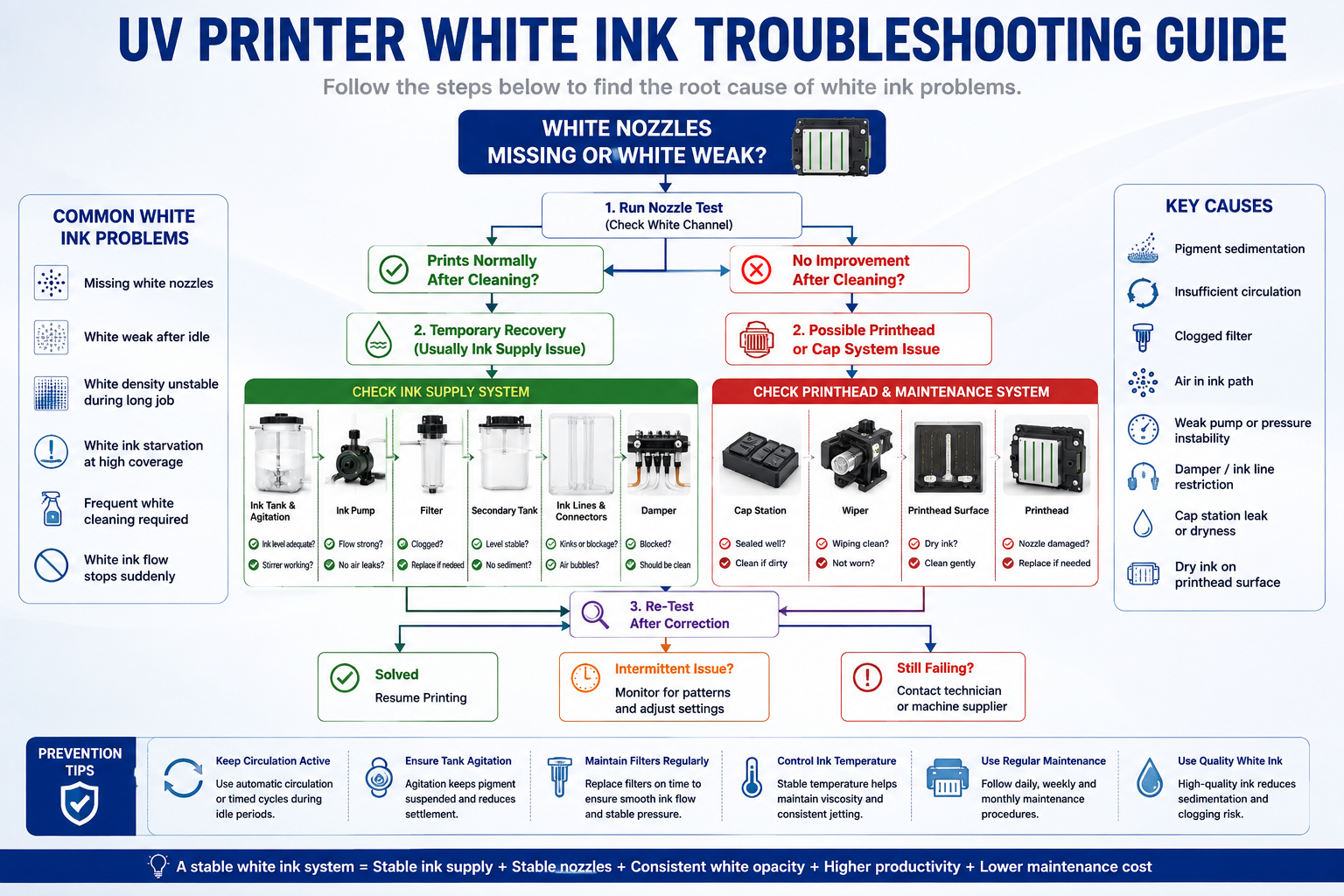
One of the most expensive mistakes in UV printer maintenance is assuming that every persistent missing-nozzle problem requires a new printhead.
The printhead is only the final part of a much larger ink-supply system.
White nozzle loss can also be caused by:
- Air entering the ink path
- A restricted white ink filter
- Insufficient pump flow
- Abnormal negative pressure
- Incorrect sub-tank level
- A damaged or restricted damper
- Blocked tubing
- Pigment accumulation
- Poor cap-station sealing
- Dry ink around the nozzle plate
Consider a common situation: white nozzles return after a cleaning cycle but disappear again during a high-coverage job.
This may indicate that the head can still fire normally, but the ink-supply system cannot replenish white ink at the required rate.
Replacing the printhead would not correct a restricted filter, weak pump or unstable negative pressure.
Replacing a printhead without diagnosing the white ink supply system may treat the symptom while leaving the root cause unchanged.
Before replacing an expensive head, a technician should inspect the complete ink path and maintenance system.
How to Evaluate a UV Printer White Ink System Before Buying
Many buyers ask only:
“Does this printer have white ink circulation?”
A better purchasing process is to ask the following questions.
1. Does the Main White Ink Tank Have Automatic Stirring?
Confirm whether the system actively mixes white ink during operation and idle periods.
2. Does White Ink Circulate Automatically?
Ask whether circulation is automatic, manual, continuous or timed.
3. Where Does the Circulation Loop Start and End?
This is one of the most important questions.
4. Is Circulation Limited to the Main Tank?
If so, ask how the downstream ink path is managed.
5. Does the Secondary Ink Tank Have Circulation?
This can be especially important for commercial and industrial machines.
6. Does Circulation Reach the Printhead Inlet Area?
Ask whether near-head tubing remains active or stagnant during idle periods.
7. Does the Printhead Support Internal Recirculation?
Do not assume near-head circulation and internal printhead recirculation are the same.
8. How Is White Ink Filtered?
Ask about recommended filter maintenance and replacement intervals.
9. How Is Ink Temperature Managed?
For production environments with significant temperature variation, this can affect consistency.
10. What Happens When the Printer Sits Idle?
Ask whether the machine continues automatic stirring, circulation or maintenance overnight or during weekends.
11. Can You Show Me the White Ink Flow Diagram?
This is often more useful than a simple specification saying “white ink circulation included.”
A flow diagram helps you understand exactly which parts of the system are actively managed.
What Does a Good White Ink Circulation System Look Like?
There is no single circulation architecture that every printer must use. Machine size, workload, printhead type and budget all matter.
Basic White Ink System
A compact system may include:
- Main-tank stirring
- Main-tank circulation
- Basic filtration
- Automatic cleaning
This can be sufficient for many lower-utilization desktop applications.
More Complete Commercial System
A production-oriented system may add:
- Main-tank agitation
- Main-tank circulation
- Secondary-tank management
- Automatic circulation intervals
- Improved filtration
- More stable pressure control
Higher-Duty Production System
A more comprehensive industrial design may combine:
- Tank agitation
- Multi-level circulation
- Near-head ink management
- Stable filtration
- Temperature management
- Negative-pressure control
- Automatic idle cycles
- Multiple dedicated white printheads
But more components do not automatically mean better reliability.
The system must be correctly engineered, calibrated and maintained.
Desktop vs 6090 vs 1390: How Much White Ink Management Do You Need?
White ink requirements also change with printer size and production volume.
Desktop / A3 UV Printer
Desktop UV printers commonly produce phone cases, acrylic items, gifts, samples and personalized products.
Typical priorities include:
- Simple maintenance
- Reliable tank stirring
- Automatic timed circulation
- Stable white output after idle periods
- Lower operating complexity
For moderate daily workloads, a well-designed compact system can be more valuable than an unnecessarily complex industrial ink loop.
See our Desktop UV Printer решения.
6090 UV Flatbed Printer
A 6090 printer often operates longer hours and handles a wider range of materials, including acrylic, wood, metal, PVC, glass and customized products.
Buyers should pay more attention to:
- Main-tank agitation
- Secondary-tank stability
- Automatic circulation
- White ink filtration
- Negative-pressure stability
- Long-job ink supply
Узнайте больше о наших 6090 UV Flatbed Printer конфигурации.
1390 UV Flatbed Printer
A 1390-class UV flatbed generally has higher daily output expectations and can use significantly more white ink when producing large acrylic sheets, signage, decorative panels or industrial products.
For these machines, buyers should evaluate:
- Multi-level circulation
- Pump capacity
- White ink channel allocation
- Number of white printheads
- Stable negative pressure
- Filter capacity
- Temperature stability
- Automated idle protection
View our 1390 UV Flatbed Printer options for larger-format production.
UV Printer White Ink Circulation System: Final Recommendation
Надежный UV printer white ink circulation system is not simply a pump moving ink around a reservoir.
White ink stability depends on how the entire system manages dense pigment from storage to the printing zone.
Important factors include:
- Tank agitation
- Main-tank circulation
- Secondary-tank management
- Near-head circulation
- Printhead architecture
- Filtration
- Pressure control
- Temperature stability
- Automatic circulation timing
- Idle-period maintenance
A desktop printer may not require the same system architecture as a high-utilization 1390 or industrial flatbed. The goal is not to install the most complicated system possible. The goal is to keep pigment concentration and ink-supply conditions stable enough for the printer’s workload.
When comparing UV printers, do not ask only:
“Does the machine have white ink circulation?”
Ask instead:
“Where does the white ink circulate, how is it stirred and filtered, and what happens to the ink when the printer is idle?”
Those questions reveal much more about long-term white ink reliability than a simple feature list.
Frequently Asked Questions About UV Printer White Ink Circulation
Why does UV white ink settle?
White UV ink contains a high concentration of dense white pigment for opacity. When the ink remains stationary, gravity can cause pigment particles to gradually settle, creating uneven pigment concentration and potential ink-flow problems.
What does a UV printer white ink circulation system do?
It moves white ink through selected sections of the ink-supply path to reduce stagnant areas and help maintain more uniform pigment dispersion and ink-supply conditions.
Is white ink tank circulation enough?
Not always. Tank circulation helps maintain the bulk ink reservoir, but tubing, filters, secondary tanks and near-head ink lines may still remain relatively stagnant if they are outside the circulation loop.
What is the difference between white ink stirring and circulation?
Stirring mixes ink inside the reservoir, while circulation moves ink through part of the supply path. Stirring protects the tank; circulation helps manage the ink path.
Does white ink circulation prevent printhead clogging?
It can reduce one important source of clogging risk by limiting pigment settling, but it cannot prevent every cause. Air, dried ink, contaminated filters, incorrect pressure and maintenance problems can also cause missing nozzles.
Should white ink circulate continuously?
Not necessarily. Some machines use continuous circulation while others use timed or periodic cycles. The correct strategy depends on the ink, printer design, pump system and expected idle period.
Why does white ink print normally after cleaning and then fail again?
This can indicate an ink-supply problem rather than a permanently blocked nozzle. A restricted filter, air leak, weak pump, abnormal negative pressure or inadequate ink flow may allow the head to recover temporarily after cleaning but fail during sustained printing.
How can I tell whether a UV printer has a good white ink system?
Ask the supplier to explain the complete ink path, including tank agitation, circulation location, secondary-tank design, filtration, pressure control, temperature management and idle-period automation. A white ink flow diagram is especially useful.