

 Portuguese
  English
  Arabic
  German
  French
  Spanish
  Turkish
  Italian
  Russian
  Persian
  Bengali
  Hebrew
  Persian (Afghanistan)
  Scottish Gaelic
  Panjabi
  Croatian
  Slovenian
  Greek
Greek  Afrikaans
  Czech
Czech  Korean
  Japanese






EU PPWR Packaging Printing 2026–2030: How New Rules Could Create Opportunities for UV Digital Printing
O EU PPWR packaging printing landscape is entering a major transition period. Regulation (EU) 2025/40 on packaging and packaging waste, commonly known as the Packaging and Packaging Waste Regulation or PPWR, entered into force on 11 February 2025 and generally applies from 12 August 2026. Important requirements will continue to develop through 2028, 2029, 2030, 2035 and 2038.
For packaging printers, converters, brands and importers, the important question is not whether PPWR requires a particular printing technology. It does not. The more useful question is how new rules on recyclability, packaging minimisation, harmonised labels, reusable packaging and digital information could change production workflows.
These changes may create new opportunities for Impressão digital UV, especially in short runs, multi-SKU packaging, localised designs, prototypes, variable QR codes and reusable transport packaging. However, printing technology is only one part of packaging compliance.
Key principle: PPWR does not require UV printing, and UV printing does not automatically make packaging sustainable or PPWR-compliant.
The opportunity comes from production flexibility: shorter runs, faster artwork changes, variable data, traceability and lower obsolete packaging inventory.
What Is the EU Packaging and Packaging Waste Regulation?
Businesses can also follow the latest implementation information on the European Commission packaging and packaging waste page.
From Directive to Regulation
The PPWR is Regulation (EU) 2025/40 on packaging and packaging waste. It replaces the previous EU Packaging and Packaging Waste Directive 94/62/EC and establishes sustainability, labelling and waste-management requirements for packaging throughout its life cycle.
This change matters because a regulation is directly applicable across EU Member States, although many technical details still depend on delegated acts, implementing acts, harmonised standards and national enforcement arrangements.
The regulation is designed to reduce unnecessary packaging, improve recyclability, increase recycled content in certain packaging, promote reuse where applicable and further harmonise packaging rules across the EU internal market.
When Does PPWR Apply?
PPWR entered into force on 11 February 2025 and generally applies from 12 August 2026. That does not mean every technical requirement began on the same day. Many important obligations have later dates or apply only after related delegated or implementing acts enter into force.
Packaging companies therefore need a roadmap rather than a single compliance date.
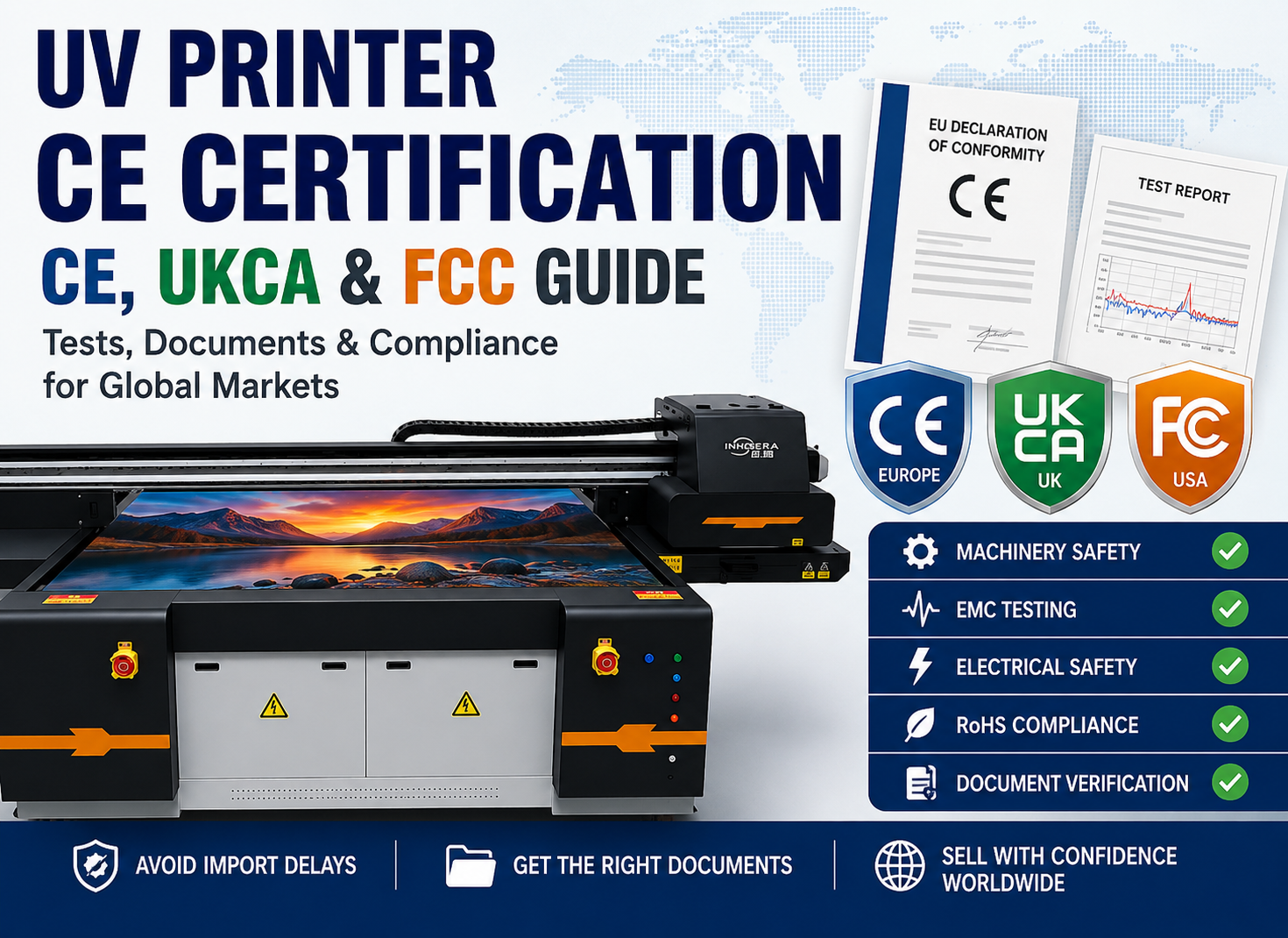
If you are also evaluating machine compliance before purchasing printing equipment for Europe or other overseas markets, read our UV printer CE, UKCA and FCC certification guide.
Who Is Affected?
The regulation matters to a wide range of businesses involved in packaging placed on the EU market, including packaging manufacturers, product manufacturers, importers, distributors, suppliers and other economic operators.
For a packaging printer, even when the printer is not legally responsible for every PPWR obligation, customers may increasingly request information about materials, inks, coatings, labels, recyclability and production traceability. This can directly affect quotation, artwork approval and production workflows.
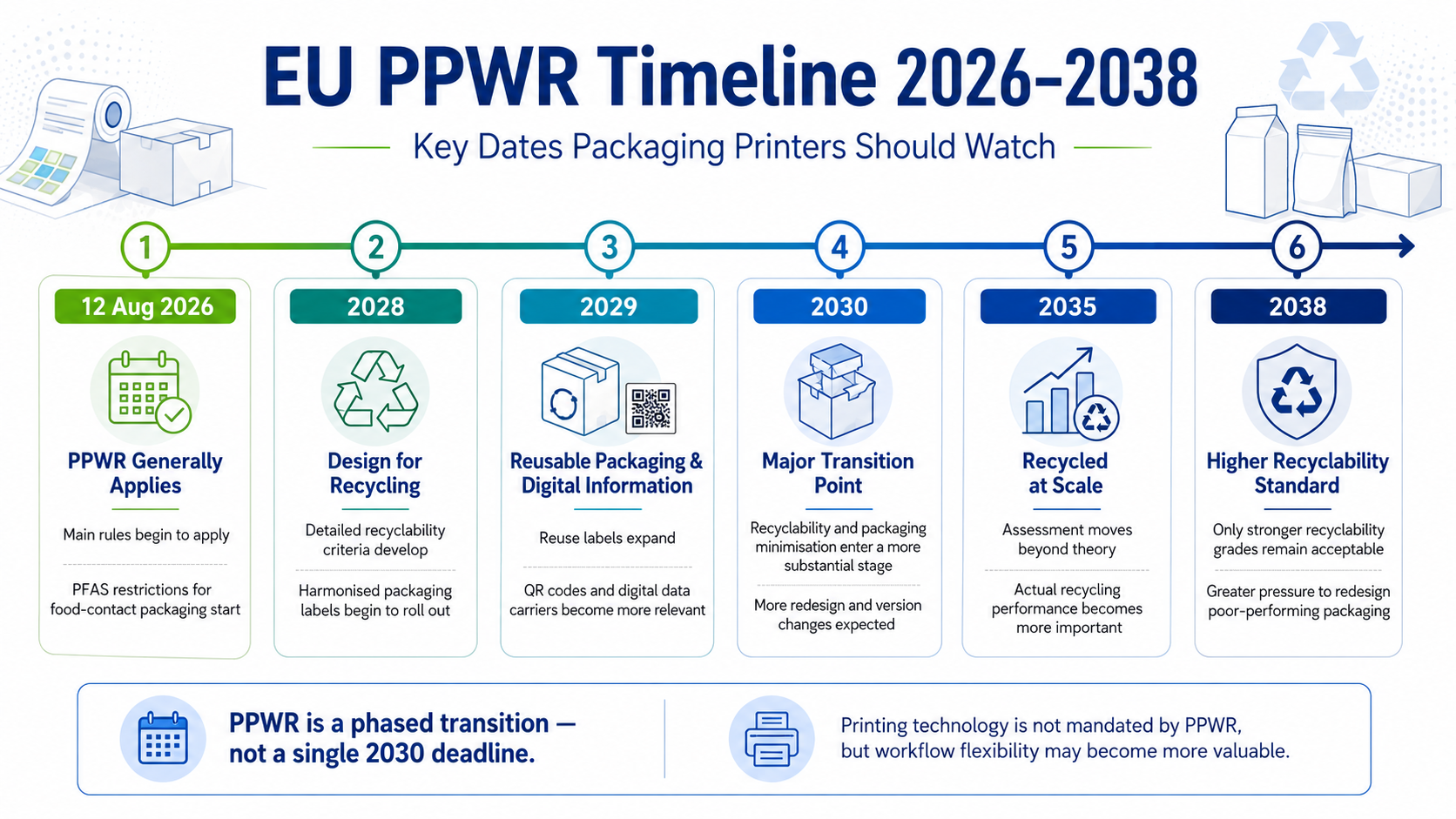
Key PPWR Dates Packaging Printers Should Watch
The transition will occur in stages. Packaging businesses should avoid treating “2030” as the only deadline.
| Date | PPWR Development | Why Packaging Printers Should Care |
|---|---|---|
| 12 August 2026 | PPWR generally applies; restrictions on PFAS in food-contact packaging also begin to apply subject to the regulation’s conditions and thresholds. | Material and chemical documentation becomes increasingly important. |
| By 1 January 2028 | Commission is to establish design-for-recycling criteria and recyclability performance grades through delegated acts. | Printed packaging structures may need to be reviewed against more detailed recyclability criteria. |
| From 12 August 2028 or later statutory trigger | Harmonised material-composition labelling requirements begin according to the timing mechanism in Article 12. | Artwork and packaging version management may change. |
| From 12 February 2029 or later statutory trigger | Reusable packaging labelling and digital information requirements begin according to the Article 12 timing mechanism. | QR codes and digital data carriers may become more important for reuse systems. |
| 2030 | Major recyclability, packaging minimisation, recycled-content and other requirements enter more substantial implementation stages. | More packaging redesign, testing and version changes may be required. |
| 2035 | Recyclability assessment moves further toward recycled-at-scale performance. | Theoretical recyclability alone becomes less important than actual recycling performance. |
| 2038 | Subject to applicable provisions and exemptions, packaging placed on the market must reach recyclability Grade A or B. | Poorly recyclable designs face greater pressure to be redesigned or replaced. |
These dates should be treated as planning milestones rather than isolated deadlines. Some PPWR provisions use wording such as “whichever is later,” meaning the effective date can depend on when a relevant delegated or implementing act enters into force.
Before changing artwork or purchasing production equipment solely because of a PPWR deadline, companies should check the latest European Commission guidance and the legal text applicable to their packaging category.
Requirement #1: Design Packaging for Recycling
What Does “Design for Recycling” Mean?
One of the central PPWR principles is that packaging should be recyclable. From the 2030 stage, recyclability will increasingly be assessed using harmonised design-for-recycling criteria and performance grades.
This means packaging companies should move away from asking only:
“Is this substrate recyclable?”
A more useful question is:
“Can this complete packaging construction be collected, sorted and recycled in the intended recycling stream without creating significant problems?”
Printing Is Only One Part of the Packaging Structure
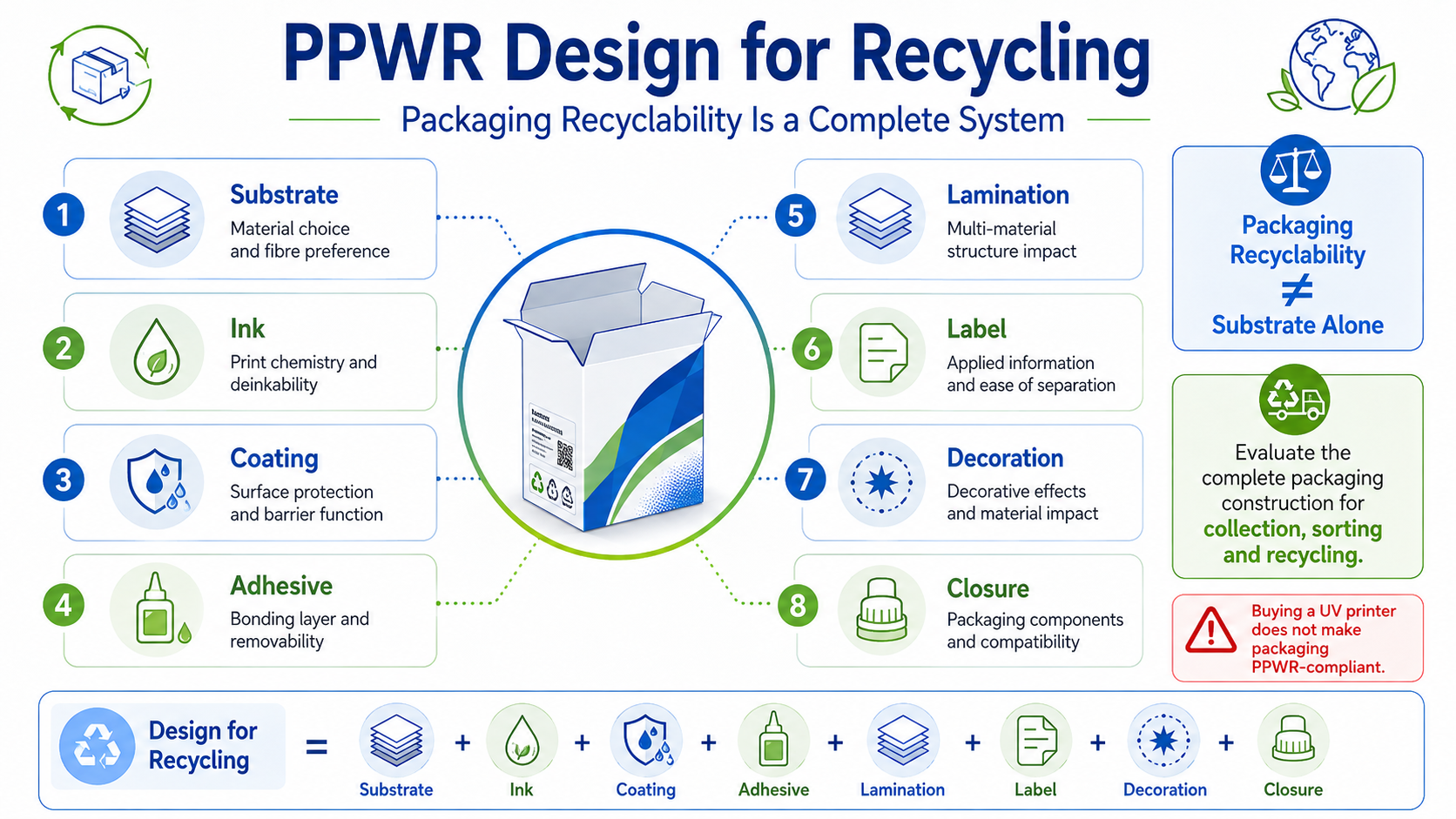
Printing affects packaging, but it is only one element of the complete construction. Recyclability decisions may involve multiple interacting components.
Packaging Recyclability ≠ Substrate Alone
Consider the substrate, ink, coating, adhesive, lamination, labels, decorations, closures and other components together.
Substrato
Paper, corrugated board, PET, PP, PE and other packaging materials enter different collection and recycling streams. A material that is recyclable in theory may still face limitations depending on packaging construction and local recycling infrastructure.
Tinta
Ink chemistry, coverage and interaction with the recycling process may need to be considered. Buyers should request appropriate technical documentation from ink suppliers instead of relying only on marketing terms such as “green ink” or “eco ink.”
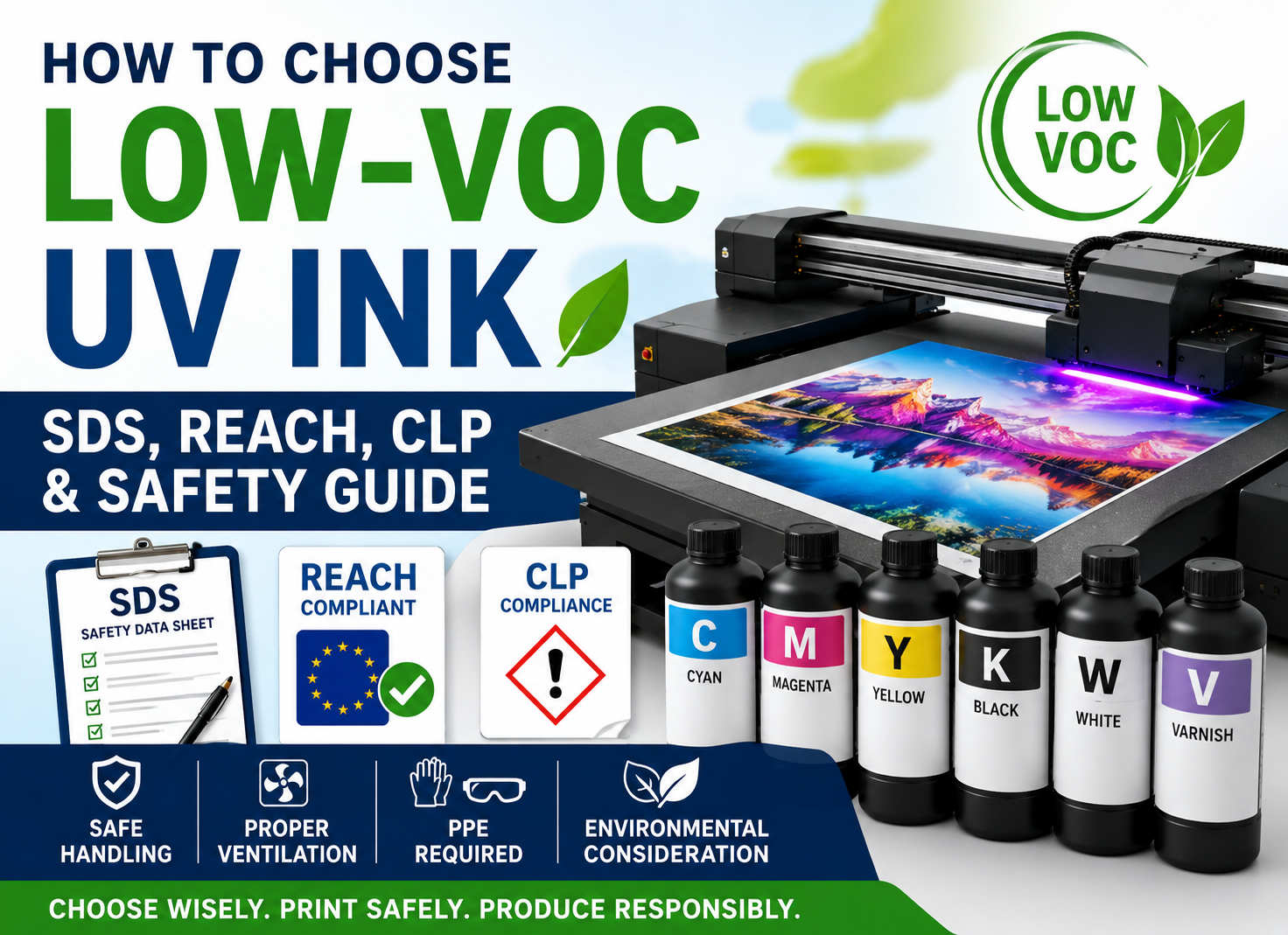
For more information about ink selection and environmental considerations, read our guide to choosing low-VOC UV inks.
Coating
Protective coatings, varnishes and decorative layers can change surface properties and may affect the overall recycling assessment. A UV varnish should therefore be evaluated as part of the finished packaging, not in isolation.
Adesivo
Labels, tapes and bonded structures introduce adhesives that can influence separation, washing or recycling processes.
Lamination
Multilayer and multi-material packaging may be more difficult to separate and recycle than simpler structures. Packaging redesign may therefore focus on reducing unnecessary complexity.
Important: Buying a UV printer does not make packaging PPWR-compliant. Compliance must be assessed for the complete packaging structure and the applicable recycling system.
Requirement #2: Reduce Unnecessary Packaging
Packaging Minimisation
PPWR also addresses unnecessary packaging rather than focusing only on recycling. By the 2030 stage, packaging placed on the market must increasingly be designed so that weight and volume are reduced to the minimum necessary to maintain functionality.
For grouped packaging, transport packaging and e-commerce packaging, the regulation introduces a maximum empty-space ratio of 50%, subject to the applicable timing mechanism and methodology.
This does not mean digital printing itself reduces packaging volume. The connection is indirect but commercially important.
Why Short-Run Digital Production May Help
Packaging redesign often creates new artwork, dimensions, labels and SKU versions. Conventional production can be highly efficient when designs are stable and quantities are large, but repeated plate or screen preparation can be less attractive when packaging changes frequently.
Digital production can make it easier to:
- test redesigned packaging in small quantities;
- produce pilot batches before full-scale conversion;
- respond quickly to artwork changes;
- reduce minimum order quantities for specific SKUs;
- produce market-specific versions without making a new plate for every design.
Lower Obsolete Packaging Inventory
Consider a brand that orders 20,000 printed cartons at one time. If the recycling label, language, product formula, legal text or packaging structure later changes, thousands of unused cartons may become obsolete.
Short-run digital packaging printing can support smaller replenishment batches. Instead of committing to a very large quantity, a company may produce 5,000, 1,000 or several hundred units depending on production economics.
This does not guarantee lower environmental impact in every case, but it may help reduce the business risk and material waste associated with obsolete printed inventory.
Requirement #3: Harmonised Labels and Digital Information
For packaging printers, Article 12 is one of the most relevant areas of PPWR because it introduces harmonised labelling and provides for digital information in several circumstances.
Harmonised Packaging Labels
PPWR provides for harmonised labels containing material-composition information to help consumers sort packaging correctly. The relevant labels must follow the formats established through EU implementing measures and are subject to the regulation’s phased application dates.
Under the PPWR provisions on packaging labels and digital data carriers, relevant labels and QR codes or other standardised open digital data carriers can be affixed, printed or engraved visibly and legibly on packaging.
For printers, this creates an important operational question: how efficiently can a production line handle future artwork and information changes?
QR Codes and Digital Data Carriers
PPWR does not mean that every package must contain a QR code. However, QR codes and other standardised open digital data carriers appear in several provisions, particularly where additional information cannot or does not need to be shown directly in conventional printed text.
Digital data carriers can potentially connect physical packaging with information about:
- material composition;
- sorting instructions;
- recycled or bio-based content where applicable;
- reusability;
- collection points;
- reuse systems;
- tracking information.
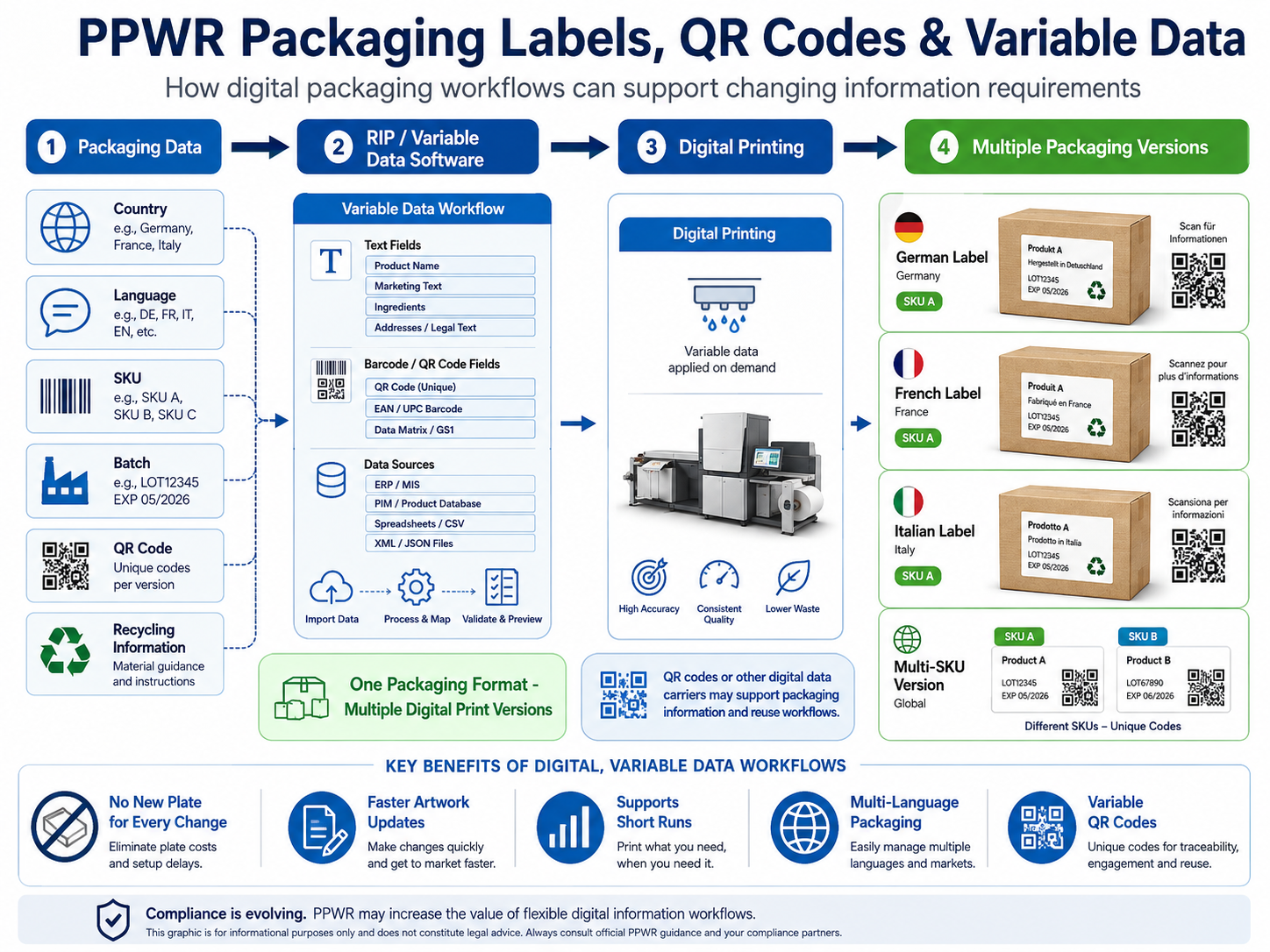
Impressão de Dados Variáveis
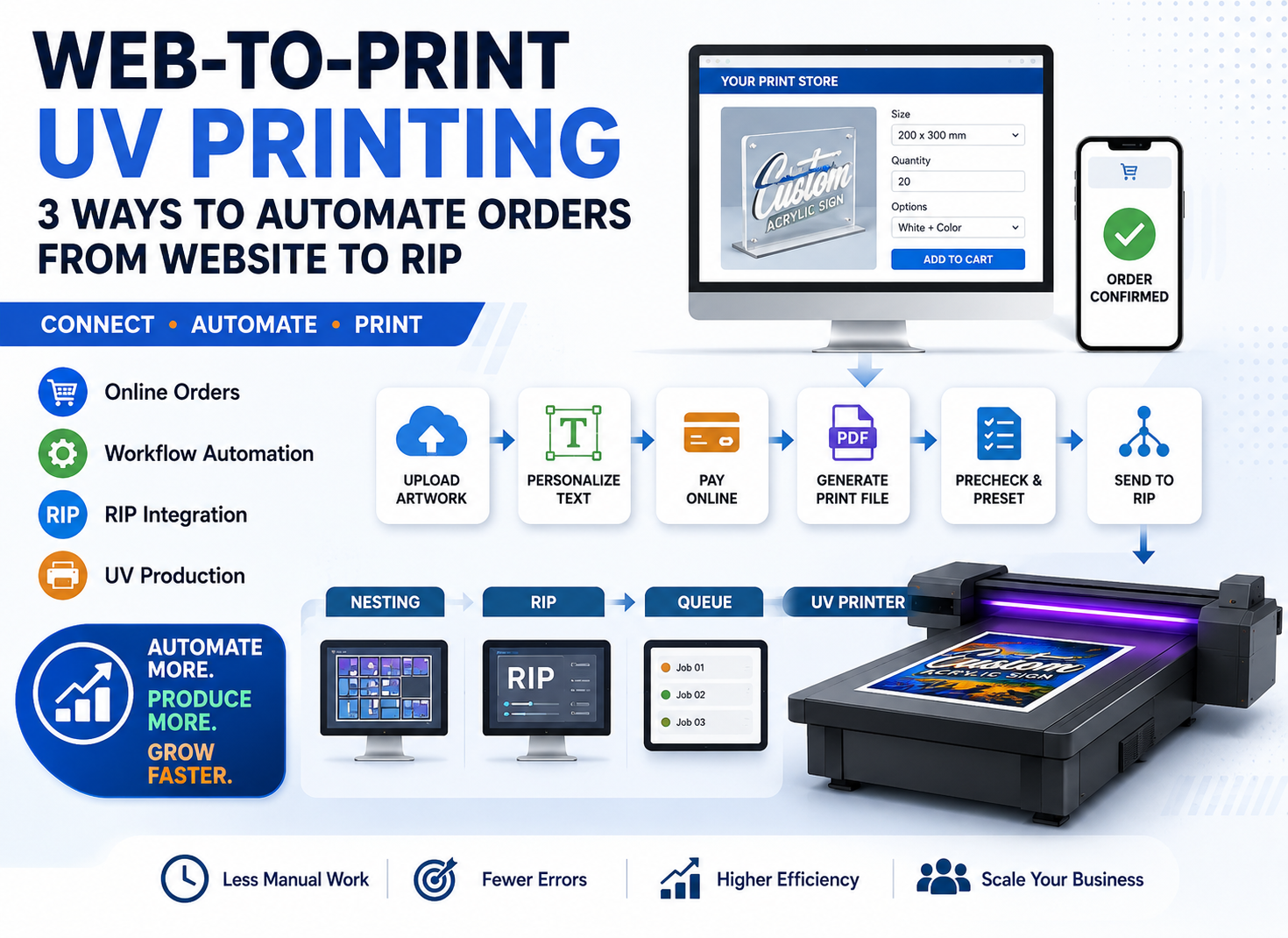
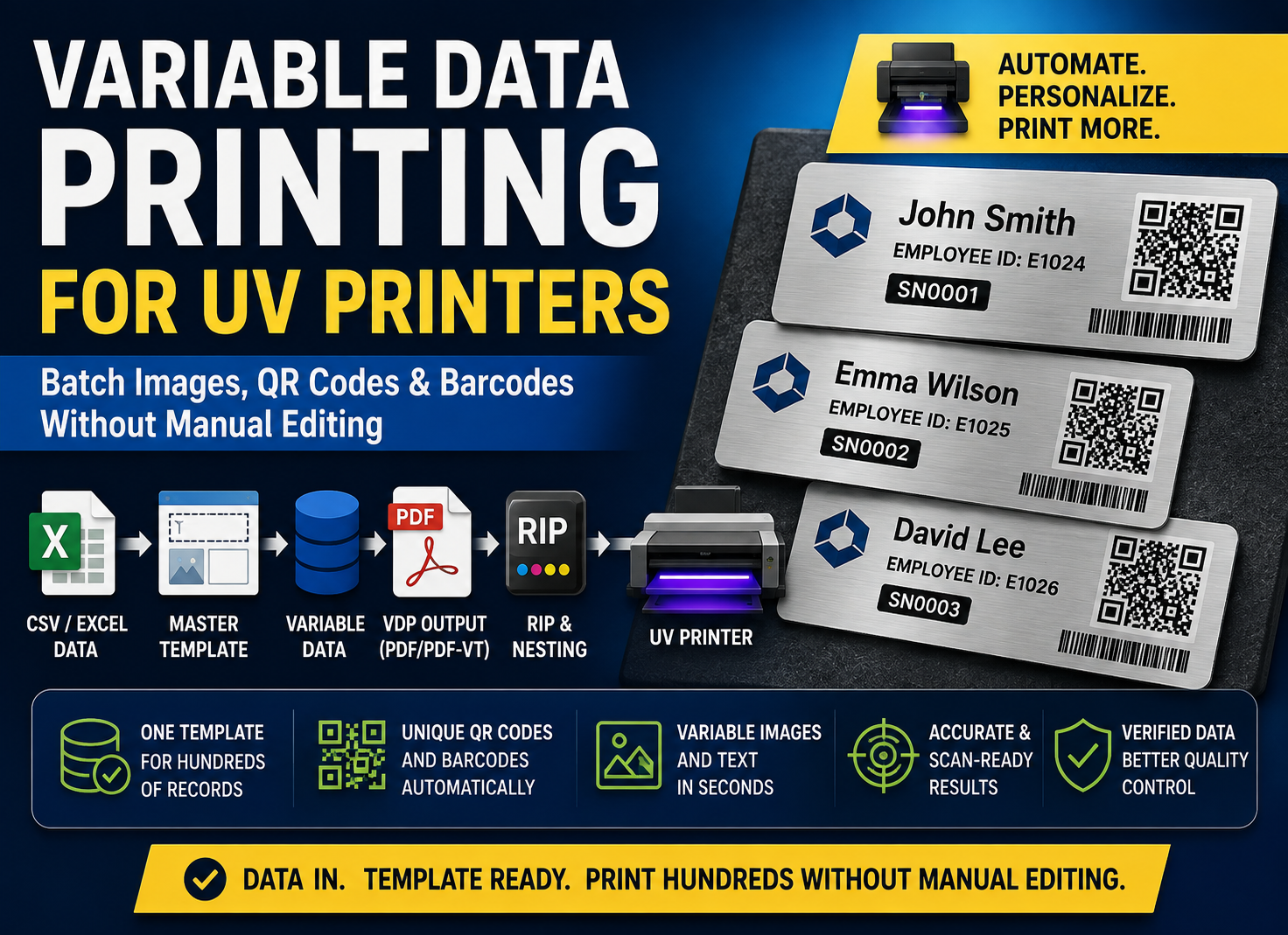
This is where PPWR digital printing may become especially relevant. A variable-data printing workflow can change information from one print job—or even one item—to another without producing a new printing plate.
Country
A packaging company serving several EU markets may need different market information or artwork versions.
Language
Packaging information may need to be understandable to users in the Member State where the packaging is made available. Managing multiple language versions efficiently can therefore become more important.
SKU
Different colours, flavours, sizes or product variants can share a packaging structure while carrying different printed information.
Batch
Where a manufacturer’s workflow requires batch-specific codes, serialisation or internal traceability data, digital printing can reduce manual version changes.
Recycling Information
Artwork can be adapted to material composition, recycling instructions or other packaging-specific information when required by the applicable rules.
In the right workflow, one packaging format can therefore support many print versions without creating a separate plate or screen for every change.
Requirement #4: Reusable Packaging and Traceability
Tracking Reuse Cycles
Reusable packaging is another important PPWR area. Reusable packaging must meet specific design and system requirements, and the regulation introduces labelling and digital-information provisions to help users identify reusable packaging and access information about reuse systems.
For reusable packaging subject to the relevant Article 12 requirements, further information can be provided through a QR code or another standardised open digital data carrier. This can include information about collection points and can facilitate tracking of trips and rotations.
Variable QR Codes
Digital printing can support variable or unique QR codes where a company’s reuse or traceability system requires them.
For example:
- Container 000001 → QR Code A
- Container 000002 → QR Code B
- Container 000003 → QR Code C
This should not be interpreted as a PPWR requirement for every reusable package to carry a unique serial number. The advantage is that digital production can support item-level identification when the operator’s tracking system needs it.
Durable Direct Printing
Some rigid reusable transport products—such as plastic crates, logistics containers, panels and reusable boxes—may be suitable for direct UV printing.
Potential applications include:
- company identification;
- handling instructions;
- QR codes;
- serial numbers;
- warehouse information;
- reuse-system markings.
However, durability should be tested under real reuse conditions. Adhesion, abrasion resistance, cleaning chemicals, washing cycles, outdoor exposure and substrate treatment can all affect print life.
PFAS and Food-Contact Packaging
A newer and particularly important PPWR requirement concerns per- and polyfluoroalkyl substances (PFAS) in food-contact packaging. De 12 August 2026, food-contact packaging containing PFAS at or above specified concentration limits cannot be placed on the market, subject to the conditions in the regulation and other applicable EU law.
Why Ink and Coating Chemistry Matter
This is another reason packaging compliance should never be reduced to substrate selection. Ink, coatings, adhesives and other chemical components may form part of the finished packaging system.
Packaging printers should maintain appropriate supplier documentation and understand the intended use limitations of consumables.
Food Contact Requires Additional Verification
PPWR is not the complete EU legal framework for food-contact materials. Packaging intended for food use may be subject to additional European and national requirements concerning materials, migration, manufacturing practices and chemical safety.
A packaging printer should therefore avoid making a general claim that a print is “food-safe” simply because the ink is UV cured.
Never Assume a Standard UV Ink Is Food-Safe
Food-contact warning: A standard UV ink should never be assumed to be suitable for direct food-contact applications unless the complete ink system, application conditions and final packaging construction have been specifically assessed for that use.
If food packaging is part of your business, request relevant declarations, technical data and testing information from material and ink suppliers before production.
Where UV Digital Printing Could Create New Opportunities
The strongest commercial connection between PPWR and UV printing for packaging is flexibility—not a claim that UV printing itself is environmentally superior.
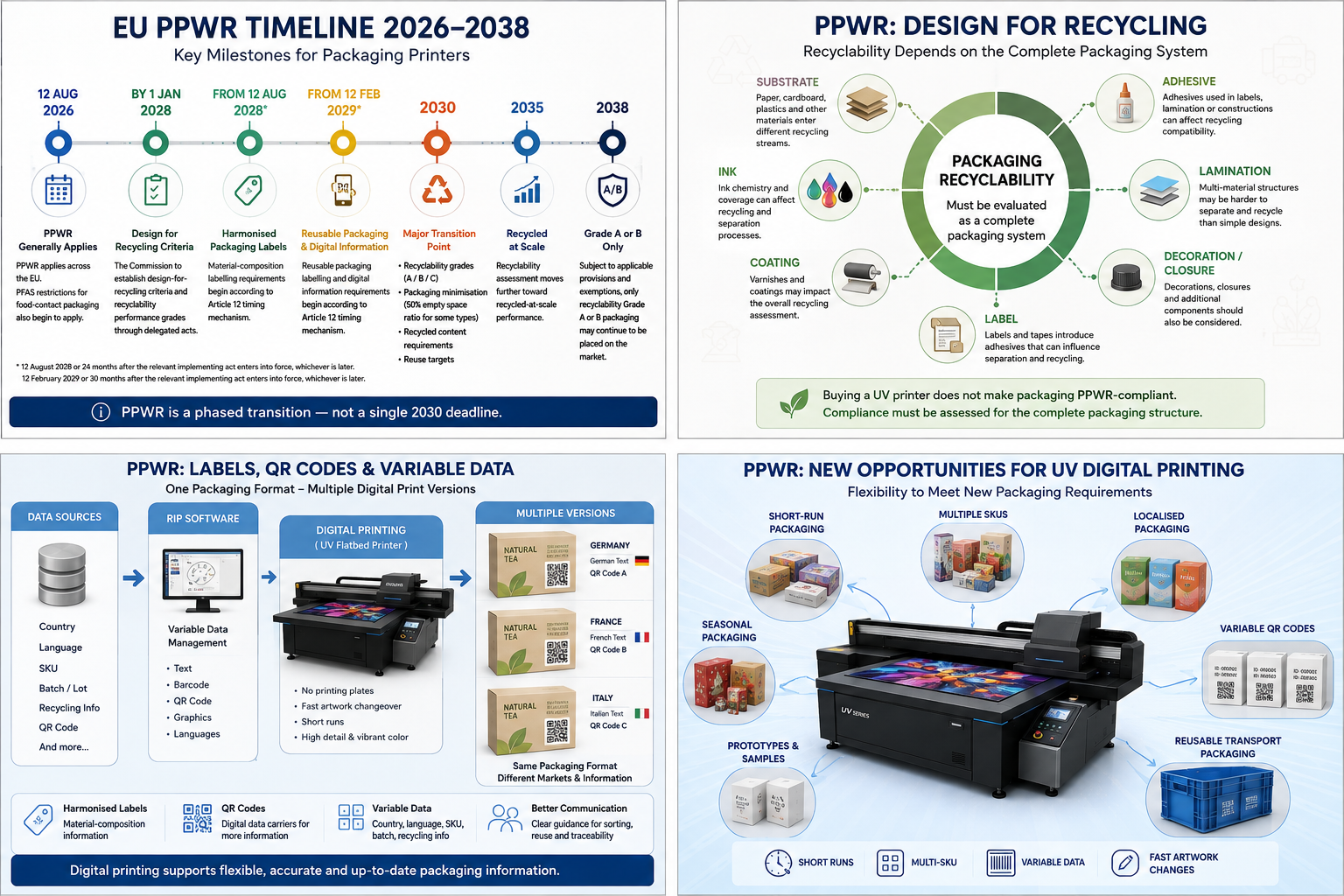
Embalagem de Curto Prazo
When regulations, labels or packaging structures change more frequently, shorter runs can reduce the commercial risk of holding large quantities of pre-printed packaging.
Multiple SKUs
Digital printing allows one production workflow to handle many product versions with less setup between designs.
Localised Packaging
Brands selling in Germany, France, Spain, Italy and other markets may need different languages, campaigns or regulatory information. Digital files can be changed without producing a new physical plate for every market version.
Variable QR Codes
UV digital systems combined with appropriate RIP and variable-data software can print changing QR codes, numbers, text or graphics. This can support traceability and digital-information workflows where required.
Prototypes and Samples
Before converting a large packaging line, companies may need several prototype versions to test colour, dimensions, label placement, QR readability or consumer communication.
Seasonal Packaging
Christmas, promotional campaigns, limited editions and regional events frequently require short-lived designs. Digital printing can produce these versions without committing to very large inventories.
Reusable Transport Packaging
Rigid logistics packaging can create opportunities for direct printing of identification, handling instructions and digital data carriers where the substrate and durability requirements are suitable.
The opportunity comes from flexibility—not from claiming that UV printing itself makes packaging sustainable.
UV Digital vs Screen, Flexo and Offset Printing Under the New Packaging Environment
No printing technology is universally best. The correct process depends on volume, substrate, design complexity, required speed, variable-data needs and cost structure.
| Fator | UV Digital Printing | Serigrafia | Flexographic Printing | Impressão Offset |
|---|---|---|---|---|
| Corridas curtas | Excelente | Moderado | Less efficient for very short runs | Moderado |
| Long Runs | Application-dependent | Bom | Excelente | Excelente |
| Plate / Screen Setup | No conventional plate | Screen required | Plate required | Plate required |
| Multiple SKUs | Excelente | Moderado | Moderado | Moderado |
| Dados Variáveis | Excelente | Limitado | Limited in conventional workflow | Limited in conventional workflow |
| Personalisation | Excelente | Limitado | Limitado | Limitado |
| Rigid Direct Printing | Strong for suitable substrates | Strong | Application-dependent | Limitado |
| Very High-Volume Packaging | Application-dependent | Application-dependent | Strong | Strong |
| Fast Artwork Changes | Strong | Moderado | Moderado | Moderado |
For a million identical packages, flexo or offset may remain more economical. For hundreds or thousands of frequently changing packages, digital printing may offer a stronger operational advantage.
The correct strategy is therefore not “replace every conventional press with UV digital.” It is to identify the jobs where digital flexibility produces measurable value.
Do Not Make Unsupported Sustainability Claims
PPWR also makes environmental claims an important compliance issue. Packaging businesses should be careful when using words such as “sustainable,” “eco-friendly,” “green” or “100% recyclable.”
Under PPWR, environmental claims concerning packaging properties for which the regulation establishes legal requirements are subject to specific conditions and must be supported by technical documentation.
Packaging printers and equipment suppliers should therefore avoid statements such as:
- “UV printing automatically makes packaging sustainable.”
- “This package is PPWR-compliant because it is digitally printed.”
- “UV ink guarantees recyclable packaging.”
- “100% eco-friendly” without appropriate evidence and scope.
More defensible statements focus on measurable production characteristics:
- “Digital production can reduce plate-making requirements for short runs.”
- “Variable-data printing supports multiple packaging versions in one workflow.”
- “Smaller print batches may help reduce obsolete packaging inventory.”
- “The final packaging construction should be assessed against the applicable recyclability criteria.”
This distinction protects credibility and prevents sustainability marketing from becoming stronger than the available evidence.
What Packaging Printers Should Prepare Before 2030
Review Substrates
Create a material database covering the main paper, board, plastic and rigid substrates used in production. Record supplier, grade, thickness, intended recycling stream, surface treatment and known application limitations.
Review Ink Documentation
Ask ink and consumable suppliers for relevant documentation such as safety data sheets, technical data, regulatory declarations and intended-use limitations. Where food-contact packaging is involved, request application-specific information rather than relying on a generic “safe” statement.
Test Recycling Compatibility
Do not ask only, “Is this ink environmentally friendly?” A more useful question is whether the complete printed packaging construction has been evaluated for the intended recycling stream and relevant design-for-recycling criteria.
Build Variable Data Capability
Packaging companies should increasingly understand workflows such as:
Database / CSV → Variable Text → Barcode / QR Code → RIP → Printer → Verification
The printer is only one component. Software, data management, barcode validation and quality control are equally important.
Improve Traceability
A practical production record can include:
- artwork version;
- customer and SKU;
- substrate supplier and batch;
- ink batch;
- coating or primer used;
- print date;
- RIP file version;
- QR or variable-data source;
- relevant compliance documents.
Better traceability makes future artwork changes, customer audits and material investigations easier to manage.
Frequently Asked Questions About PPWR and UV Printing
What is the EU PPWR?
PPWR is Regulation (EU) 2025/40 on packaging and packaging waste. It introduces EU-wide requirements covering packaging sustainability, recyclability, minimisation, labelling, recycled content, reuse and packaging waste management.
When did the PPWR start applying?
The regulation entered into force on 11 February 2025 and generally applies from 12 August 2026. Many individual provisions have later application dates or depend on delegated and implementing acts.
Does PPWR require digital printing?
No. PPWR does not require packaging manufacturers to use UV digital printing, flexographic printing, offset printing, screen printing or another specific print process. Printing technology should be selected according to application, compliance requirements, productivity and economics.
Does PPWR require QR codes on every package?
No. PPWR includes QR codes and other standardised open digital data carriers in specific information and reuse-related provisions, but it should not be interpreted as requiring a QR code on every package in every situation.
Does PPWR require all packaging to be recyclable by 2030?
Recyclability is a central PPWR requirement. From the applicable 2030 stage, packaging must meet the relevant design-for-recycling performance requirements, subject to the detailed timing rules, delegated acts and exemptions. From the applicable 2035 stage, recycled-at-scale performance becomes an additional part of the assessment, and from 2038 the regulation further tightens the permitted recyclability grades.
Can UV printing be used on recyclable packaging?
Potentially, yes. However, recyclability should be evaluated for the complete packaging construction, including substrate, ink, coatings, adhesives, lamination and other components. The printing process alone cannot determine PPWR compliance.
Is UV ink compliant with PPWR?
PPWR does not provide a simple certification that makes an entire ink technology “PPWR compliant.” Ink suitability depends on composition, intended application, packaging design, relevant chemical requirements and the recycling system. Request technical documentation for the exact ink being used.
What opportunities could PPWR create for packaging printers?
The strongest opportunities may include short-run packaging, multi-SKU production, localised versions, rapid prototypes, variable QR codes, reusable packaging identification and faster artwork changes. These opportunities come from digital production flexibility rather than from a claim that digital printing itself ensures sustainability.
Conclusion: PPWR Is Changing Packaging Workflows, Not Choosing the Printing Technology
The most important lesson from EU PPWR packaging printing is that compliance cannot be solved by purchasing one machine, changing one ink or adding one recycling logo.
Packaging producers increasingly need to manage the complete system: substrate, ink, coating, labels, recyclability, packaging volume, artwork versions, reusable packaging, digital information and documentation.
For large repetitive jobs with stable artwork, conventional flexographic or offset printing may remain the most economical solution. For shorter runs, multiple SKUs, localised packaging, prototypes, variable QR codes and frequently changing artwork, UV digital printing could create valuable new production opportunities.
The best strategy is therefore to treat PPWR as a workflow challenge rather than simply an equipment requirement.
If your packaging business is preparing for new EU requirements, evaluate your materials, print volumes, SKU structure, variable-data needs and compliance workflow before choosing a printing system. Contact us to discuss your packaging application and UV digital printing requirements.
Disclaimer: This article is provided for general technical and business information and does not constitute legal advice. PPWR requirements include exemptions, transitional provisions and implementing measures that may vary by packaging category and application. Businesses should review the current legal text and obtain appropriate regulatory advice for their specific products.