

 Portuguese
  English
  Arabic
  German
  French
  Spanish
  Turkish
  Italian
  Russian
  Persian
  Bengali
  Hebrew
  Persian (Afghanistan)
  Scottish Gaelic
  Panjabi
  Croatian
  Slovenian
  Greek
Greek  Afrikaans
  Czech
Czech  Korean
  Japanese






UV LED Curing System Guide: Does Higher Power Mean Better Curing?
Ao escolher um UV LED curing system for a UV printer, many buyers focus on one specification: power. A higher wattage number may appear to mean faster curing, higher printing speed, and better print quality. However, this is not always true.
Higher UV LED power does not automatically mean better UV curing. The actual curing performance of a UV printer depends on several factors working together, including wavelength, irradiance, exposure time, printing speed, ink thickness, curing distance, cooling performance, and UV ink compatibility.
For UV flatbed printers, desktop UV printers, 6090 machines, 1390 printers, and larger industrial models, selecting the correct curing configuration is therefore more important than simply choosing the most powerful LED system available.
This guide explains how a UV printer curing system works, why wavelength and irradiance matter, how printing speed affects exposure time, and how to identify under-curing and over-curing problems. It also provides practical guidance for choosing a UV LED curing system according to different printer sizes and production requirements.
Índice
- What Is a UV LED Curing System?
- How Does UV LED Curing Work?
- Why UV LED Wavelength Matters
- UV LED Power vs. Irradiance
- Does Higher UV LED Power Mean Faster Printing?
- Why Curing Distance Matters
- Printing Speed, Exposure Time and UV Curing Dose
- How Ink Layer Thickness Affects Curing
- What Happens When UV Ink Is Under-Cured?
- Can UV Ink Be Over-Cured?
- How to Choose a UV LED Curing System
- Air-Cooled vs. Water-Cooled UV LED Systems
- How UV LED Aging Affects Printing
- Common UV LED Curing Problems
- Questions to Ask a UV Printer Manufacturer
- Higher Power vs. Better Configuration
- Perguntas frequentes
What Is a UV LED Curing System?
UM UV LED curing system is the part of a UV printer that provides ultraviolet light to cure UV-sensitive ink after the ink is deposited onto the printing surface. Unlike conventional thermal drying, UV ink curing is primarily a photochemical process.
A typical UV printer curing system may include a UV LED array, LED driver, optical components, cooling components, control electronics, and a mechanical mounting structure. On many printers, the UV LED module travels together with the printhead carriage so that the freshly deposited ink can be exposed during the printing process.
The purpose is not simply to produce as much UV light as possible. The system must deliver the appropriate amount of UV energy to the correct area at the correct time.
A well-designed curing system should provide consistent exposure across the effective printing width while maintaining appropriate temperature and allowing the printer to operate at its intended production speed.
This is particularly important when a printer handles different materials such as acrylic, glass, wood, metal, ceramic, PVC, promotional products, and other substrates. Different materials may react differently to heat and UV exposure.
How Does UV LED Curing Work in a UV Printer?
UV printing ink contains photoinitiators that respond to ultraviolet radiation. When the freshly deposited ink receives suitable UV energy, a photochemical reaction begins and the ink changes from a liquid state toward a solid, cured film.
The simplified workflow is:
UV Ink → Ink Deposition → UV Exposure → Photochemical Reaction → Cured Ink Film
The curing result depends on both the ink formulation and the UV LED system. The same LED configuration may produce different results with different ink formulations because photoinitiator systems, pigment concentrations, ink thickness, and substrate conditions can vary.
For this reason, a UV printer manufacturer should evaluate the complete printing system rather than selecting a curing lamp based only on its electrical wattage.
The relationship between the printhead, ink delivery system, carriage movement, UV LED module, RIP software, printing mode, and substrate is important. A printer running at a high-speed production mode may require a different curing configuration from a printer optimized for high-detail, low-speed printing.
Why UV LED Wavelength Matters
One of the most important specifications of a UV curing system is UV LED wavelength. Wavelength determines which portion of the ultraviolet spectrum reaches the ink.
Common UV LED systems used in industrial applications may operate around wavelengths such as 365 nm, 385 nm, 395 nm, or 405 nm. However, there is no universal wavelength that is automatically best for every UV printer.
The correct choice depends on the UV ink formulation and its photoinitiator system. The LED wavelength and ink should therefore be considered as a matched system.
For example, increasing LED power without using a wavelength that the ink can efficiently utilize may not solve a curing problem. If the ink does not respond effectively to the available wavelength, additional electrical power may provide limited practical improvement.
When purchasing a UV printer, ask the manufacturer:
- What UV LED wavelength is used?
- Which UV ink formulation is recommended?
- Has the ink been tested at the specified wavelength?
- What printing speed was used during the curing test?
- Was the test performed with CMYK, white ink, or varnish?
For technical reference, manufacturers and printhead suppliers may provide additional information about UV inkjet technology and curing requirements.
Read more technical information about UV curing and industrial inkjet technology
UV LED Power vs. Irradiance: They Are Not the Same
One of the most common misunderstandings in UV printer purchasing is treating electrical power and UV irradiance as the same specification.
They are related, but they describe different things.
| Especificação | What It Means | Por que isso importa |
|---|---|---|
| Electrical Power | Electrical power consumed by the LED system | Indicates system power requirements |
| Optical Output | UV light produced by the LED system | Helps describe actual UV radiation output |
| Irradiance | UV power received per unit area | Important for evaluating curing intensity at the print surface |
| UV Dose | Irradiance multiplied by exposure time | Helps describe total UV energy delivered to the ink |
For UV printer applications, irradiance is often much more useful than simply knowing the total electrical wattage of the LED module.
For example, a curing system with a high electrical power rating does not automatically deliver twice the effective irradiance of another system with half the electrical power. Optical design, LED efficiency, beam distribution, lens design, distance, cooling, and system geometry all affect the result.
This is why buyers should avoid comparing UV printer curing systems based only on statements such as “500 W,” “800 W,” or “1000 W.”
Does Higher UV LED Power Mean Faster Printing?
Not necessarily.
A more powerful UV LED curing system can provide greater curing capability, but real-world printing speed depends on the complete printer configuration.
Several factors work together.
1. Printing Speed
As carriage speed increases, the amount of time that a specific area of ink is exposed to the UV LED may decrease. If the curing system cannot provide sufficient effective UV energy during this shorter exposure period, the printer may experience under-curing.
2. Pass Count
Different printing modes use different pass counts. A lower-pass production mode may deposit and cure ink differently from a higher-pass quality mode. Therefore, the same LED setting may not produce identical results across every printing mode.
3. Ink Deposition
The amount of ink deposited onto the substrate also matters. A heavier ink layer may require different curing conditions from a thin layer.
4. LED Irradiance
The actual UV intensity reaching the print surface affects how quickly the ink can receive usable curing energy.
5. Curing Distance
The distance between the UV LED and the printed surface affects the UV energy distribution. If the distance increases significantly, the effective irradiance at the substrate may decrease.
6. Ink Formulation
Different UV inks respond differently to UV radiation. A curing configuration should therefore be validated with the actual ink used for production.
The practical conclusion is simple:
Higher LED power can support higher production requirements, but it does not automatically make a UV printer twice as fast.
UV LED Curing Distance: Why the LED-to-Print Distance Matters
The distance between the UV LED module and the printing surface is another important factor in curing performance.
UV energy reaching the substrate is affected by optical geometry. When the LED is positioned farther away from the print surface, the energy distribution can change and the effective irradiance may decrease.
This becomes particularly important for flatbed UV printers because substrates may have different thicknesses and surface heights.
For example, a printer may process:
- Acrylic sheets
- Glass panels
- Wood boards
- Metal plates
- Ceramic products
- Stone surfaces
- Produtos promocionais
If the printing height changes, the distance between the UV LED and the ink may also change. A well-designed UV printer should therefore maintain appropriate printhead and curing geometry across the intended operating height range.
This is one reason why a curing system should be evaluated as part of the printer rather than as a standalone wattage specification.
Printing Speed, Exposure Time and UV Curing Dose
A useful way to understand UV curing is through the concept of UV dose.
The simplified relationship is:
UV Dose = Irradiance × Exposure Time
For example, if the effective irradiance at the print surface is 1 W/cm² and the exposure time is 1 second, the simplified dose is approximately 1 J/cm².
This does not mean that every UV ink requires the same dose. Actual curing requirements depend on the ink formulation, substrate, ink thickness, wavelength, and production conditions.
However, the relationship helps explain why increasing printing speed can create curing challenges. When exposure time becomes shorter, the printer may need greater effective irradiance or a different curing strategy to maintain the required curing result.
Therefore:
Higher printing speed + shorter exposure time = greater demand on the curing system.
But again, this does not mean that simply installing a higher-wattage LED will automatically solve every high-speed curing problem.
Ink Layer Thickness: Why White Ink Needs More Attention
Ink thickness is another major factor in UV curing.
A relatively thin CMYK ink layer may cure differently from a heavier white ink layer or a thick varnish layer. White ink can be particularly challenging because of its pigment concentration and the way light interacts with the ink layer.
When a printer uses multiple layers, white ink, or high ink density, the curing system must provide suitable exposure for the actual ink deposition.
This means a UV printer should not be evaluated only using a simple CMYK color test. If the customer plans to use white ink and varnish in commercial production, those configurations should also be included in the curing evaluation.
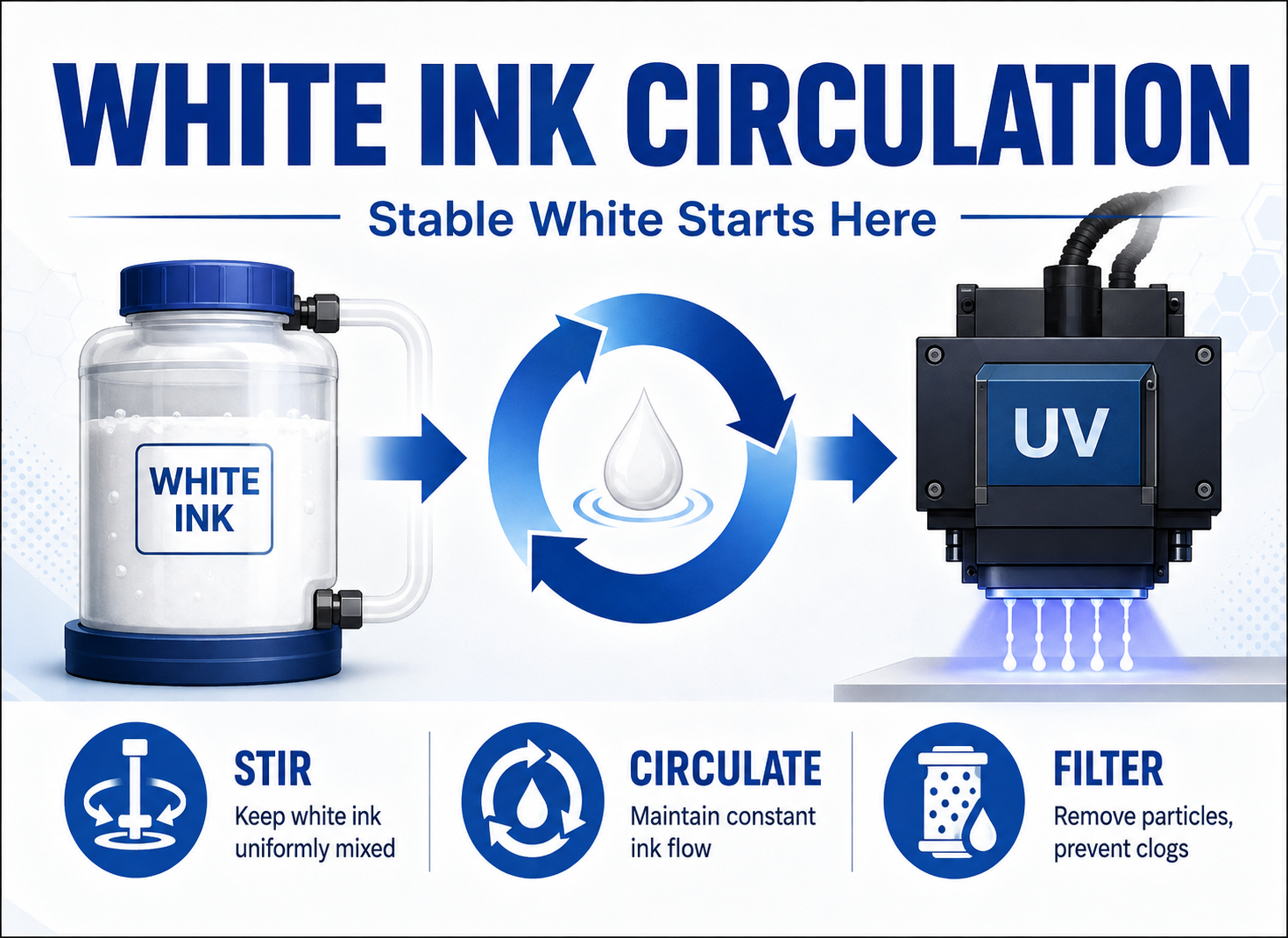
For more information about maintaining stable white ink performance, see our related guide:
UV Printer White Ink Circulation System Explained
Under-Curing: What Happens When UV Ink Is Not Fully Cured?
Under-curing occurs when the UV ink does not receive sufficient usable curing energy under the actual production conditions.
Common symptoms include:
- Sticky or tacky printed surfaces
- Poor adhesion to the substrate
- Ink that scratches easily
- Weak surface durability
- Inconsistent curing at high printing speeds
- Different curing results between white ink and CMYK
Possible causes include:
- Insufficient irradiance
- Incorrect UV wavelength
- Excessive printing speed
- Excessive ink thickness
- LED aging
- Excessive LED-to-substrate distance
- Inadequate cooling or thermal performance
- Ink and LED wavelength incompatibility
If the printed surface suddenly becomes sticky after the printer has been operating normally, do not immediately assume that the ink itself is defective. Check the complete curing system and operating conditions first.
========================================================= –>
Over-Curing: Can Too Much UV Also Cause Problems?
The opposite assumption is also incorrect: more UV exposure is not always better.
The goal of a curing system is controlled curing, not maximum UV exposure.
Excessive UV exposure or excessive thermal load may affect the printed surface or heat-sensitive materials. Depending on the ink and substrate, potential issues can include changes in surface appearance, excessive hardness, brittleness, gloss differences, or substrate deformation caused by heat accumulation.
Heat-sensitive materials require particular attention. Thin plastics, synthetic materials, and certain coated substrates may respond poorly to excessive thermal input.
This is why a professional UV printer should provide a curing configuration that balances:
- UV output
- Wavelength
- Exposure time
- Velocidade de impressão
- Ink thickness
- Substrate characteristics
- Cooling performance
The objective is not to choose the strongest LED system. The objective is to achieve stable curing at the required production speed without unnecessary thermal stress.
How to Choose a UV LED Curing System for Different UV Printers
The right curing configuration depends on the printer size, intended production speed, ink configuration, and substrate requirements.
| UV Printer Type | Main Priority | Curing Consideration |
|---|---|---|
| Desktop / A3 UV Printer | Stability and heat control | Compact LED configuration with controlled thermal performance |
| Impressora UV 6090 | Cost-production balance | Balanced irradiance, coverage and production speed |
| 1390 UV Printer | Higher productivity | Greater curing coverage and suitable carriage speed |
| 2513 UV Printer | High production throughput | High-speed curing and thermal management become more important |
| Industrial UV Printer | Continuous production | Stable UV output, cooling and long-term reliability |
For example, a small desktop UV printer does not necessarily need the same curing architecture as a large industrial flatbed printer. The larger machine may operate at higher speeds, use multiple printheads, deposit more ink, and cover a much wider area.
For larger machines, the LED coverage and carriage design can be just as important as the nominal power rating.
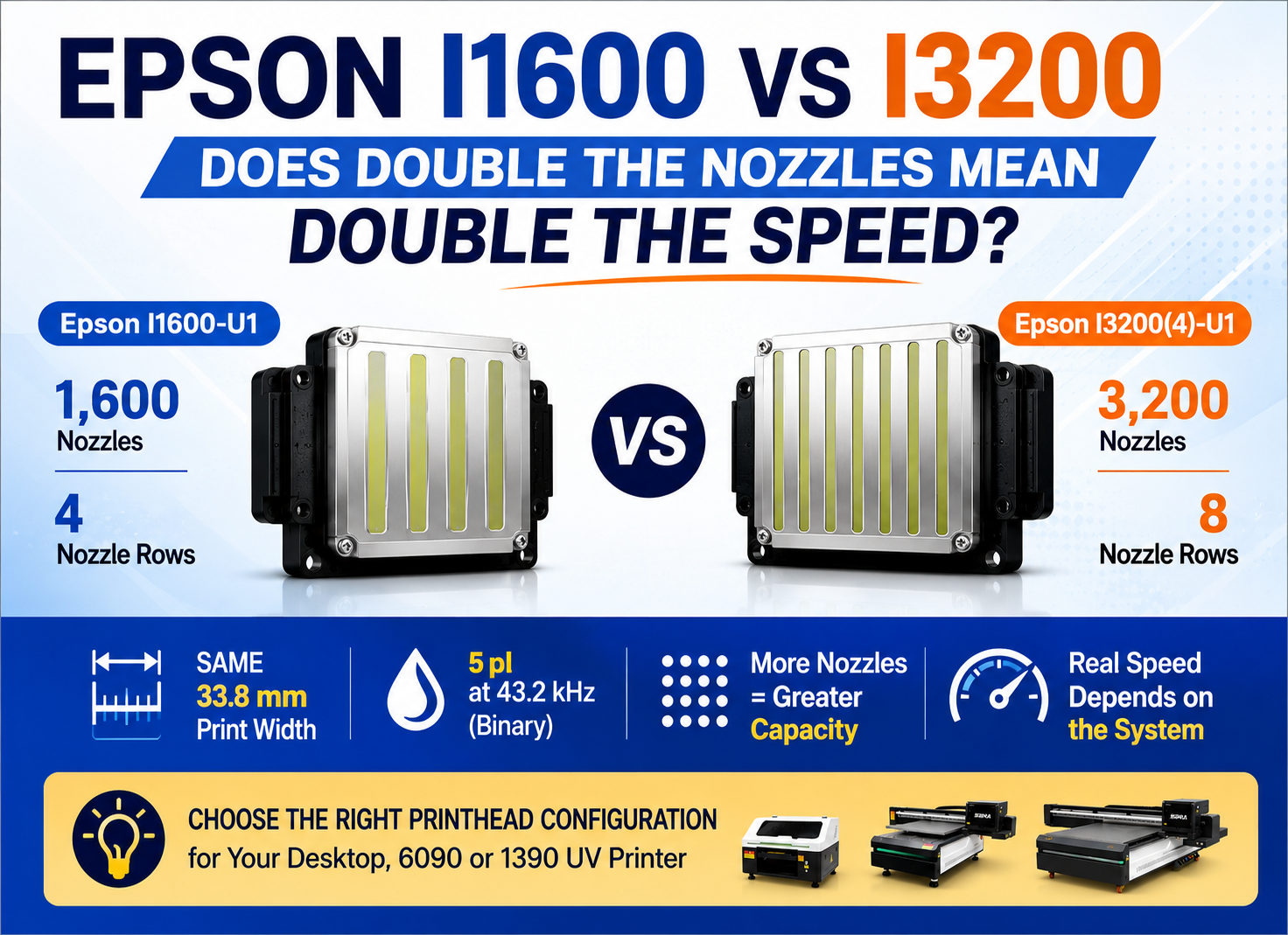
If you are comparing printer configurations, you can also review our:
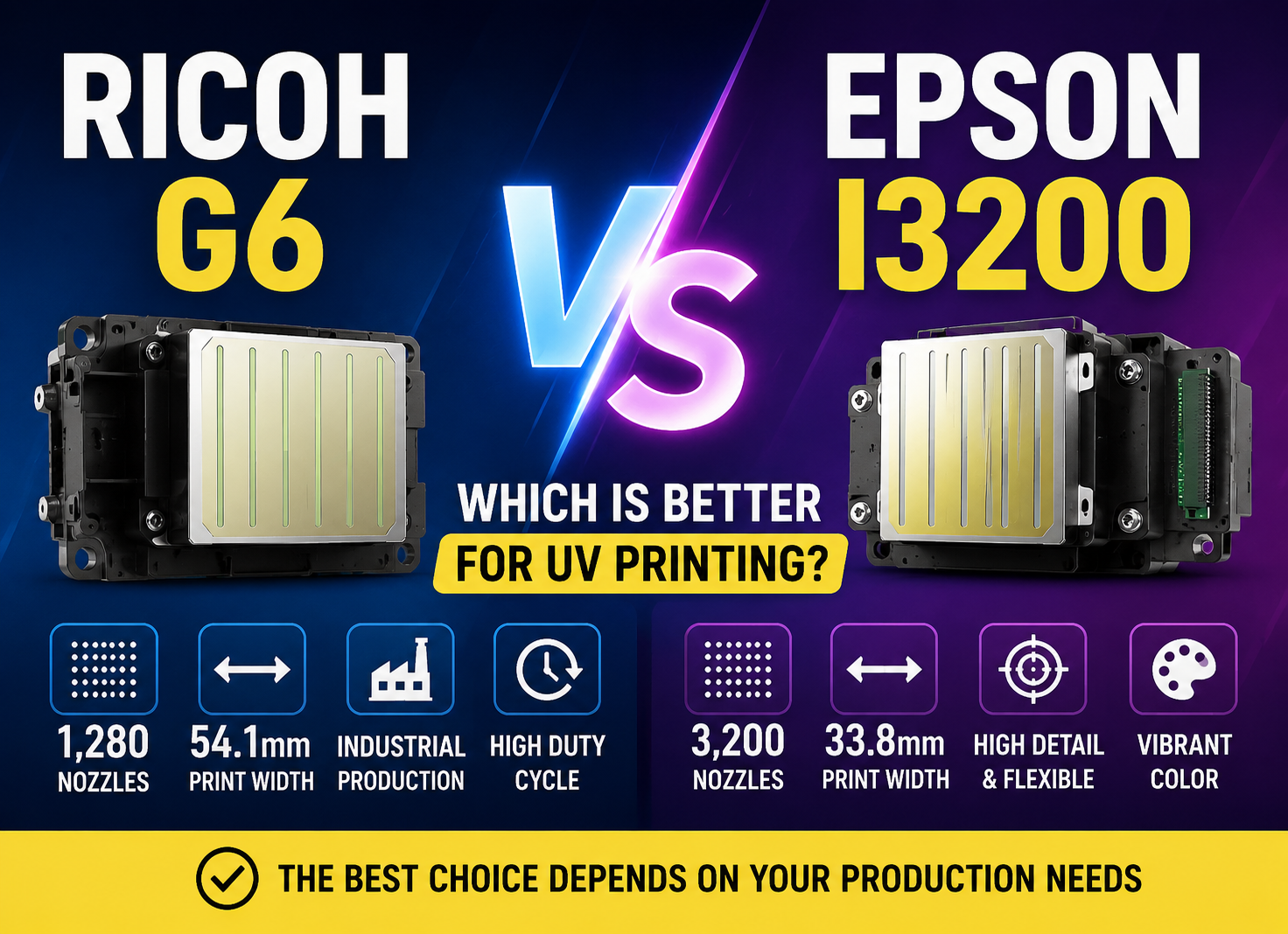
Epson I1600 vs I3200 UV printhead comparison
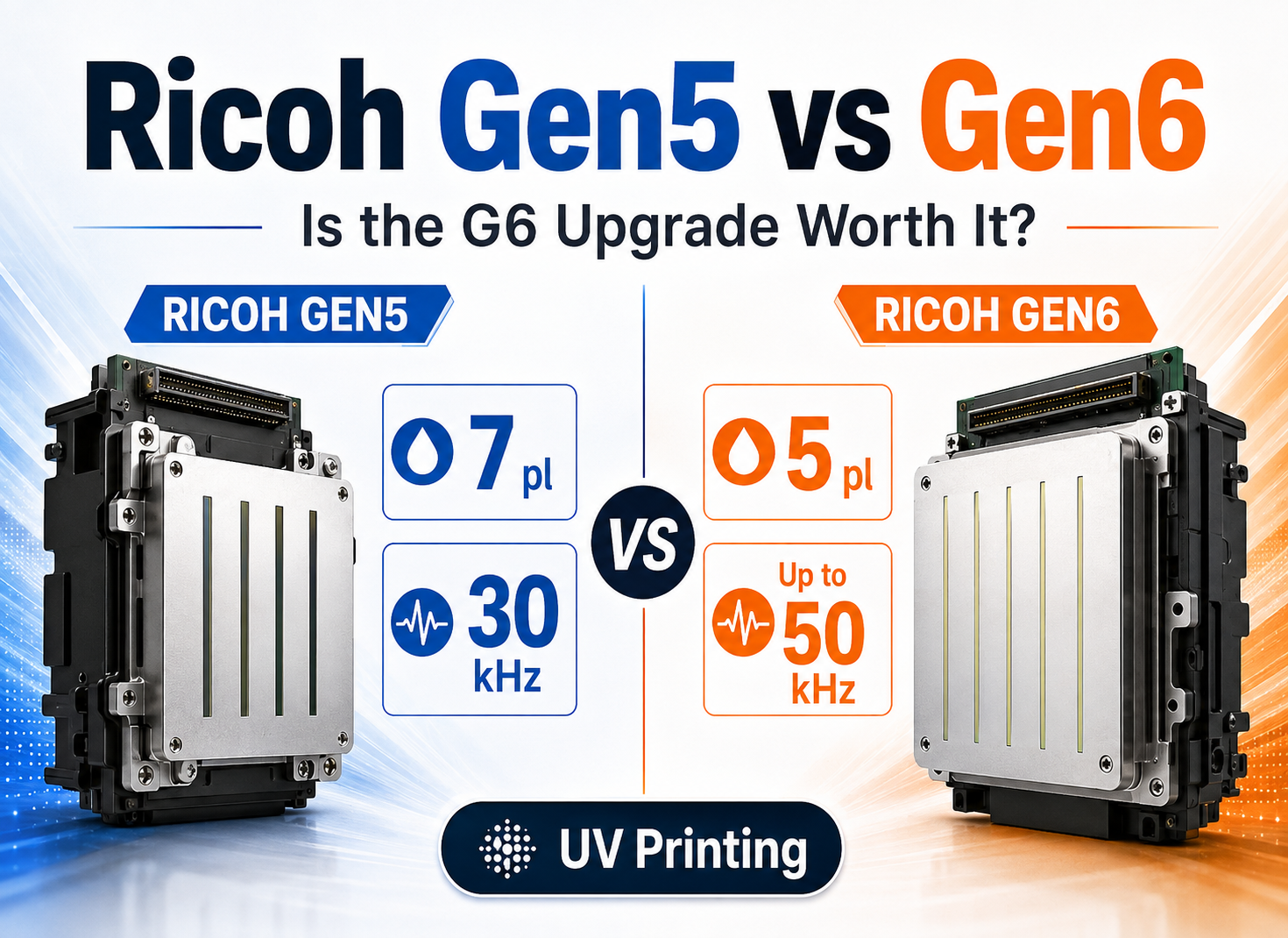
and:
Ricoh Gen5 vs Gen6 UV printhead comparison
Air-Cooled vs. Water-Cooled UV LED Systems
Cooling is an important part of a UV LED curing system because LED performance and long-term stability are affected by temperature.
Air-Cooled UV LED Systems
Air-cooled systems use fans and airflow to remove heat from the LED module. They generally have a simpler structure and can be suitable for desktop and smaller-format UV printers with moderate production requirements.
Advantages may include:
- Simple system structure
- Easy maintenance
- Lower system complexity
- Suitable for moderate-duty applications
Water-Cooled UV LED Systems
Water-cooled systems use a liquid cooling circuit to remove heat from the LED module. They may be suitable for applications where the LED system operates at a higher continuous output or where more controlled thermal management is required.
Potential advantages include:
- Improved thermal management
- Stable operating temperature
- Suitable for higher continuous output
- Better suited to demanding industrial applications
The correct choice depends on the actual LED output, operating time, printer structure, and manufacturer design. Water cooling is not automatically better for every UV printer, just as air cooling is not automatically sufficient for every industrial application.
How UV LED Aging Affects Printing Stability
UV LED systems can change over their service life. As the system ages, UV output and thermal characteristics may change depending on LED quality, operating temperature, cooling performance, and usage conditions.
One possible symptom is a printer that initially produced well-cured prints but later begins to show surface tackiness or reduced curing performance under the same printing conditions.
When this happens, check:
- UV LED output
- LED cooling performance
- LED-to-print distance
- LED surface condition
- Ink condition
- Velocidade de impressão
- Ink thickness
Regular maintenance and appropriate thermal management can help maintain more consistent curing performance over the operating life of the printer.
5 Common UV LED Curing Problems and Solutions
| Problem | Possible Cause | Recommended Check |
|---|---|---|
| Sticky printed surface | Under-curing | Check irradiance, wavelength, exposure time and printing speed |
| Poor ink adhesion | Ink/substrate or wavelength mismatch | Verify ink compatibility and curing conditions |
| Uneven curing | Uneven UV exposure | Check LED alignment, optical coverage and curing distance |
| Material deformation | Excessive thermal load | Check LED power, cooling and exposure conditions |
| Curing failure at high speed | Exposure time too short | Optimize printing speed and effective irradiance |
If the printer also shows banding, missing nozzles, or unstable ink delivery, the curing system may not be the only cause. Ink delivery and printhead performance should be checked separately.
For additional troubleshooting information, see our:
UV Printer Banding and Missing-Nozzle Troubleshooting Guide
For more information about ink pressure and stable ink delivery, see:
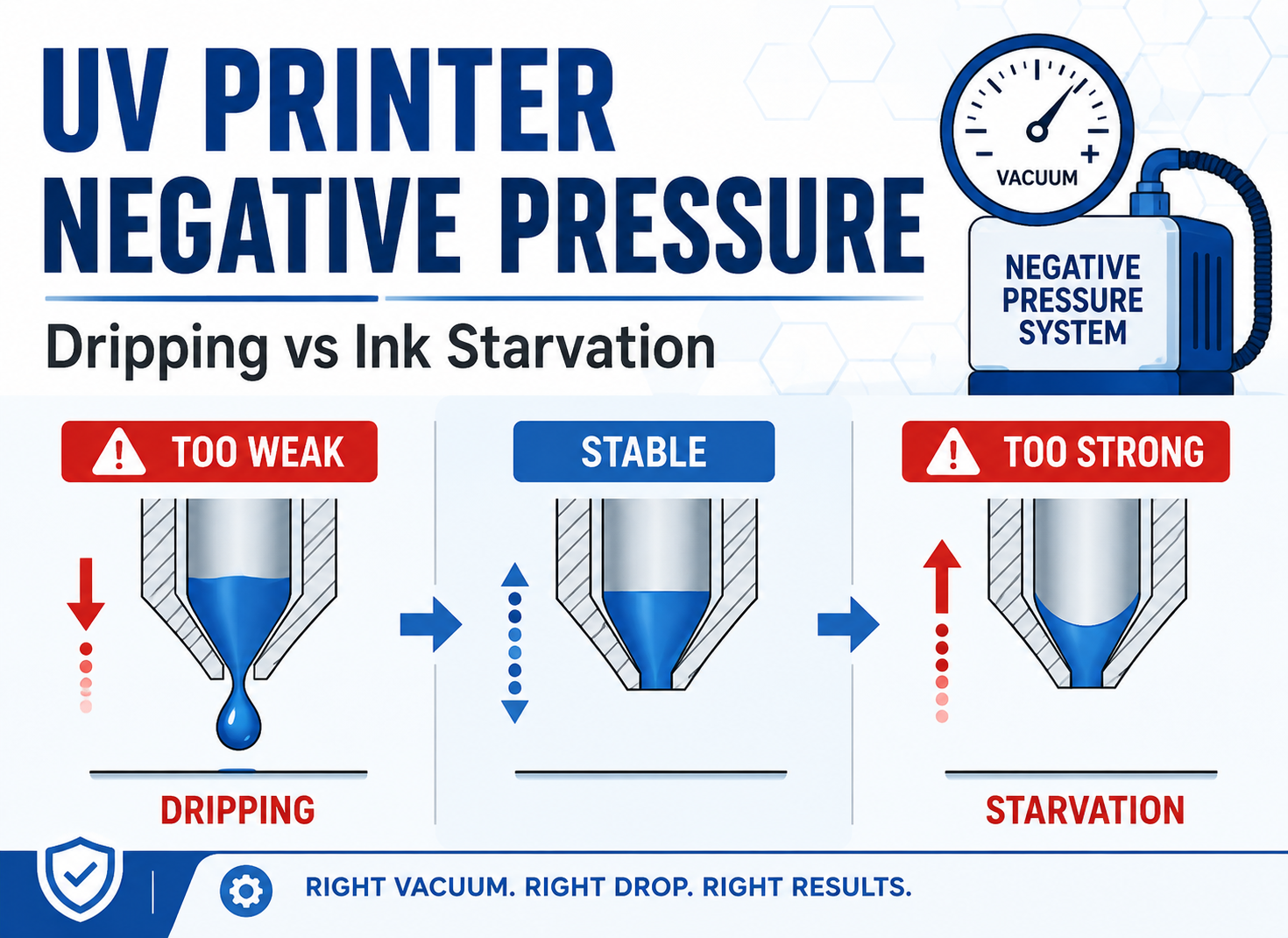
UV Printer Negative Pressure System Explained
What Should You Ask a UV Printer Manufacturer?
When comparing UV printers, do not ask only:
“How many watts is the UV LED?”
Instead, ask the manufacturer for information about the complete curing configuration.
- What UV wavelength does the curing system use?
- What is the effective irradiance at the print surface?
- At what LED-to-print distance was the irradiance measured?
- What printing speed was used for the curing test?
- Which UV ink was used during the test?
- Was the test performed using white ink and varnish?
- Is the curing power adjustable?
- How is the LED module cooled?
- What is the recommended curing distance?
- Can the system maintain stable curing during continuous production?
These questions provide much more useful information than comparing wattage numbers alone.
A reliable UV printer manufacturer should be able to explain how the curing system is matched to the printhead configuration, ink system, carriage speed, printing mode, and intended application.
Higher Power vs. Better Configuration: What Should You Choose?
The most important lesson is simple:
Do not choose a UV LED curing system based only on electrical power.
A higher-power system may be useful for a high-speed industrial UV printer, but its real performance depends on how efficiently the UV energy reaches the ink and how the complete printer configuration uses that energy.
When selecting a UV printer, evaluate:
- UV wavelength
- Effective irradiance
- UV curing dose
- Exposure time
- Velocidade de impressão
- Pass count
- Ink layer thickness
- LED-to-print distance
- Cooling system
- Compatibilidade com tinta UV
In other words:
Wavelength + Irradiance + Exposure Time + Ink Thickness + Printing Speed + Distance + Cooling = Real Curing Performance
This is why a properly configured medium-power curing system can sometimes deliver better production results than a poorly matched high-power system.
For customers comparing UV printers, the better question is not:
“Which machine has the most powerful UV LED?”
The better question is:
“Which curing system provides stable and sufficient curing under my actual printing speed, ink configuration and material requirements?”
Related UV Printer Solutions
If you are selecting a UV printer according to production requirements, you can also explore our:
-
Desktop / A3 UV Printer solutions
-
6090 UV Flatbed Printer
-
1390 UV Flatbed Printer
-
2513 UV Flatbed Printer
Frequently Asked Questions About UV LED Curing Systems
1. Does higher UV LED power make a UV printer faster?
Not necessarily. Higher power can provide greater curing capacity, but actual printing speed also depends on irradiance, wavelength, exposure time, pass count, ink thickness, curing distance, carriage speed and ink formulation. A higher wattage specification alone does not guarantee double the printing speed.
2. What UV wavelength is best for UV printing?
There is no single wavelength that is best for every UV printer. Common UV LED systems may use wavelengths such as 365 nm, 385 nm, 395 nm or 405 nm, but the correct wavelength depends on the UV ink formulation and photoinitiator system. The ink and LED wavelength should be tested as a matched system.
3. What is the difference between UV LED power and irradiance?
UV LED power usually describes the electrical power used by the LED system, while irradiance describes the UV power received by a specific area at the print surface. Irradiance is therefore a more useful parameter when evaluating the actual intensity reaching the ink.
4. Why is my UV printed surface still sticky?
A sticky surface can be a sign of under-curing. Possible causes include insufficient irradiance, excessive printing speed, incorrect wavelength, excessive ink thickness, excessive curing distance, LED aging, poor cooling, or incompatibility between the ink and curing system.
5. Can too much UV curing damage the printed material?
Excessive UV exposure or thermal load can potentially affect the ink film or heat-sensitive substrates. The goal is controlled curing rather than maximum UV exposure. The correct curing level should be validated according to the ink and material being printed.
6. Does white ink require stronger UV curing?
White ink can require different curing conditions because its formulation and pigment concentration can affect how UV energy interacts with the ink layer. The correct curing setting should be determined through actual printing tests rather than assuming that white ink always requires a specific power level.
7. How does printing speed affect UV curing?
Higher printing speed can reduce the exposure time available for curing. When exposure time becomes shorter, the system may need sufficient effective irradiance to maintain the required curing result. Printing speed and curing performance should therefore be evaluated together.
8. Should I choose an air-cooled or water-cooled UV LED system?
The choice depends on the LED output, production workload, printer structure and thermal requirements. Air cooling may be suitable for many desktop and moderate-duty printers, while water cooling can be useful for demanding systems requiring stronger continuous thermal management.
Need Help Choosing the Right UV Printer Configuration?
Escolhendo o certo UV LED curing system should start with your actual production requirements, not simply the highest wattage specification.
If you are comparing A3, 6090, 1390, 2513 or other UV printer configurations, we can help you evaluate the relationship between printhead configuration, printing speed, UV curing, ink thickness, substrate and production volume.