

 Czech
Czech  English
  Arabic
  German
  French
  Spanish
  Turkish
  Italian
  Russian
  Persian
  Bengali
  Hebrew
  Persian (Afghanistan)
  Scottish Gaelic
  Panjabi
  Croatian
  Slovenian
  Greek
Greek  Afrikaans
  Korean
  Japanese
  Portuguese











Sustainable UV Printing: From Carbon Footprint to ESG in Modern Manufacturing
Is UV printing environmentally friendly? There is no responsible yes-or-no answer without data. The environmental performance of a printing operation depends on electricity, substrates, ink chemistry, production efficiency, waste, logistics, maintenance, equipment lifetime and what happens to the finished product at the end of its useful life.
For this reason, sustainable UV printing should be treated as a measurable improvement process rather than a marketing label. As European and international buyers pay more attention to carbon footprint, ESG and supply-chain sustainability data, printing companies increasingly need evidence—not simply words such as “green” or “eco-friendly.”
This guide explains where the carbon footprint of UV digital printing can come from, how Scope 1, Scope 2 and Scope 3 emissions work, where digital production may reduce waste, how to measure UV LED energy efficiency, what ESG means for printing suppliers, and what sustainability information a professional UV printer manufacturer should be prepared to provide.
Key Principle: Do not sell “green.” Measure energy, materials, waste and carbon—and show the evidence.
Sustainability Is More Than Low-VOC Ink
Low-VOC ink can be an important part of an environmental strategy, but UV printing sustainability involves much more than ink chemistry.
Energie
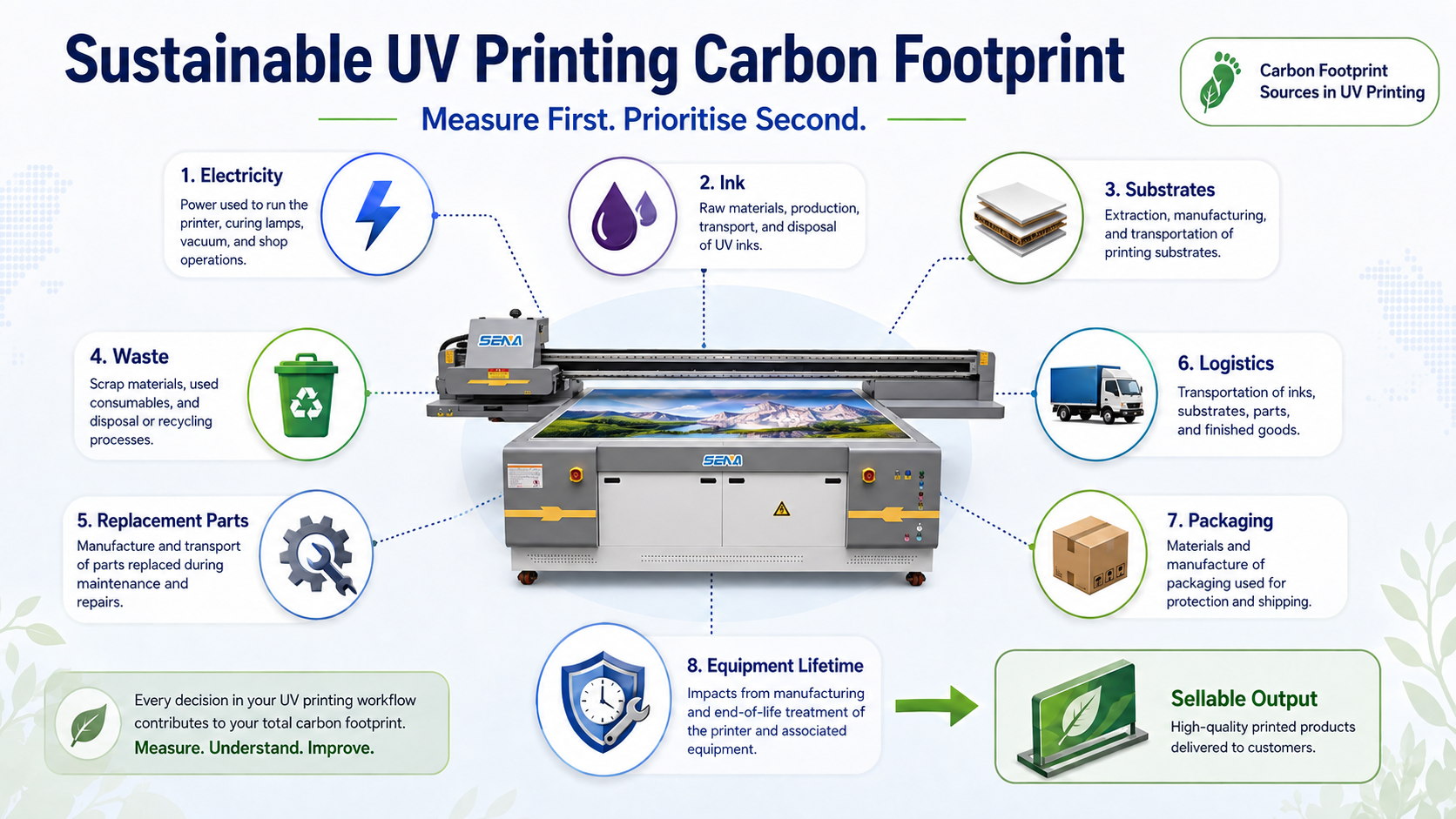
Electricity may be consumed by the printer, UV curing system, vacuum pumps, ink circulation, heaters, computers, compressors, ventilation and factory HVAC. The carbon impact also depends on how the electricity is generated.
Materiály
Acrylic, PVC, wood, metal, glass, paperboard and other substrates all have their own manufacturing and transport impacts. In some applications, substrate choice may influence the total footprint more than small differences in printer electricity consumption.
Inkoust
Important factors include ink composition, consumption per job, white-ink coverage, varnish use, expired ink and waste generated during cleaning or maintenance.
Odpad
Failed prints, setup sheets, damaged substrates, excessive cleaning and obsolete inventory all consume materials without creating sellable output.
Logistics and Equipment Lifetime
Machines, substrates, inks, replacement parts and finished products all require transportation. Equipment lifetime also matters: serviceable machines with available spare parts can reduce the need for premature replacement.
A practical sustainability framework: Energy + Materials + Chemicals + Waste + Logistics + Equipment Life.
Corporate Carbon Footprint vs Product Carbon Footprint
Before calculating the carbon footprint of UV printing, companies should define what they are measuring.
Corporate Carbon Footprint
A corporate greenhouse-gas inventory looks at emissions associated with an organisation over a defined reporting period. It may include factory electricity, fuels, purchased materials, transport, waste and other value-chain activities.
Product Carbon Footprint
A product carbon footprint looks at emissions associated with a particular product across a defined life-cycle boundary. For a UV printer, this could include materials, manufacturing, transport, customer use, maintenance and end-of-life treatment. For a printed product, the boundary could include substrate production, printing, finishing, transport and disposal or recycling.
The GHG Protocol treats corporate value-chain accounting and product-level life-cycle accounting as different but complementary approaches. Buyers may therefore ask a supplier for company-level carbon information, product-specific information, or both.
The GHG Protocol Product Life Cycle Accounting and Reporting Standard provides a framework for assessing greenhouse-gas emissions associated with individual products across defined life-cycle boundaries.
What Is a Carbon Footprint in Printing?
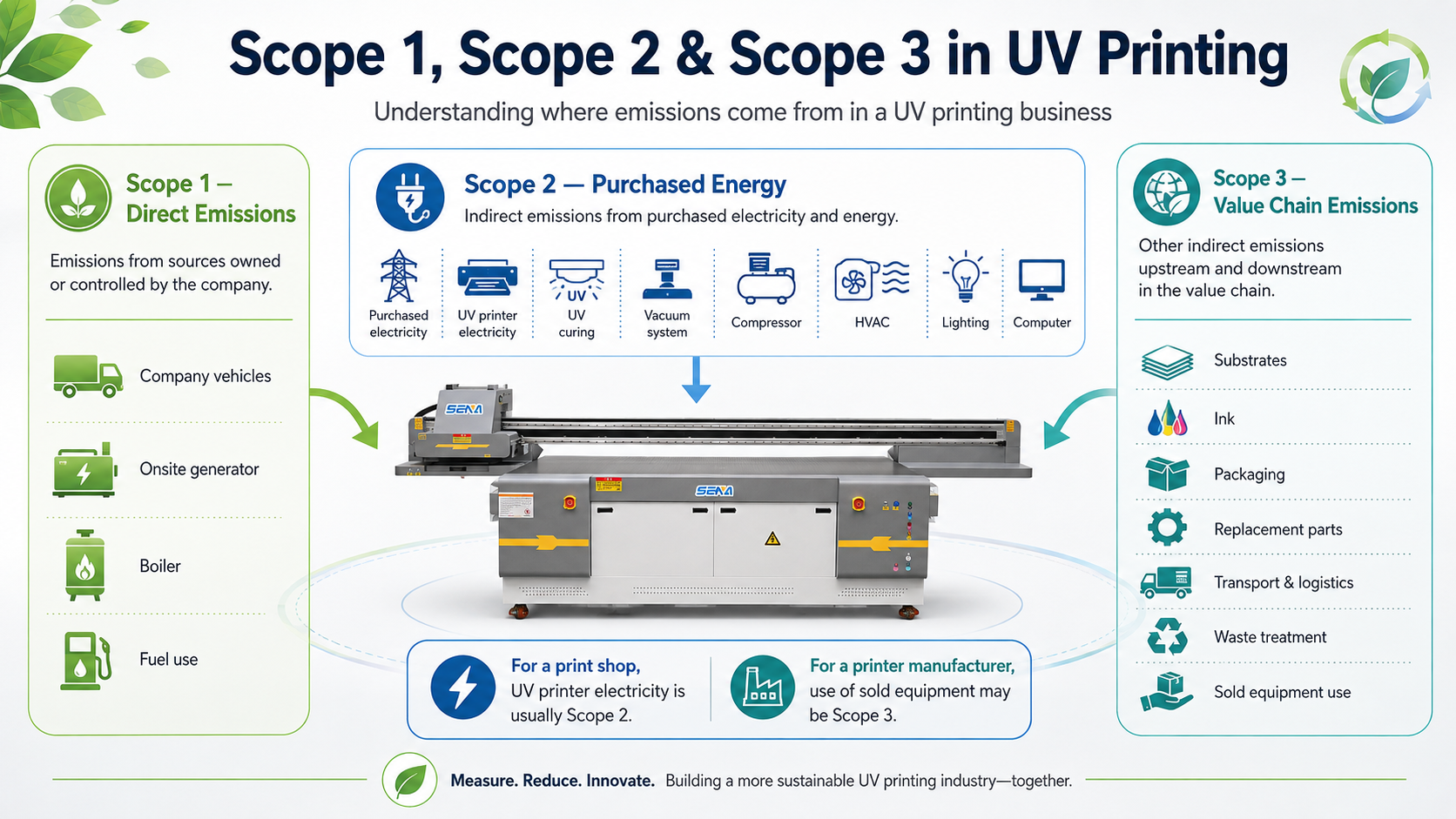
A carbon footprint normally expresses greenhouse-gas emissions as carbon dioxide equivalent, or CO₂e. Under the GHG Protocol Corporate Standard, corporate greenhouse-gas emissions are commonly organised into Scope 1, Scope 2 and Scope 3.
Scope 1 Emissions
Scope 1 covers direct emissions from sources owned or controlled by the reporting company. For a printing business, examples may include company-owned fuel vehicles, boilers, generators or other onsite fuel combustion.
Scope 2 Emissions
Scope 2 covers indirect emissions associated with purchased electricity, steam, heating or cooling. Electricity used by UV printers, curing systems, vacuum pumps, compressors, computers and factory lighting can therefore contribute to the printing company’s Scope 2 inventory.
Scope 3 Emissions
Scope 3 emissions cover other indirect emissions across the upstream and downstream value chain. For a printing company, possible sources include purchased substrates, inks, packaging materials, replacement parts, outsourced transportation, waste treatment and other upstream or downstream activities.
Why Scope 3 Can Become a Major Part of the Footprint
For many businesses, purchased materials and other value-chain activities can represent a significant share of total emissions. This is why focusing only on printer electricity can give an incomplete picture.
The scope also depends on whose inventory is being calculated. Electricity used by a print shop to operate its printer is normally part of that print shop’s Scope 2 emissions. From the printer manufacturer’s perspective, energy consumed during the customer’s use of sold machines may be relevant to Scope 3 calculations under the use-of-sold-products category.
Where Does the Carbon Footprint of a UV Printing Business Come From?
The first step in reducing emissions is identifying the main sources. Do not assume that the printer itself is automatically the largest contributor.
| Source | Useful Activity Data | Possible KPI |
|---|---|---|
| Electricity | Metered kWh | kWh/m² or kWh/1,000 products |
| Inkoust | Litres or kilograms used | ml/m² or ml/job |
| Substráty | kg, sheets or m² purchased | Material use per sellable unit |
| Odpad | kg or m² discarded | Waste rate (%) |
| Replacement Parts | Units and weight | Parts used per year |
| Transportation | Distance and shipment weight | Transport activity data |
| Obal | kg by material type | Packaging weight per shipment |
The principle is simple: measure first, prioritise second. A business should identify its real hotspots before investing in environmental improvements based only on assumptions.
How UV Digital Printing May Reduce Waste
No Conventional Printing Plates or Screens
UV digital printing works directly from a digital file, so conventional printing plates or screens are not required for each artwork. For jobs with frequent design changes, this can reduce some plate-making, screen-making and setup materials.
Short Runs and Print on Demand
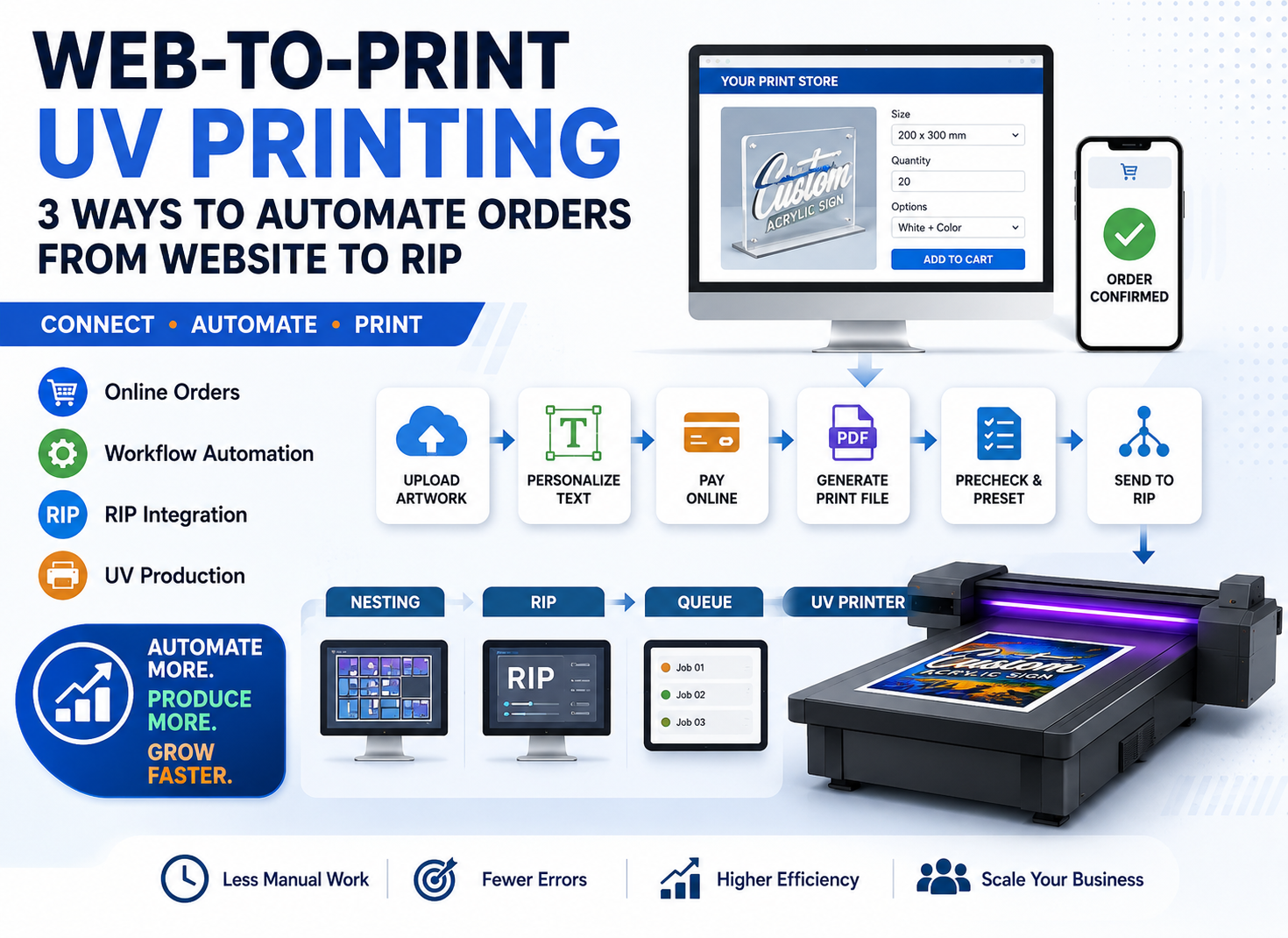
Digital production is particularly useful when customers need hundreds or thousands of products rather than extremely large identical runs. Smaller batches can help businesses manufacture closer to actual demand.For businesses managing multiple SKUs, personalised products or frequently changing artwork, a variable-data digital printing workflow can also reduce repetitive artwork preparation and support more flexible production.
Reduced Inventory
On-demand production may reduce the need to hold large volumes of pre-printed products or packaging. This can be valuable when products have many SKUs, languages, seasonal versions or frequently changing designs.
Fewer Obsolete Printed Products
Artwork revisions, packaging regulations and sustainability requirements, discontinued SKUs and marketing changes can turn previously printed inventory into waste. Shorter digital runs may reduce exposure to this risk.
However, none of these advantages automatically proves a lower total carbon footprint. Real environmental performance still depends on productivity, materials, electricity, rejected output and the alternative process being compared.
UV LED Curing and Energy Efficiency
Okamžité vytvrzování
UV-curable inks polymerise rapidly when exposed to suitable UV energy. This enables printed products to move quickly to handling or finishing stages without waiting for conventional evaporation-based drying.
No Large Heat-Drying System in Many Applications
In many UV digital applications, curing does not require the type of large hot-air drying system associated with some other printing processes. UV LED systems can also operate with different heat and operating characteristics from traditional mercury-lamp curing systems.
However, this should not be converted into an unsupported statement such as “UV LED saves 80% electricity.” Actual consumption depends on printer design, productivity, curing settings and production conditions.
Standby Power Still Matters
A machine may print for four hours but remain powered for ten more. Ink circulation, vacuum systems, computers, climate control and other auxiliary equipment can continue consuming electricity during idle periods.
Measure kWh per Finished Product
A better energy-efficiency assessment uses real production data:
Energy Intensity = Total Production Electricity (kWh) ÷ Sellable Output
Useful KPIs include kWh/m² of sellable output a kWh/1,000 finished products.
A printer with low hourly electricity consumption is not necessarily more efficient if production speed is also much lower.
Measure Good Output, Not Only Printed Output
If a production line prints 100 m² but 10 m² is rejected, only 90 m² creates sellable output. Energy, ink and substrate used for rejected prints still count. Improving first-pass yield can therefore improve both profitability and environmental performance.
Low VOC Is Only One Part of Sustainability
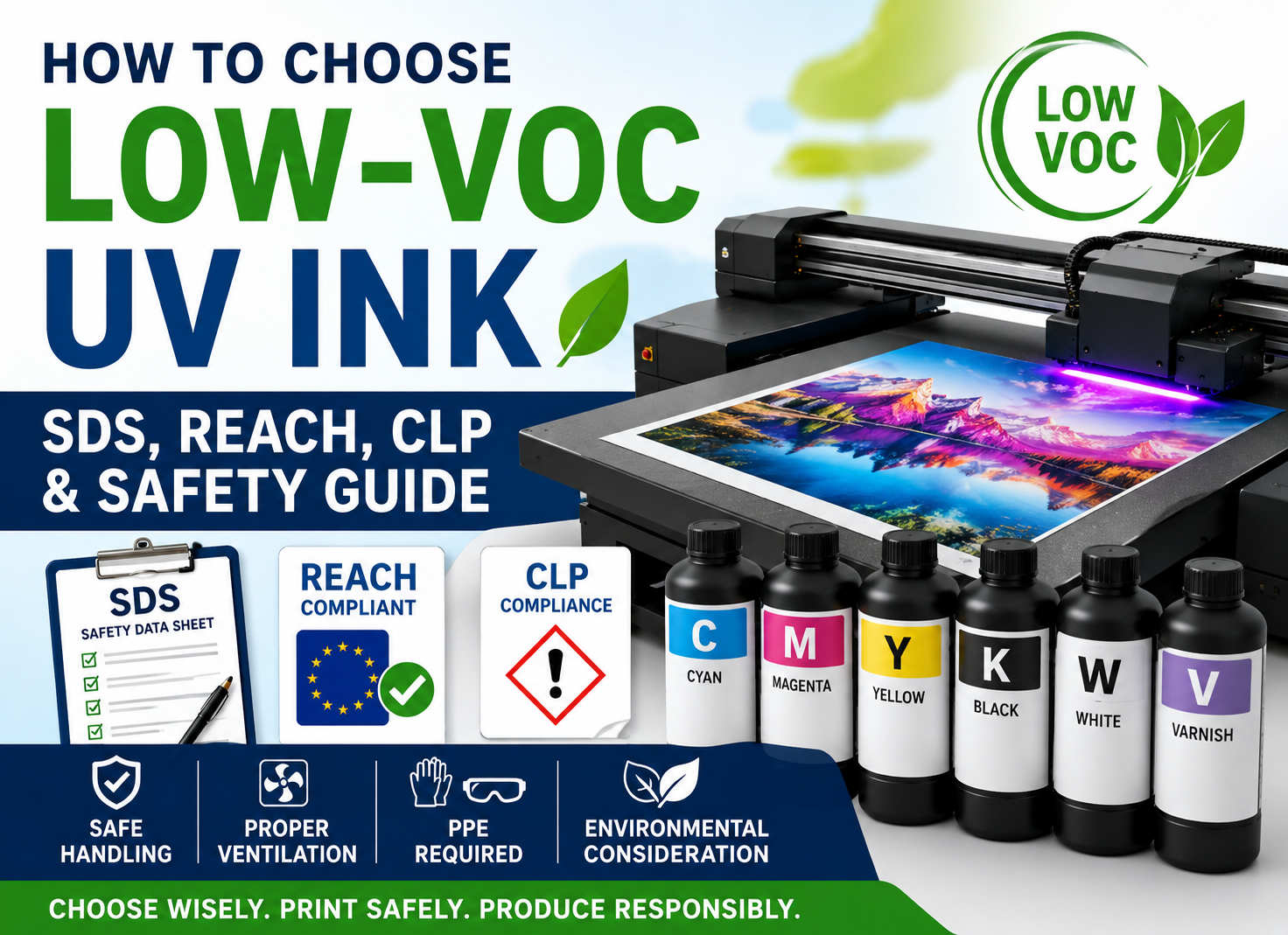
UV-curable inks are often discussed in connection with VOC reduction because their curing mechanism does not rely on the same level of solvent evaporation used in some solvent-based printing processes. For a deeper explanation, read our guide to choosing low-VOC UV ink.However, low VOC digital printing should not be treated as equivalent to low carbon or complete sustainability.
VOC, Worker Exposure and Ventilation
Printing businesses should review ink chemistry, workplace exposure controls, ventilation requirements and supplier safety information. Appropriate handling remains necessary even when VOC emissions are lower.
Ink Waste
Expired ink, excessive flushing, unnecessary cleaning and failed prints all increase chemical and material waste.
Chemical Documentation
Professional suppliers should provide relevant SDS and technical documentation so customers can understand handling requirements, hazards and application limitations.
Do not confuse these terms: Low VOC ≠ Low Carbon ≠ Recyclable ≠ Sustainable.
UV Digital Printing vs Screen Printing: Where Can Waste Be Reduced?
It is misleading to claim that UV digital printing is always environmentally better than screen printing. The answer depends heavily on run length, artwork changes, energy use, substrate, setup requirements and production yield.
| Faktor | UV Digital Printing | Sítotisk |
|---|---|---|
| Plate / Screen | No conventional screen required | Screen preparation required |
| Artwork Change | Change digital file | May require new screen |
| Krátké běhy | Strong application | Setup can be significant |
| Proměnná data | Strong | Limited in conventional workflow |
| Screen Cleaning | No screen-cleaning stage | Screen cleaning may require chemicals and water |
| Long Stable Runs | Application-dependent | Can be highly efficient |
| Energy Intensity | Must be measured | Must be measured |
| Overall Carbon Footprint | Requires data and defined boundaries | Requires data and defined boundaries |
For multi-SKU, short-run and frequently changing orders, digital printing may reduce setup-related materials and cleaning. For very large volumes of identical products, screen printing or another conventional process may remain economically and environmentally competitive. A fair comparison requires actual production data.
What Does ESG Mean for a Printing Company?
ESG stands for Environmental, Social and Governance. It is not one certificate that makes a company “sustainable.” It is a framework for understanding how environmental and social issues are managed and how reliable the company’s governance and documentation are.
Environmentální
- Energy consumption
- Greenhouse-gas emissions
- Waste generation
- Chemical management
- Material efficiency
- Water and resource use where relevant
Social
- Worker safety
- PPE and chemical-handling procedures
- Technical training
- Working conditions
- Health and safety records
Governance
- Compliance documentation
- Supplier traceability
- Material and ink records
- SDS revision control
- Environmental-data management
- Internal responsibilities and procedures
A printing business with good ESG management should therefore be able to show how data is collected, updated and used—not merely display environmental logos.
Will Every European Customer Ask for ESG Reports?
Mandatory Reporting vs Supply-Chain Requests
No. It is inaccurate to say that every European business must publish a full ESG report. The EU’s 2026 Omnibus I simplification substantially narrowed the scope of mandatory Corporate Sustainability Reporting Directive reporting, focusing the revised scope mainly on larger companies with more than 1,000 employees and more than €450 million in net annual turnover.
This reduces direct reporting obligations for many smaller companies, but it does not eliminate sustainability information from procurement.
Why SMEs May Still Receive Sustainability Questionnaires
A small printing company or UV printer supplier may sell to a large brand, packaging company, distributor, financial institution or multinational customer. Those organisations may request sustainability information from suppliers as part of their own risk management, purchasing procedures or reporting processes.
Typical questions can cover electricity, carbon emissions, waste, chemicals, SDS documentation, RoHS information, worker safety and material traceability.
Voluntary Sustainability Reporting for Smaller Companies
The European Commission has also developed voluntary sustainability reporting frameworks intended to make information requests more proportionate for smaller businesses outside mandatory CSRD scope. This reflects an important market reality: a company may not be legally required to produce a full CSRD report but may still benefit from having structured sustainability data available.
Why UV Printer Suppliers Should Prepare Environmental Data Anyway
Good sustainability data can shorten supplier qualification, make questionnaires easier to answer, improve communication with distributors and give customers more confidence in technical claims.
What Sustainability Data Should a UV Printer Manufacturer Provide?
A manufacturer does not need to claim that its machine is “green” to demonstrate environmental professionalism. More useful evidence is measurable technical information.
| Data Category | Useful Evidence |
|---|---|
| Machine Power Consumption | Rated power plus measured operating data where available |
| Produktivita | m²/h or pieces/h under stated print conditions |
| Energy Intensity | kWh/m² or kWh/1,000 finished units |
| Ink Consumption | ml/m² or ml/job under defined artwork and print settings |
| Ink Documentation | SDS and technical documentation |
| Compliance Information | Applicable CE, RoHS or other relevant documentation |
| Spare Parts | Availability and service policy |
| Equipment Lifetime | Maintenance, replaceable components and service information |
| Transport Packaging | Material type and packaging weight where recorded |
| Snížení odpadu | Maintenance and production guidance |
Machine Power Consumption
Rated power alone is not enough for a detailed environmental comparison. Where practical, manufacturers can measure standby consumption, normal printing consumption and defined full-load conditions.
Ink Consumption
Ink-use figures should state the test conditions. White ink coverage, varnish, resolution, pass mode and artwork coverage can significantly change ml/m².
CE, RoHS and SDS Documentation
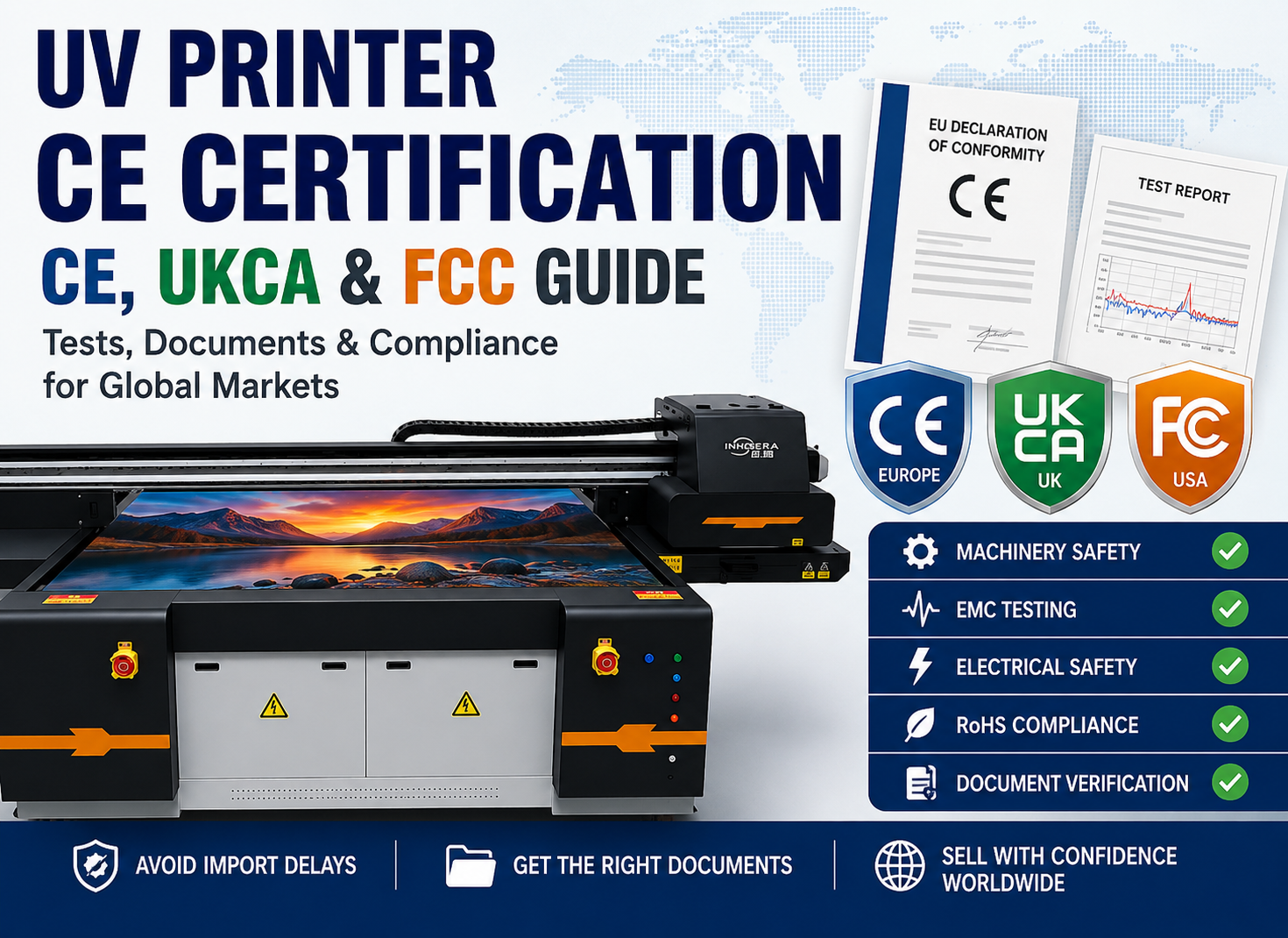
Compliance documents are useful, but their purpose must be communicated accurately. CE is not a carbon-footprint certificate, RoHS is not proof of low energy consumption, and an SDS is not an ESG rating. For more information about equipment certification, see our UV printer CE, UKCA and FCC certification guide.
Spare Parts and Equipment Service Life
Long-term parts availability, replaceable modules and maintenance support can help customers extend useful equipment life and avoid premature replacement.
Maintenance and Waste Reduction Guidance
Preventive UV printer maintenance can improve first-pass yield and reduce unnecessary ink, substrate and component waste. Printhead care, white-ink circulation, correct ink storage and regular nozzle checks are therefore relevant to both productivity and material efficiency.
The Sustainability Evidence Ladder
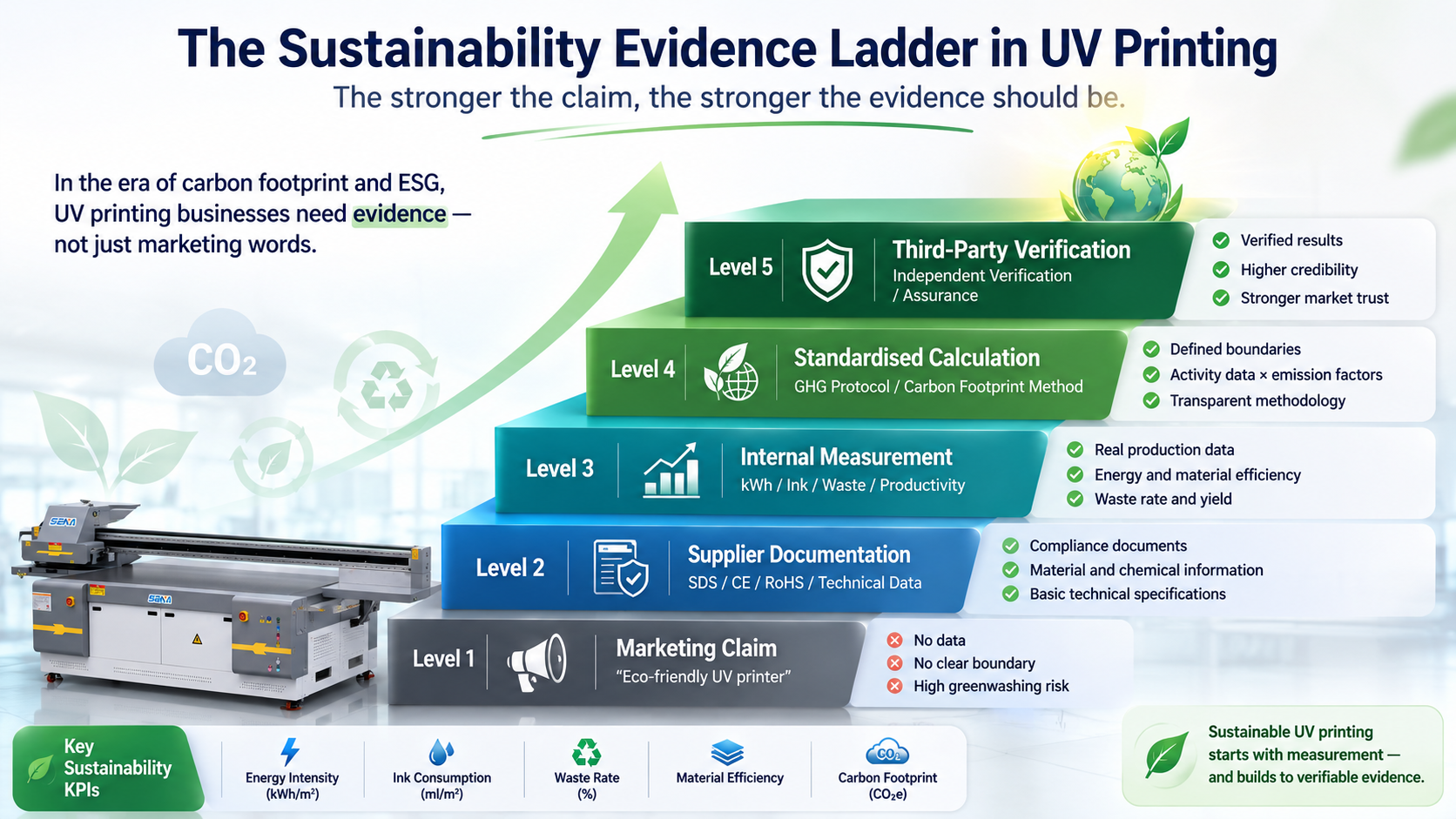
Not all environmental claims have the same strength. A useful way to evaluate evidence is to move from marketing language toward increasingly measurable and verifiable information.
- Level 1 — Marketing Claim: “Eco-friendly UV printer.” Little useful evidence.
- Level 2 — Supplier Documentation: SDS, technical specifications and relevant regulatory documents.
- Level 3 — Internal Measurement: Electricity, ink consumption, waste rate and productivity data.
- Level 4 — Standardised Calculation: Carbon calculations using recognised methodologies, defined boundaries and documented emission factors.
- Level 5 — Independent Verification: Appropriate third-party verification or assurance when required.
The stronger the sustainability claim, the stronger the evidence should be.
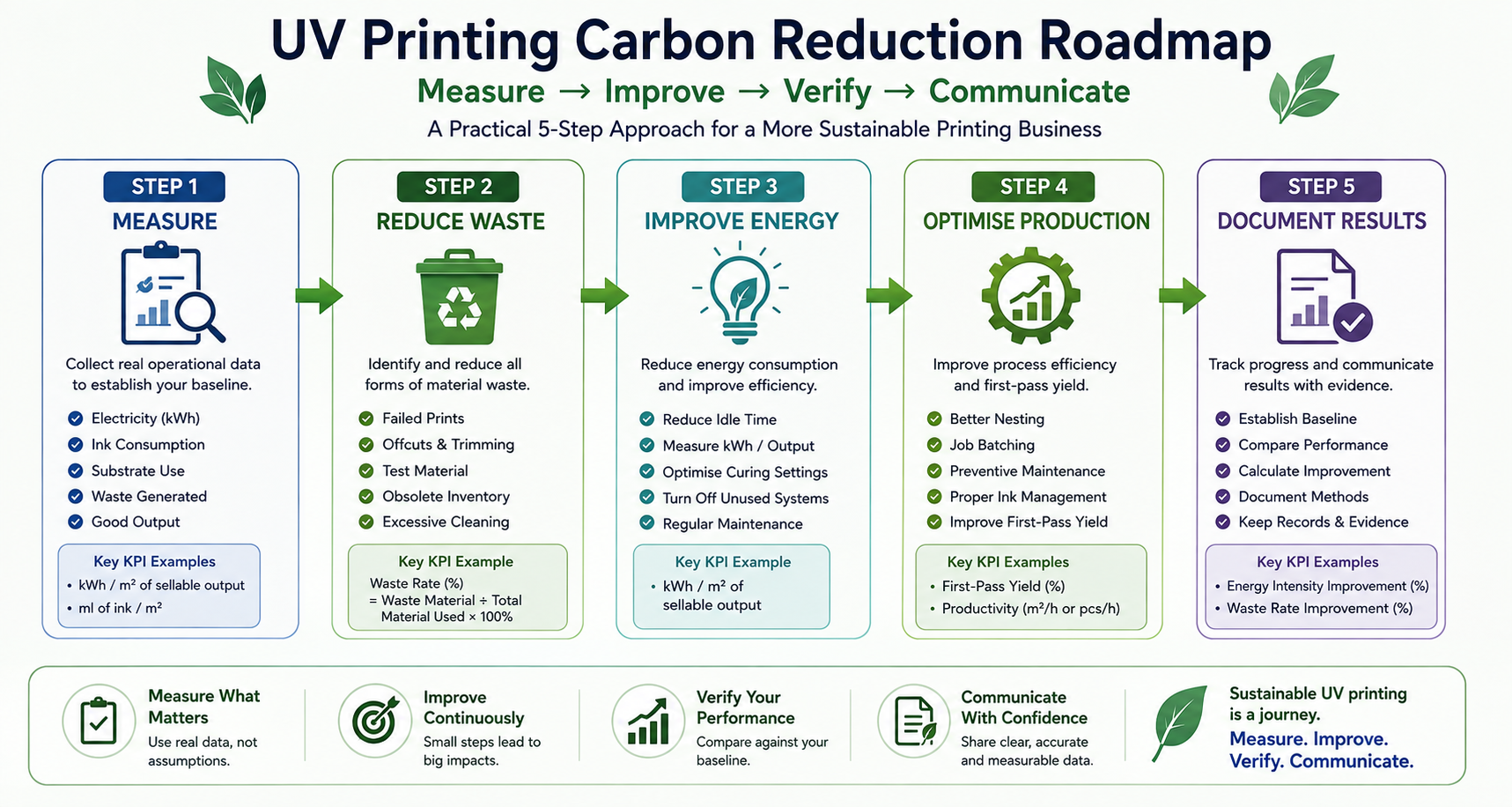
A Practical Carbon Reduction Roadmap for UV Printing Companies
Step 1: Measure
Collect several months of electricity, substrate, ink, waste and production-output data. Establish a baseline before setting reduction claims.
Step 2: Reduce Waste
Track failed prints, offcuts, test material and rejected output. A useful internal KPI is:
Waste Rate = Waste Material ÷ Total Material Used × 100%
Step 3: Improve Energy Efficiency
Measure electricity against sellable output. Review idle time, unnecessary auxiliary equipment operation and production scheduling.
Step 4: Optimise Production
Better nesting, job batching, preventive maintenance, fewer unnecessary cleaning cycles and improved first-pass yield can reduce both cost and environmental intensity.
Step 5: Document Results
Compare a defined baseline with future performance. A claim such as “energy intensity decreased by 12% compared with our 2026 baseline under the same measurement method” is far more useful than saying “our printing is greener.”
How to Avoid Greenwashing in UV Printing Marketing
Environmental marketing is becoming more sensitive in the European market. Directive (EU) 2024/825 strengthens consumer protection against misleading environmental and sustainability claims, with the relevant rules applying from 27 September 2026.
Do Not Say “Zero Emissions” Without Data
A UV printer may not produce visible exhaust during normal printing, but that does not mean its carbon emissions are zero. Purchased electricity alone can create indirect greenhouse-gas emissions.
Do Not Say “100% Eco-Friendly”
Broad statements such as “green,” “eco-friendly” or “environmentally friendly” require much more caution than specific, measurable claims. A claim should identify exactly what characteristic is being described and what evidence supports it.
Separate Product Compliance from Environmental Performance
CE ≠ Low Carbon.
RoHS ≠ Carbon Neutral.
Low VOC ≠ Zero Emissions.
Recyclable ≠ Zero Waste.
Use Measurable Claims
Weak claim: “Our UV printer is 100% environmentally friendly.”
Better claim: “UV-curable digital printing eliminates conventional plate-making in the digital workflow and can support on-demand production. Overall environmental performance still depends on electricity, ink chemistry, substrate choice, productivity and waste management.”
If measured data is available, a stronger claim might state electricity or material use under clearly defined test conditions. Specific numbers should always include the measurement boundary and production conditions.
Frequently Asked Questions About UV Printing, Carbon Footprint and ESG
Je UV tisk šetrný k životnímu prostředí?
It depends on the complete application. UV digital printing can offer advantages such as plate-free production, rapid curing and short-run flexibility, but its environmental impact still depends on electricity, substrate choice, ink chemistry, waste, productivity and end-of-life treatment.
What is the carbon footprint of UV printing?
There is no universal figure. The result changes with electricity mix, material, ink consumption, machine productivity, rejected output, logistics and the boundaries used in the calculation.
Does UV LED printing use less electricity?
UV LED curing can offer energy-efficiency advantages in some equipment and applications, but a universal percentage should not be claimed without comparable test data. Measure kWh per m² or per 1,000 sellable products under defined conditions.
Is UV printing more sustainable than screen printing?
Not automatically. UV digital printing can reduce plate or screen preparation and may perform well for short-run and multi-SKU production. Screen printing can remain highly efficient for large, stable runs. A reliable comparison needs real material, waste and energy data.
Is low-VOC UV ink environmentally friendly?
Lower VOC emissions can be beneficial, but VOC is only one environmental factor. Carbon emissions, material use, chemical composition, waste and recyclability should also be considered.
What are Scope 1, Scope 2 and Scope 3 emissions in printing?
Scope 1 covers direct emissions from owned or controlled sources. Scope 2 covers emissions associated with purchased energy. Scope 3 covers other indirect emissions throughout the company’s upstream and downstream value chain.
How do you calculate a printing carbon footprint?
A basic carbon calculation typically combines activity data × an appropriate emission factor. Activity data could include kWh of electricity, kilograms of material, litres of fuel or transport activity. A professional calculation must also define organisational or product boundaries, reporting period, data sources and methodology.
Does every European printing supplier need an ESG report?
No. EU mandatory sustainability reporting now focuses on a narrower group of larger companies. However, smaller suppliers may still receive environmental questionnaires from customers, financial institutions or multinational companies in their supply chain.
What environmental information should a UV printer supplier provide?
Useful information can include machine power data, productivity, ink consumption under defined conditions, SDS documentation, applicable CE and RoHS documents, spare-part availability, maintenance guidance, packaging information and measured energy-efficiency data where available.
Conclusion: Sustainable UV Printing Starts With Measurement
Sustainable UV printing should not be marketed as a simple product feature. It is the result of measuring and improving energy efficiency, material use, ink consumption, waste, production yield, equipment life and supply-chain performance.
UV digitální tisk can support more sustainable manufacturing in applications where plate-free production, short runs, print-on-demand, variable data and lower obsolete inventory create measurable benefits. In other applications, conventional printing may remain the more efficient choice.
For manufacturers and printing companies serving European and international buyers, the most valuable sustainability strategy is therefore not to make the strongest environmental claim. It is to build the strongest evidence.
Compliance tells customers whether requirements are met. Sustainability data shows how environmental performance is being measured, managed and improved.
If your company needs UV printing equipment and wants to evaluate power consumption, ink documentation, application efficiency or other sustainability-related data, contact us to discuss your printing requirements.
Disclaimer: This article is provided for general technical and business information and does not constitute legal, ESG, carbon-accounting or environmental certification advice. Reporting requirements, calculation boundaries and environmental claims should be evaluated according to the applicable laws, standards and specific business situation.