Vermy jou navraag is vertragingsreaksie, voer asseblief jou WhatsApp/WeChat/Skype in saam met die boodskap, sodat ons jou die heel eerste keer kan kontak
Ons sal jou binne 24 uur antwoord. As vir 'n dringende saak, voeg asseblief WhatsApp by: +8613011708220, or WeChat: +86 13011708220. Or call +86 13011708220 direk.
*Ons respekteer jou vertroulikheid en alle inligting word beskerm. Ons sal slegs jou inligting gebruik om op jou navraag te reageer en sal nooit ongevraagde e-posse of promosieboodskappe stuur nie.
UV printer CE certification is often treated as if it were a single certificate that a manufacturer buys from a testing company. In reality, product compliance is broader. Depending on the printer design and target market, manufacturers and importers may need to consider machinery safety, electromagnetic compatibility, electrical safety, technical documentation, declarations, labeling, hazardous-substance restrictions, and other requirements.
The situation becomes more complicated when the same UV printer may be sold in the European Union, Great Britain, the United States, Canada, Australia, or other markets. CE, UKCA, and FCC do not mean the same thing, and they should not be treated as interchangeable certificates.
This guide explains what UV printer buyers should check before ordering, which compliance documents may be relevant, how to identify warning signs in supplier documentation, and what is changing in the European machinery regulatory framework in 2027.
Important: This article provides general compliance information for UV printer buyers and manufacturers. The exact legal requirements depend on the machine configuration, intended use, components, destination market, and current regulations. For a specific import or conformity decision, consult a qualified compliance professional or the relevant authority.
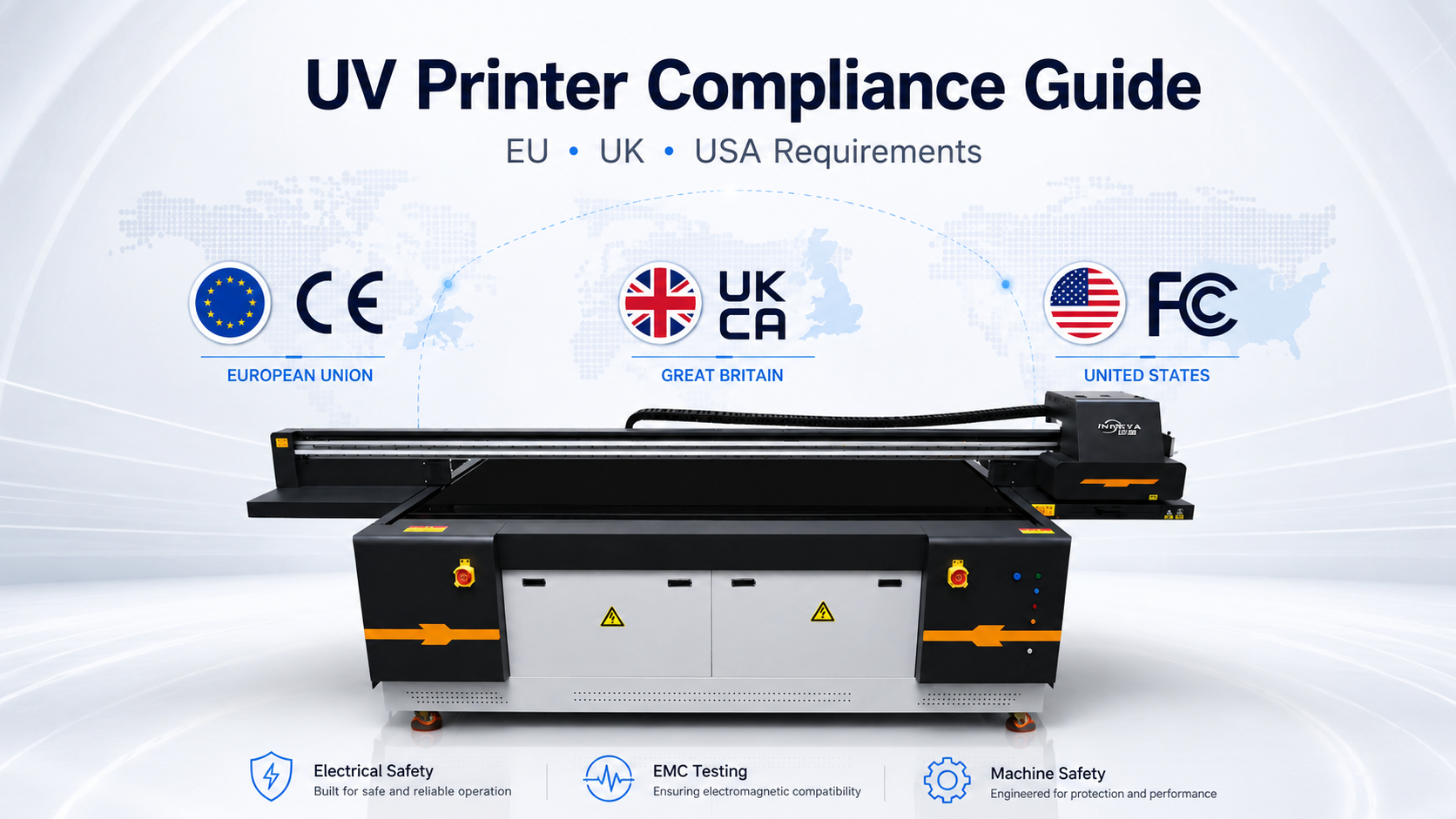
UV printer compliance requirements vary between the EU, Great Britain, and the United States.
Does a UV Printer Need CE Certification?
If a UV printer is placed on the EU market and falls within legislation requiring CE marking, the manufacturer must ensure that the product satisfies the applicable requirements before the CE mark is affixed.
However, asking only, “Does this UV printer have a CE certificate?” is usually too simple.
A better question is:
Which EU requirements apply to this exact UV printer, and what evidence supports its conformity?
CE marking is not simply a decorative label or a universal approval issued by one European authority. The manufacturer normally needs to identify the applicable legislation, evaluate the product, prepare technical documentation, draw up the appropriate EU Declaration of Conformity, and affix the CE mark when the relevant requirements have been satisfied.


 Afrikaans
  English
  Arabic
  German
  French
  Spanish
  Turkish
  Italian
  Russian
  Persian
  Bengali
  Hebrew
  Persian (Afghanistan)
  Scottish Gaelic
  Panjabi
  Croatian
  Slovenian
  Greek
Greek  Czech
Czech  Korean
  Japanese
  Portuguese