

 Italian
  English
  Arabic
  German
  French
  Spanish
  Turkish
  Russian
  Persian
  Bengali
  Hebrew
  Persian (Afghanistan)
  Scottish Gaelic
  Panjabi
  Croatian
  Slovenian
  Greek
Greek  Afrikaans
  Czech
Czech  Korean
  Japanese
  Portuguese





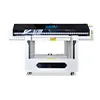
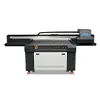
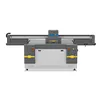
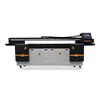
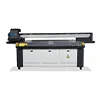
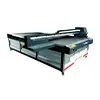
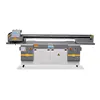
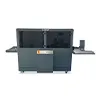
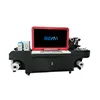

How a Vietnamese Entrepreneur Built a UV Printing Business from Scratch with Custom Acrylic Products
Iniziare un UV printing business without previous printing experience can look difficult. There is equipment to understand, artwork to prepare, materials to test, customers to find, prices to calculate, and production problems to solve. For many first-time buyers, the biggest question is not simply which UV printer to purchase. It is whether a small printing business can realistically attract enough orders to justify the investment.
A Vietnamese entrepreneur faced exactly this decision when exploring a small personalized-products business. Instead of beginning with a large industrial printer or trying to offer dozens of products immediately, the business started by identifying a narrow group of products that were relatively easy to customize, visually attractive, and suitable for local and online sales.
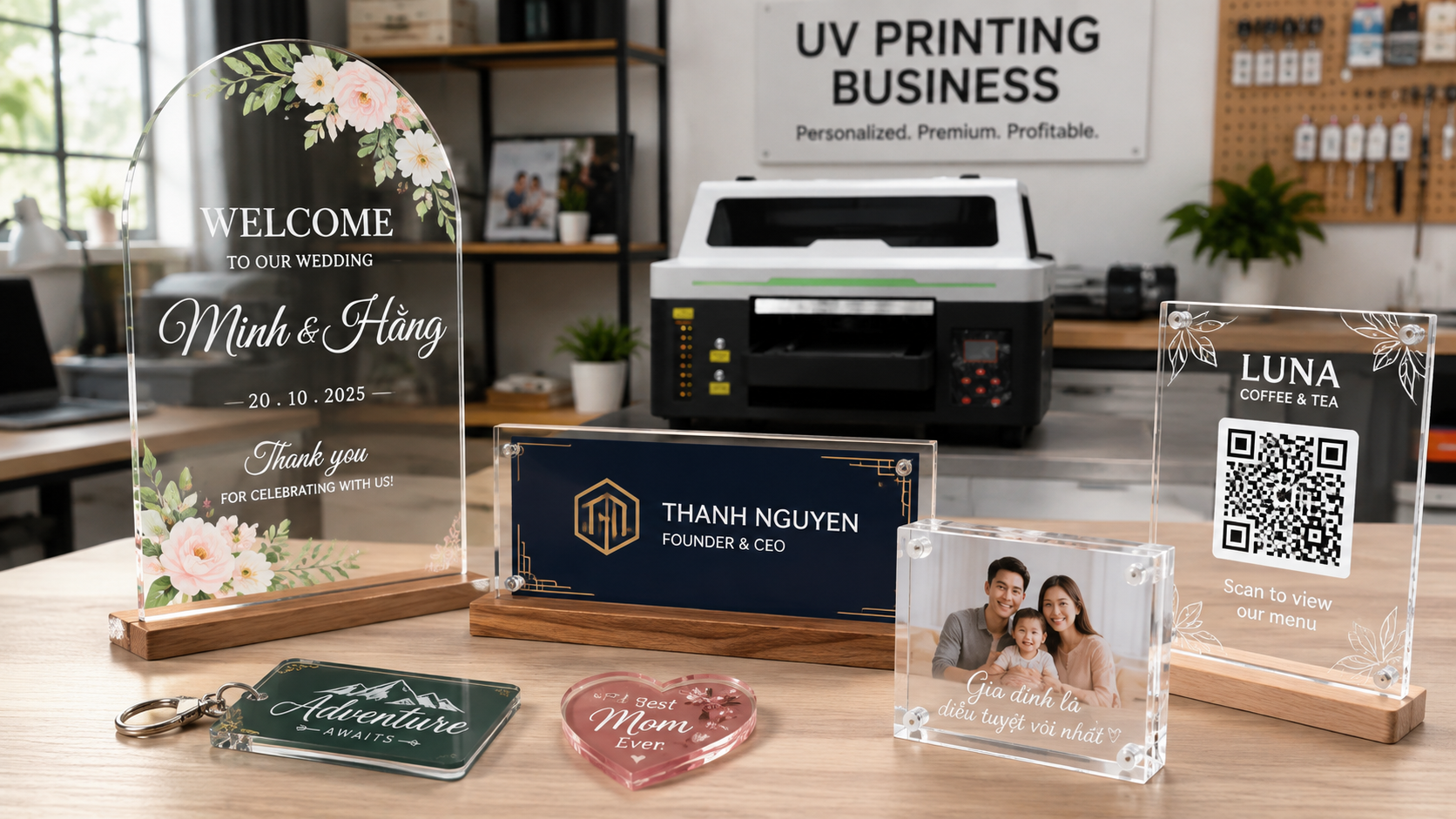
Transparent acrylic became the first major product category. Wedding signs, desk nameplates, QR code displays, photo blocks, and personalized gifts could all be produced from similar materials while serving different customer groups.
The most important lesson from this startup was simple: choose the products and customers before choosing the printer. A UV printer is a production tool. The business model must determine what that tool needs to do.
1. Starting a UV Printing Business with No Printing Experience
1.1 Previous Background
The entrepreneur did not come from a professional commercial printing background. Concepts such as RIP software, white ink layers, print passes, UV curing, adhesion testing, and printhead maintenance were initially unfamiliar.
That situation is common among people researching a UV printer business for beginners. Many are designers, gift sellers, sign makers, e-commerce sellers, advertising businesses, or entrepreneurs who see demand for personalized products but have never operated digital printing equipment.
The lack of printing experience was therefore not treated as the main barrier. The more important question was whether the production process could be learned systematically and whether the products had enough market value to justify the learning curve.
1.2 Why UV Printing Was Selected
Several production methods were considered. Outsourcing required little initial equipment investment but reduced control over delivery time, samples, small orders, and design changes. Traditional screen printing could work well for repeated high-volume designs, but screen preparation makes frequent artwork changes less convenient.
UV digital printing offered a different model. Artwork could be changed from one order to the next without preparing a new physical printing screen. The printer could also apply color directly to compatible rigid materials while using white ink to create stronger images on transparent or colored surfaces.
This made UV printing particularly attractive for low-volume, customized, and multi-SKU orders. The decision was not based on the assumption that UV printing is always cheaper than every other printing method. It was based on flexibility.
1.3 Why Acrylic Was the First Product Category
Acrylic was selected because one material could support several different commercial applications. Transparent acrylic is visually attractive, easy to photograph, suitable for modern interior styles, and highly compatible with personalization.
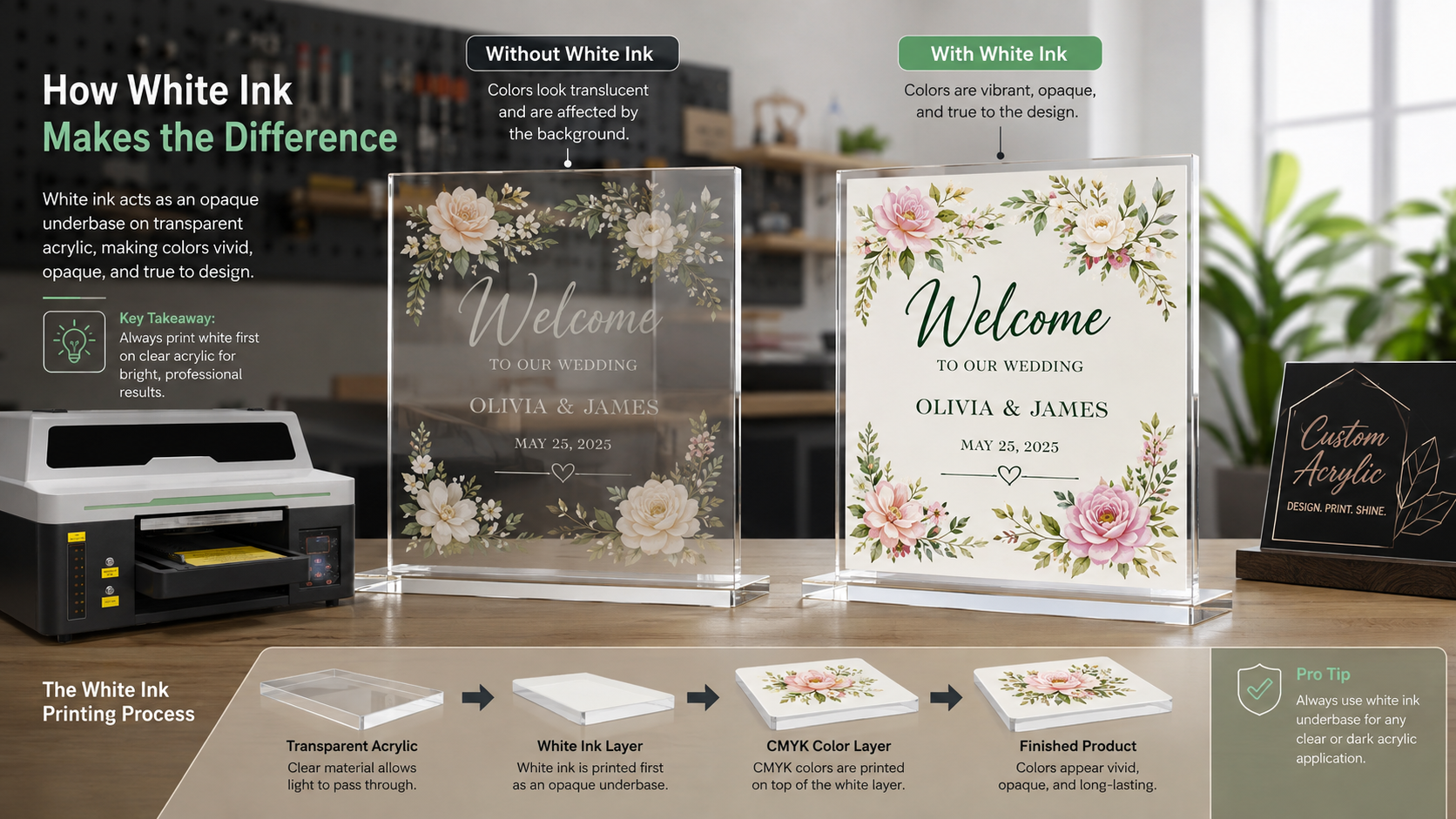
White ink also creates an important design advantage. A clear acrylic sheet can combine transparent areas, full-color graphics, and opaque white elements within one product.
From a startup perspective, acrylic products can also be made in relatively small sizes. This means a new business can test demand without immediately requiring an extremely large printing area.
For anyone considering an acrylic printing business, however, the material itself is only the starting point. Profit comes from turning that material into products customers actually want.
2. Choosing Products Before Choosing the Printer
One of the most common mistakes made by new printing businesses is selecting equipment before deciding what they intend to sell.
A more practical sequence is:
- Identify target customers.
- Select several products they already buy.
- Determine typical product dimensions.
- Estimate acceptable selling prices.
- Test whether customization adds enough value.
- Estimate realistic monthly order volume.
- Choose equipment that fits this production model.
This approach reduces the risk of buying a printer that is either unnecessarily large or too limited for the intended products.
2.1 Acrylic Wedding Signs
Wedding products were an attractive starting category because personalization is central to the purchase. Typical products include welcome signs, table numbers, seating signs, name plaques, ceremony signs, and decorative acrylic displays.
Customers are not simply buying a square meter of acrylic. They are buying names, dates, colors, artwork, design coordination, and a product associated with an important event.
This allows the business to compete on design and service instead of only material price.
2.2 Desk Nameplates
Personalized desk nameplates can serve offices, professionals, reception desks, home offices, corporate gifts, and small businesses.
They use relatively little material, can be customized with names and logos, and are normally easier to package than large signs. This makes them suitable for both local orders and online sales.
2.3 QR Code Signs
QR code displays became another practical product category because cafés, restaurants, salons, hotels, shops, and other small businesses increasingly use QR codes for menus, payments, reviews, websites, and social media.
A relatively small acrylic piece can therefore carry meaningful commercial value. The customer is paying for a finished business tool, not merely the acrylic and ink.
2.4 Photo Blocks
UV-printed acrylic photo products can be positioned as personalized gifts for weddings, anniversaries, families, pets, birthdays, and commemorative occasions.
Products like these also demonstrate an important principle when selecting profitable UV printed products: products with strong personalization often have more pricing flexibility than generic printed objects.
2.5 Personalized Gifts
Once the initial workflow became more familiar, the product range could expand into acrylic keychains, plaques, awards, decorative pieces, custom logos, small display products, and other personalized gifts.
However, the startup did not need dozens of products on the first day.
A better objective for a beginner is to identify several products that can be produced repeatedly, priced consistently, photographed professionally, and sold to clearly defined customers.
3. Selecting the First UV Printer
After identifying the initial products, the next step was choosing a UV printer for startup produzione.
The goal was not to buy the largest printer available. The goal was to purchase enough production capability for the planned product range without creating unnecessary initial investment.
3.1 Required Printing Area
The required printing area should come directly from product dimensions.
If the initial business focuses on desk nameplates, QR signs, small photo blocks, acrylic gifts, and similar products, a compact desktop UV printer may provide enough working area.
If the business plans to produce large wedding signs, wall signs, display panels, or other larger acrylic products, a larger flatbed may eventually be required.
This is why startup buyers should list the minimum, average, and maximum dimensions of their planned products before requesting a printer quotation.
3.2 White Ink Requirement
White ink is particularly important when printing transparent acrylic.
CMYK ink printed directly onto clear material can remain partially transparent. This may be desirable for certain creative designs, but it can reduce color density when an opaque appearance is required.
A white ink layer can serve as an underbase behind color graphics, making the image more visible and improving contrast. White ink can also be printed selectively as part of the design itself.
For this reason, anyone purchasing a UV printer for acrylic products should understand how the printer handles white ink and how the RIP software controls white layers.
3.3 Varnish Requirement
Varnish can add gloss, spot effects, texture, or a premium appearance to selected acrylic products. However, it is not necessary for every job.
Adding varnish can increase ink consumption and production time, so beginners should view it as an optional value-added process rather than assuming every product must use it.
3.4 Printing Height
Printing height matters if the business may later expand beyond thin acrylic sheets.
Thicker acrylic blocks, gift boxes, plaques, small objects, fixtures, or other three-dimensional products may require more vertical clearance.
Evaluating this before purchase can prevent the business from outgrowing the machine too quickly.
3.5 Budget
The price of the printer is only one part of the startup investment.
A realistic budget should also include:
- UV ink;
- initial acrylic inventory;
- a suitable computer;
- RIP or design software where applicable;
- sample production;
- packaging;
- basic maintenance supplies;
- workspace preparation;
- marketing and customer acquisition.
Underestimating these additional costs can create cash-flow pressure even when the printer itself is affordable.
4. Learning the UV Printing Workflow
4.1 Artwork Preparation
The first production skill to develop was artwork preparation. High-quality source files, correct dimensions, transparent backgrounds, vector graphics when appropriate, and accurate positioning all affect the finished result.
For multiple small products, several designs can often be arranged within one printing layout. Efficient nesting reduces material waste and makes production more organized.
4.2 Creating the White Ink Layer
Transparent acrylic requires more planning than printing the same image on a white substrate.
A typical workflow may include CMYK color plus a white layer. Depending on the desired viewing direction and printing method, the order of these layers can change.
Beginners should therefore learn how the RIP software defines white ink areas instead of treating white ink as an automatic background for every design.
4.3 Printing on Transparent Acrylic
Transparent acrylic offers several creative possibilities. Graphics can be printed on the front surface, or the artwork can be prepared for reverse viewing through the acrylic.
Reverse printing can help protect the printed image behind the material and produce a different visual effect. However, artwork orientation, white ink order, and viewing direction must be planned correctly.
For a more detailed technical explanation, this topic can be connected to a dedicated guide on Stampa UV su acrilico.
4.4 Adhesion Testing
Not all acrylic surfaces behave identically. Material source, coatings, surface contamination, protective film, and manufacturing process may affect adhesion.
Before accepting a large order, the business should test:
- initial ink adhesion;
- scratch resistance;
- cleaning resistance;
- color appearance;
- white ink opacity;
- whether primer is required.
A short material test is usually less expensive than discovering an adhesion problem after an entire batch has been produced.
4.5 Finishing
Printing is only one stage of an acrylic product.
Depending on the product, the complete workflow may include cutting, edge polishing, removing protective film, installing stands or hardware, cleaning the surface, inspecting the print, and protective packaging.
5. How the First Customers Were Acquired
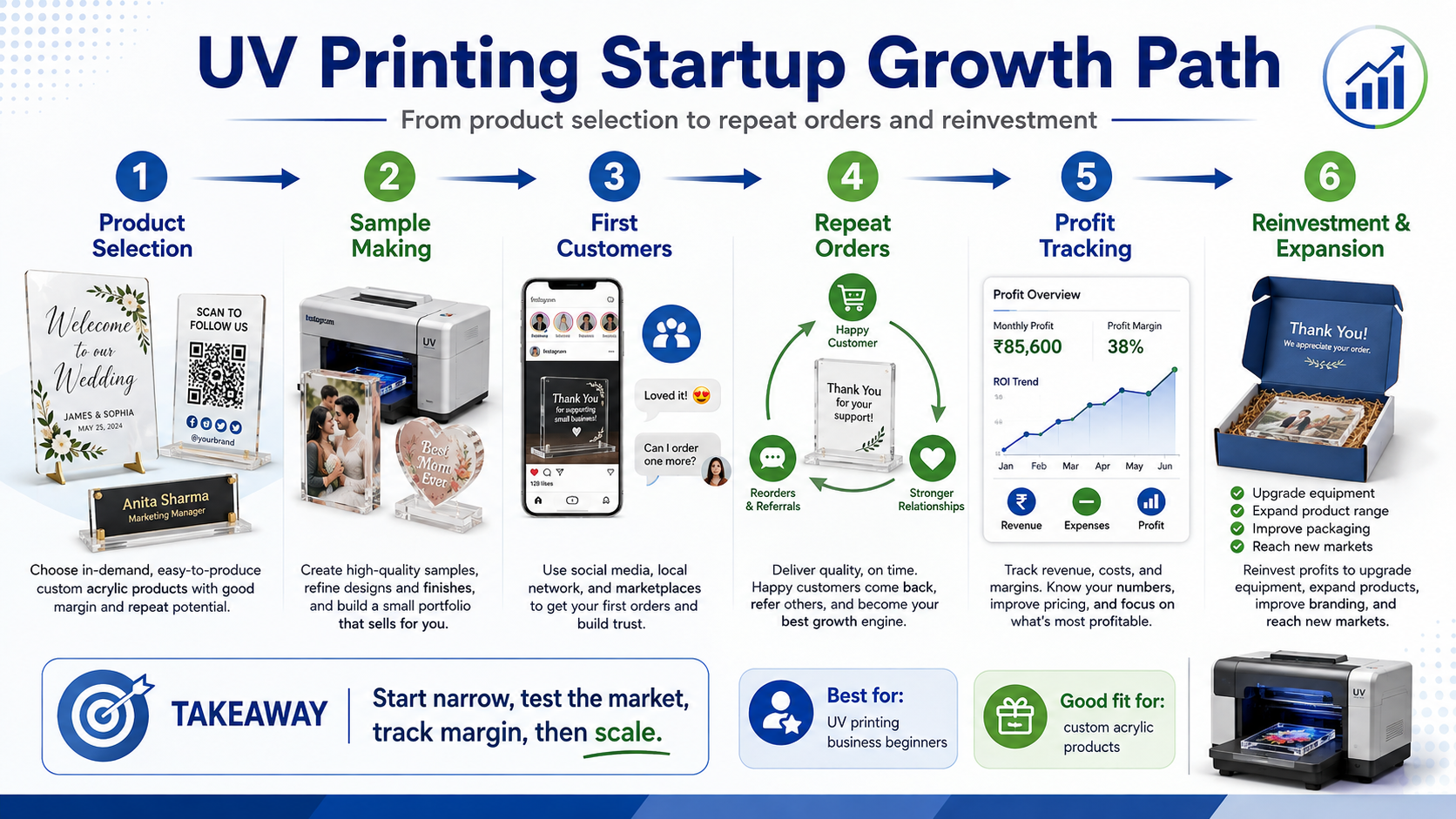
Purchasing a printer does not automatically create orders. Customer acquisition therefore became as important as learning the printing process.
Instead of trying to reach every possible customer, the startup focused on several channels where personalized acrylic products already had clear use cases.
5.1 Social Media
Acrylic products are well suited to visual marketing. Short videos can show a blank transparent sheet becoming a colorful customized product, while finished-product photographs clearly demonstrate personalization.
Platforms such as Facebook, Instagram, and TikTok can be used to test product designs, demonstrate the printing process, publish customer examples, and identify which products receive stronger interest.
The objective is not simply to publish machine videos. Potential customers generally care more about what the machine can make for them.
5.2 Local Wedding Businesses
Wedding planners, event decorators, photographers, florists, and wedding venues can become useful B2B partners because they repeatedly serve new clients.
Instead of finding every bride or groom individually, a printing business can supply customized acrylic products to businesses that already have access to the target market.
5.3 Cafés and Restaurants
Cafés and restaurants provide opportunities for QR menu stands, reservation signs, table numbers, payment QR displays, opening-hour signs, counter displays, and branded decorative pieces.
These products also provide a path toward repeat B2B orders if the customer opens new locations, changes a menu system, or needs replacement signs.
5.4 Small Business Signage
Local shops, salons, offices, clinics, studios, and other businesses often require small customized signs that do not justify industrial-scale production.
Logo plaques, counter signs, office nameplates, operating-hour signs, and directional signs can therefore be valuable products for a small UV printing operation.
5.5 Online Personalized Orders
Online orders allow the business to sell beyond the immediate local market, but they also increase the importance of standardized product options.
A practical approach is to offer several repeatable formats with customizable elements such as:
- names;
- dates;
- logos;
- photos;
- short messages;
- QR codes.
Standardizing product sizes while keeping the artwork customizable simplifies pricing, production, packaging, and customer communication.
6. Product Cost and Pricing
One of the biggest differences between a hobby and a sustainable UV printing business is the ability to calculate real costs.
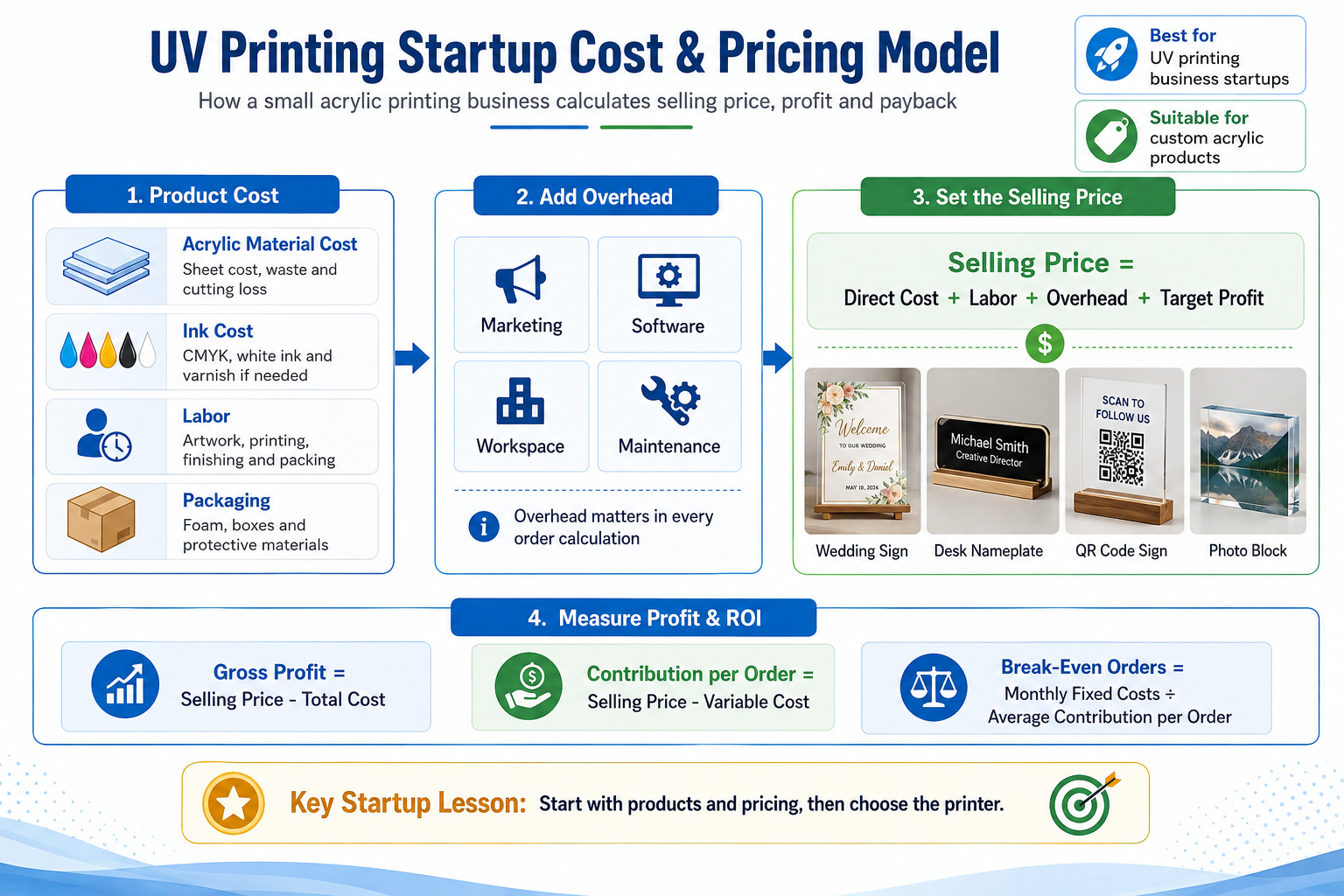
6.1 Acrylic Material Cost
Material cost is more than the price of one acrylic sheet divided by the number of finished pieces.
The calculation should also consider cutting waste, damaged material, test prints, defective pieces, and unusable offcuts.
6.2 Ink Cost
Ink cost depends on artwork coverage and the printing structure.
A design using heavy CMYK coverage, a full white underbase, and varnish will consume more ink than a minimal design using selective graphics.
This is especially important in transparent acrylic production because white ink coverage can represent a meaningful part of the variable cost.
6.3 Labor
Many beginners underestimate labor because they count only the minutes during which the printer is operating.
Labor should also include:
- customer communication;
- artwork modification;
- RIP preparation;
- material positioning;
- printing supervision;
- finishing;
- quality inspection;
- packing.
6.4 Packaging
Acrylic can scratch, crack, or suffer edge damage during delivery. Protective film, foam, corner protection, boxes, and other packaging therefore form part of the product cost.
A profitable order at the factory can quickly become an unprofitable order if the product arrives damaged and must be replaced.
6.5 Selling Price
A practical pricing structure is:
Selling Price = Direct Cost + Labor + Overhead Allocation + Target Profit
However, custom products should not always be priced by multiplying material cost by a simple percentage.
A customer purchasing a personalized wedding sign, branded QR display, or custom photo product is paying for personalization, design, convenience, and low-volume production.
6.6 Gross Margin
Gross margin should not be confused with net profit.
Even if the difference between product selling price and direct material cost looks high, the business may still need to pay for advertising, rent, software, failed samples, machine maintenance, payment-processing fees, customer service, and equipment depreciation.
7. How to Calculate the UV Printer Payback Period
For a startup, ROI should be calculated before purchasing equipment and then reviewed regularly after production begins.
A short UV printer payback period is possible only when enough profitable orders are generated. Machine ownership alone does not create ROI.
7.1 Initial Investment
| Startup Cost | What to Include |
|---|---|
| Stampante UV | Machine, required accessories, freight and installation where applicable |
| Inchiostro | Initial CMYK, white ink and varnish if required |
| Acrylic Materials | Production stock, samples and testing materials |
| Computer & Software | Design workstation, RIP and other required software |
| Workspace | Tables, storage, electrical preparation and basic workspace requirements |
| Confezione | Boxes, foam, protective materials and labels |
| Marketing | Samples, photography, advertising and sales materials |
7.2 Monthly Fixed Costs
Monthly expenses may include rent, electricity, software subscriptions, internet, marketing, maintenance allowance, and labor.
These costs must be paid whether the business receives ten orders or one hundred orders, so they directly affect the required break-even sales volume.
7.3 Average Profit per Order
A simple starting calculation is:
Contribution per Order = Selling Price − Variable Cost per Order
Variable costs can include acrylic, ink, direct labor, packaging, and transaction-related expenses.
Revenue should never be treated as profit. A business selling $5,000 of products per month is not necessarily more profitable than one selling $3,000 if the first business has significantly higher material, advertising, labor, and waste costs.
7.4 Break-Even Order Volume
Once average contribution per order is known, the business can estimate the monthly order volume required to cover fixed costs:
Break-Even Orders = Monthly Fixed Costs ÷ Average Contribution per Order
For example, if a business has monthly fixed costs of $1,000 and an average contribution of $20 per order, it would need approximately 50 equivalent orders to cover those fixed costs.
This is an illustrative example only. Actual prices, costs, currencies, order sizes, advertising expenses, and labor costs vary considerably by market.
7.5 Calculating the Payback Period
After operating costs are covered, the remaining monthly cash contribution can be compared with the initial investment.
A simplified formula is:
Payback Period = Initial Investment ÷ Average Monthly Net Cash Contribution
If order volume increases, average profit improves, or production becomes more efficient, the payback period may become shorter. If orders are inconsistent, advertising costs increase, or waste is higher than expected, payback may take longer.
For a deeper analysis of equipment ownership costs, margin, and ROI, connect this section to your UV Printing ROI & Pricing Strategy guide.
8. Mistakes Made During the Early Startup Stage
A realistic customer story should include mistakes, because the first months of a new printing business are usually a learning period rather than a straight line from printer installation to profit.
8.1 Offering Too Many Products Too Early
Trying to print acrylic, wood, metal, leather, glass, phone cases, bottles, gifts, signs, and dozens of other products immediately creates unnecessary complexity.
Every material can require different positioning, adhesion testing, print settings, artwork preparation, and packaging.
A better approach is to start with a small group of repeatable products and expand only after the workflow becomes stable.
8.2 Underpricing Small Custom Orders
A small product does not necessarily mean a small amount of work.
A single customized nameplate may still require customer communication, artwork modification, file setup, printing, inspection, and packaging.
For this reason, minimum order values, setup fees, or design charges may be necessary for very small customized jobs.
8.3 Ignoring Sample Costs
Samples are useful for testing products and attracting customers, but they still consume acrylic, ink, labor, packaging, and sometimes shipping.
A startup should therefore treat samples as a marketing expense and set a reasonable sample budget.
8.4 Using the Same Print Settings for Every Acrylic Type
Different acrylic suppliers, thicknesses, colors, coatings, and surface conditions can produce different printing results.
A setting that works perfectly for one sheet should not automatically be applied to every new batch without testing.
Building a small material-and-settings database can save time as the business grows.
9. What New UV Printing Businesses Can Learn
Several lessons from this startup model apply to almost anyone researching how to start a UV printing business.
- Start with products, not equipment. Identify what customers will buy before deciding what printer they need.
- Test demand before expanding. A focused product range is easier to market, price, and produce.
- Understand total cost before competing on price. Ink and material are only part of the real cost.
- Build repeatable production settings. Stable results reduce waste and make future orders easier.
- Track profit and ROI monthly. Sales revenue alone does not show whether the business is recovering its equipment investment.
The businesses that use UV printing most effectively are not necessarily those with the largest printers. They are usually the businesses that connect the capabilities of the printer to clearly defined products and customer needs.
10. Is This UV Printing Business Model Right for You?
A personalized acrylic business can be attractive, but it is not automatically suitable for every entrepreneur.
This Business Model May Be Suitable If:
- you can identify local or online demand for personalized products;
- you are willing to learn basic artwork and RIP preparation;
- you can produce samples before large orders;
- you are prepared to market the products actively;
- you have enough working capital for materials, ink, packaging, and customer acquisition;
- you can track costs and pricing consistently.
Be More Cautious If:
- you expect the printer to generate customers automatically;
- you have not identified any specific products to sell;
- your only strategy is to offer the lowest price;
- you have no budget for samples or marketing;
- you have not researched local competition or customer demand.
A UV printer is a production tool, not a customer acquisition system.
The strongest startup plans combine product selection, customer acquisition, pricing, production control, and equipment capability.
11. Frequently Asked Questions About Starting a UV Printing Business
Is a UV printing business profitable?
A UV printing business can be profitable when the printer is connected to products with sufficient customer demand and margin. Profitability depends on selling price, material cost, ink coverage, labor, marketing cost, order volume, waste, maintenance, and equipment utilization. Personalized products can provide attractive margins because customers are paying for customization and convenience, but profitability should always be calculated using real local costs.
How much does it cost to start a UV printing business?
Startup cost depends heavily on printer size, printhead configuration, product range, country, shipping, and workspace requirements. Buyers should budget for more than the UV printer itself. Initial ink, materials, a computer, software, sample production, packaging, maintenance supplies, marketing, and working capital should all be included before calculating the required investment.
What is the best UV printer for a startup?
The best UV printer for startup use is the machine that matches the products you realistically expect to sell. A business producing small QR signs, desk nameplates, gifts, and photo blocks may not need a large industrial flatbed at the beginning. A company planning large signage or high-volume panel production may require a larger system. Product size and expected order volume should determine equipment size.
Can a beginner operate a UV printer?
Yes, beginners can learn UV printing, but training and disciplined maintenance are important. New operators should understand artwork preparation, RIP software, white ink management, printhead cleaning, material positioning, adhesion testing, and basic troubleshooting. Starting with a limited range of products and materials makes the learning process much easier than attempting many applications immediately.
What are good acrylic printing business ideas?
Common acrylic printing business ideas include wedding signs, QR code stands, desk nameplates, company logo plaques, photo blocks, personalized gifts, awards, decorative signs, table numbers, and small commercial displays. The best products depend on local demand, competition, shipping requirements, and the customer’s willingness to pay for personalization.
How long does it take to recover the cost of a UV printer?
There is no universal UV printer payback period. Recovery time depends on the initial investment, average contribution per order, monthly order volume, fixed operating costs, marketing expenses, waste, and downtime. A buyer should calculate several scenarios before purchasing, including conservative, expected, and high-demand cases rather than assuming an optimistic sales forecast.
Do I need white ink to print transparent acrylic?
White ink is strongly recommended for many transparent acrylic applications because it can increase opacity and provide a background behind CMYK graphics. Without white ink, colors may appear more transparent and their appearance can change depending on what is behind the acrylic. However, transparent effects can also be intentional, so the white layer should be designed according to the desired visual result.
Conclusion: Start with the Business Model, Then Choose the Printer
The most important lesson from this Vietnamese acrylic startup is that starting a UV printing business should not begin with the question, “Which printer should I buy?”
It should begin with: Who are my customers? What products will they pay for? What sizes do I need to print? What does each order really cost? How many profitable orders can I realistically generate each month?
Once those questions are answered, choosing a printer becomes much easier.
A small UV printer can provide an entry point into customized acrylic products when the production area, white ink capability, printing height, and workflow match the intended applications. As demand becomes more predictable, the business can expand its product range or production capacity based on real orders rather than assumptions.
Planning to start your own UV printing business?
Send us the products you want to make, your maximum product dimensions, expected monthly order volume, material samples, and available equipment budget. We can help you compare suitable UV printer sizes and configurations before you invest.
You may also be interested in:
UV Printing on Acrylic: Applications, Adhesion and Printing Process,
UV Printing ROI & Pricing Strategy,
E
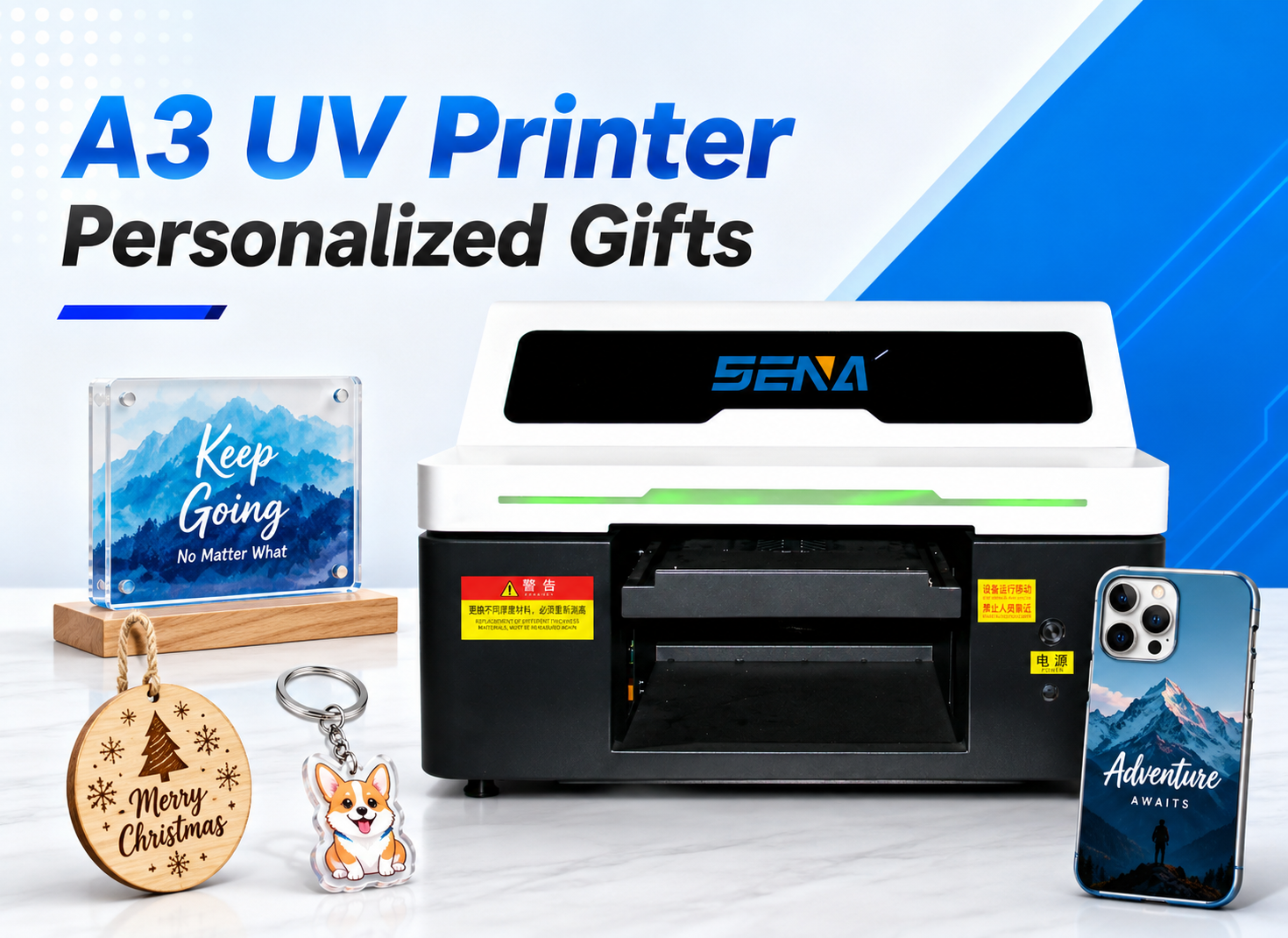
A3 Desktop UV Printer for Personalized Products.