Avoid your inquiry is delay response, please enter your WhatsApp/WeChat/Skype along with the message, so we can contact you at the very first time
We will reply you within 24 hours. If for urgent case, please add WhatsApp: +8613011708220, or WeChat: +86 13011708220. Or call +86 13011708220 directly.
*We respect your confidentiality and all information are protected. We will only use your information to respond to your inquiry and will never send unsolicited emails or promotional messages.
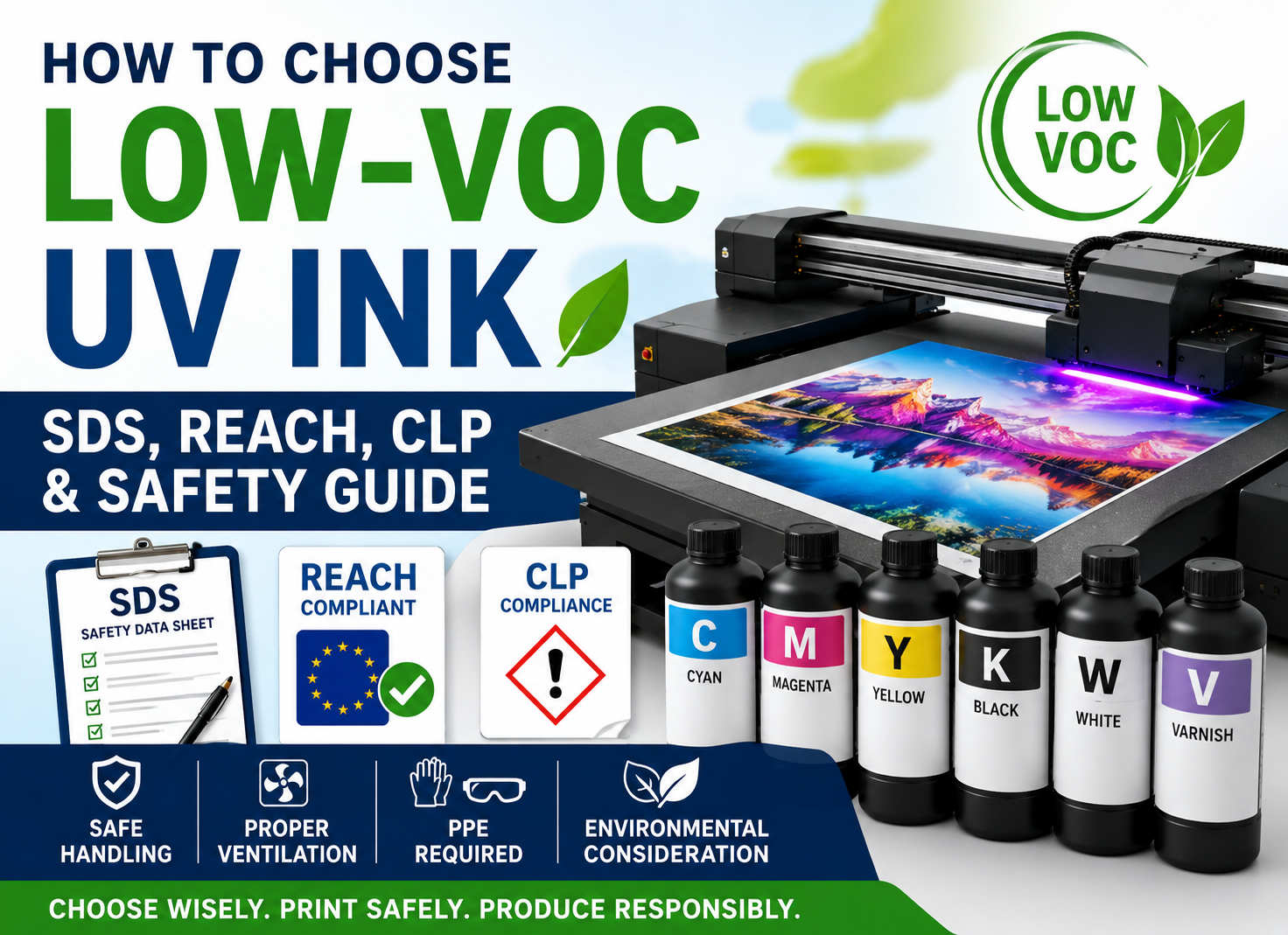
How to Choose Low-VOC UV Ink: SDS, REACH, CLP & Safety Guide
Two UV inks are offered for the same printer. Both suppliers describe their products as “eco-friendly,” “low odor,” and “low VOC.” One supplier provides a current Safety Data Sheet, technical data, chemical compliance information, recommended protective measures, and clear curing instructions. The other provides only a brochure with a green leaf logo.
Which ink should you trust?
Choosing low VOC UV ink should not be based on marketing language alone. Ink chemistry affects operator safety, printer stability, curing performance, adhesion, odor, waste handling, regulatory documentation, and even whether the finished print is appropriate for a specific application.
UV-curable inks generally rely less on solvent evaporation than conventional solvent-based printing systems because the liquid ink is cured by UV energy. However, this does not mean every UV ink is VOC-free, non-toxic, food-safe, or suitable for every workplace.
This guide explains how buyers and UV printer users can evaluate low-VOC UV ink using practical evidence such as SDS documents, REACH-related information, CLP classification, printer compatibility, curing performance, ventilation requirements, and application-specific testing.
Important: This article provides general purchasing and workplace-safety guidance. Chemical classification, occupational exposure requirements, environmental rules, and food-contact requirements vary by product and market. Always review the current SDS and technical documentation for the exact ink series you use.
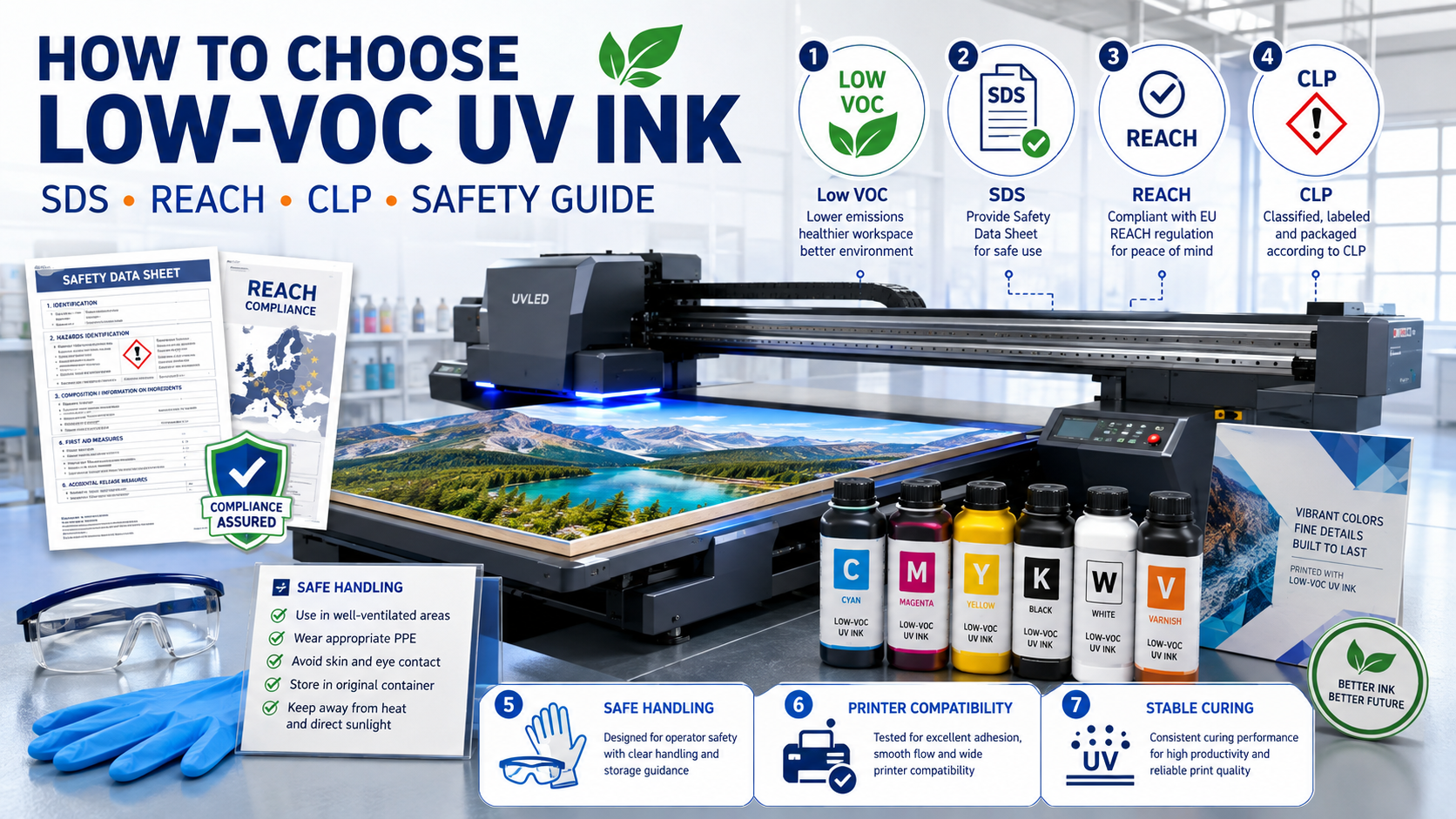
Low-VOC UV ink should be evaluated using chemical documentation, safety information, printer compatibility and actual print performance.
What Does Low-VOC UV Ink Actually Mean?
VOC stands for volatile organic compound. In many conventional solvent-based printing processes, liquid solvents evaporate as part of the drying process. This can create significant solvent-vapor management requirements depending on the ink chemistry, printing volume, ventilation system, and local regulations.
UV-curable printing works differently. The ink is deposited onto the substrate and exposed to UV energy, which initiates a curing reaction and converts the liquid ink into a solid or semi-solid polymer film.
This curing mechanism can reduce dependence on large amounts of evaporating solvent, which is one reason UV printing is often considered attractive for applications where VOC reduction is a priority.
Low VOC Does Not Mean Zero Hazard
This distinction is critical.
An ink can have relatively low VOC content and still contain ingredients that require controlled handling. Uncured UV-curable formulations may contain reactive components that can irritate the skin or eyes or contribute to sensitisation in susceptible workers.
Therefore:
low VOC does not automatically mean VOC-free;
low odor does not prove low VOC;
low VOC does not automatically mean non-toxic;
eco-friendly does not automatically mean safe for every application.
The right way to evaluate an ink is to combine environmental claims with product-specific technical and safety documentation.
What Is Inside UV-Curable Ink?
UV ink formulations vary between manufacturers, colors, printhead technologies, rigid and flexible applications, and specialty products. However, most UV-curable systems contain several functional groups of ingredients.
Oligomers
Oligomers help form the structure of the cured ink film. They can influence properties such as hardness, flexibility, chemical resistance, adhesion, and surface durability.
An ink designed for rigid acrylic panels may therefore require different performance characteristics from an ink intended for leather, film, flexible PVC, or other materials that bend after printing.
Monomers and Reactive Diluents
Reactive diluents help control viscosity and participate in the curing process. Their chemistry can also influence adhesion, flexibility, curing speed, and handling characteristics.
Some acrylate-related materials require careful skin-contact control. This is why operators should never assume that uncured UV ink is harmless simply because the finished print feels dry.
Photoinitiators
Photoinitiators absorb UV energy and help start the curing reaction. Their type and concentration must work with the UV wavelength, ink formulation, print speed, ink-film thickness, and curing system.
Pigments and Additives
Pigments create color, while additives may influence flow, surface tension, adhesion, foam control, storage stability, gloss, or other properties.
Buyers do not need the complete confidential formulation to evaluate an ink. What they do need is reliable information about hazards, safe use, compatibility, storage, and intended application.
7 Things to Check Before Choosing Low-VOC UV Ink
When comparing UV inks, use a structured purchasing process instead of judging them only by price per liter.
1. Ask for the Current SDS
The Safety Data Sheet is one of the first documents a professional buyer should review.
It provides information on the product, identified hazards, handling, storage, exposure controls, personal protection, transport, disposal, and emergency measures where applicable.
Do not accept a generic SDS for an unrelated ink series. The product name or identification should correspond with the ink you are actually buying.
2. Ask for REACH-Related Information
European buyers often ask suppliers, “Do you have a REACH certificate?”
This question can be misleading because REACH is a regulatory framework, not simply one universal product certificate that makes an ink environmentally safe.
A more useful question is:
“What REACH-related information, declarations, substance information or supporting documentation can you provide for this exact ink series?”
Depending on the product and supply-chain role, different obligations may apply.
3. Review CLP Classification and Label Information
Under the EU Classification, Labelling and Packaging framework, hazardous substances and mixtures are classified according to their hazards and communicated through labels and related documentation.
Where applicable, look for information such as:
hazard pictograms;
signal words;
hazard statements;
precautionary statements;
product identifiers;
supplier information.
The absence of strong odor does not override this information.
4. Ask for VOC Data Instead of Marketing Claims
Terms such as “green ink,” “eco ink,” or “environmental ink” have little value without supporting information.
If VOC performance is important to your project, ask whether the supplier has quantitative VOC information, test data, technical documentation, or another clear basis for the claim.
Ask for data, not slogans.
5. Evaluate Odor Separately From Chemical Safety
Odor is important in many indoor production environments because operators may spend eight or more hours around printing equipment.
However, odor perception is subjective. A product that smells mild is not automatically safer, while a noticeable smell does not by itself prove that VOC content is high.
Use the SDS and workplace risk assessment rather than the human nose as your safety instrument.
6. Confirm the Intended Application
Ask whether the ink is designed and tested for the materials you actually print.
Applications may include:
acrylic;
glass;
PVC;
wood;
metal;
ceramic;
leather;
flexible media;
promotional products;
packaging.
An ink performing well on rigid signage is not automatically the ideal formulation for a flexible product.
7. Test Printing Performance Before Full Production
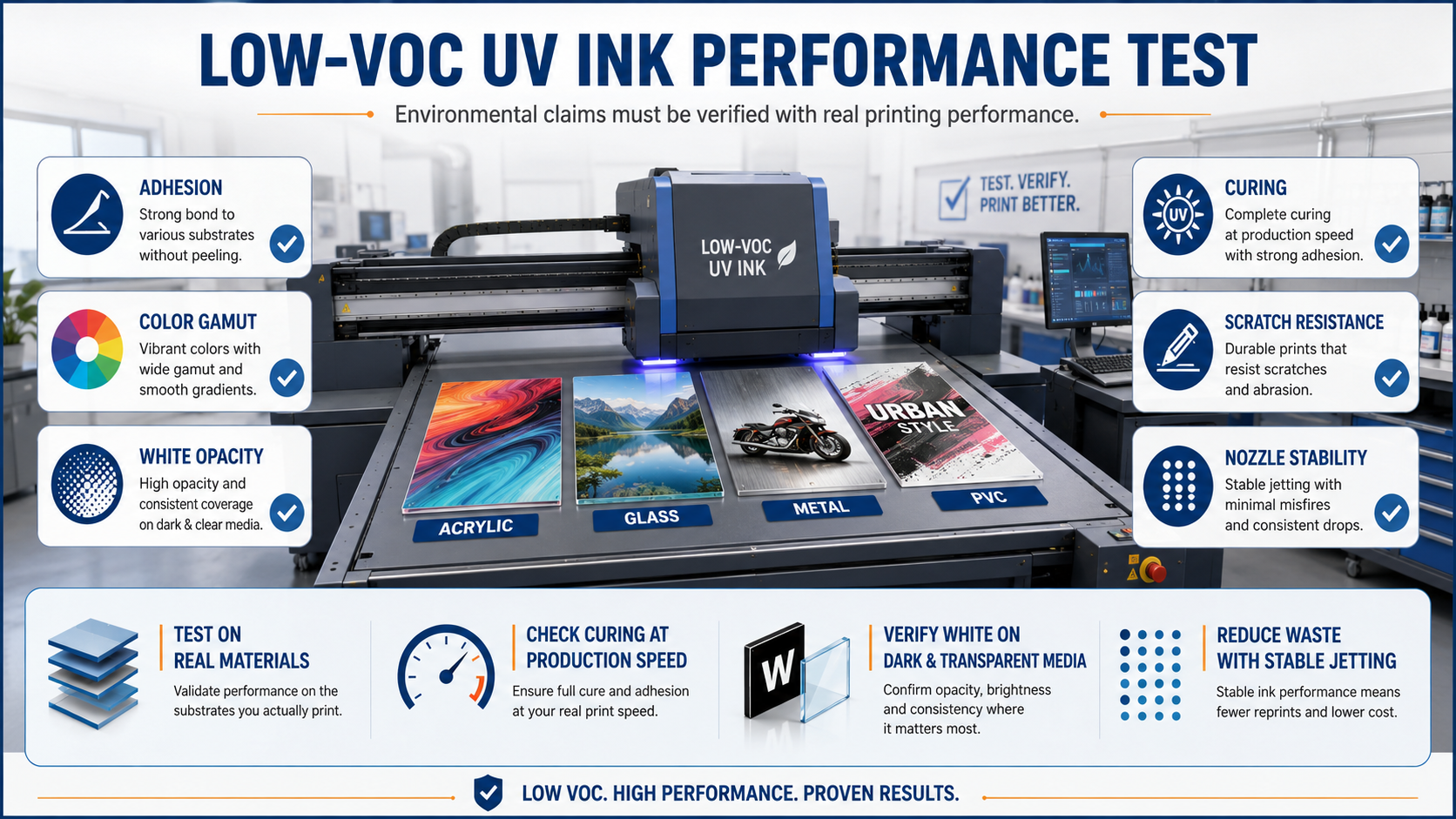
Environmental performance cannot compensate for poor printing performance.
Before changing ink brands or formulations, test adhesion, curing, color, white opacity, surface resistance, flexibility where relevant, and long-run nozzle stability.
If an ink causes frequent nozzle problems or high rejection rates, its total environmental and operating cost may be worse despite an attractive “eco-friendly” label.
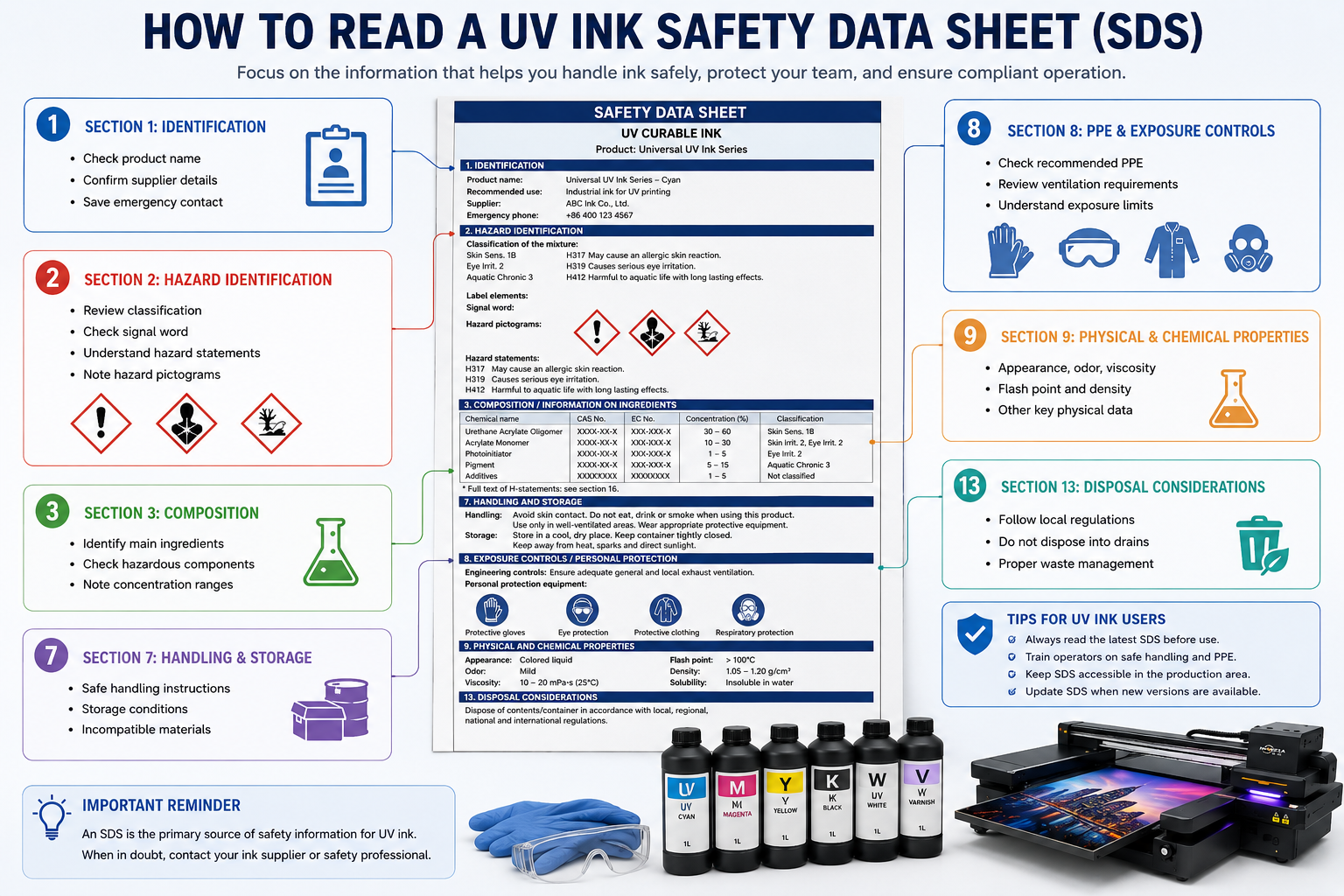
How to Read a UV Ink Safety Data Sheet
A modern SDS normally contains 16 standard sections. UV printer users do not need to memorise every chemical term, but several sections deserve particular attention.
Focus on identification, hazards, handling, PPE, physical properties and disposal when reviewing a UV ink SDS.
Section 1: Identification
Start by confirming the product identity.
Check the ink series, supplier information, recommended use, and emergency contact details where provided.
If you purchased one ink series but received an SDS for another product, ask the supplier for clarification before use.
Section 2: Hazard Identification
This is one of the most important sections.
It may show the product classification, hazard pictograms, signal word, hazard statements, precautionary statements, and other relevant hazards.
Do not ignore this section because the supplier’s brochure describes the product as environmentally friendly.
Section 3: Composition / Information on Ingredients
This section provides composition-related information required under the applicable SDS rules.
A commercial formulation may not disclose every ingredient at its exact percentage because legitimate confidential-business-information provisions can apply. The important issue for users is whether the document provides the hazard-relevant information required for safe handling.
Section 7: Handling and Storage
This section can help production teams understand appropriate storage and handling conditions.
Pay attention to recommendations concerning:
container closure;
temperature;
sunlight or UV exposure;
incompatible conditions;
safe handling.
Improper storage can affect both safety and printing stability.
Section 8: Exposure Controls / Personal Protection
Production managers should review this section carefully.
It may specify appropriate gloves, eye protection, ventilation, engineering controls, or occupational exposure information.
PPE decisions should be based on the specific ink and SDS rather than one universal rule for all UV inks.
Section 9: Physical and Chemical Properties
This section provides relevant physical and chemical characteristics. Depending on the product, it may include appearance, odor, viscosity-related information, flash point, density, or other properties.
Section 13: Disposal Considerations
Waste ink, contaminated wipes, empty containers, and cleaning fluids should not automatically be treated as ordinary household waste.
Follow the SDS, local waste regulations, and instructions from qualified waste-management providers.
REACH vs CLP vs SDS: What Is the Difference?
These three terms often appear together in UV ink sales discussions, but they do not mean the same thing.
Term
Main Purpose
Why UV Ink Buyers Care
REACH
EU framework covering registration, evaluation, authorisation and restriction of chemicals, plus supply-chain obligations.
Helps determine chemical and supply-chain responsibilities and restricted-substance issues.
CLP
Classification, labelling and packaging of substances and mixtures.
Communicates hazards through classification and labels.
SDS
Safety communication document with product, hazard and safe-use information.
Helps buyers and operators understand handling, PPE, storage, disposal and emergency measures.
What Does “REACH-Compliant UV Ink” Really Mean?
When a supplier uses this phrase, ask what specific evidence supports it.
For example, does the supplier understand restrictions relevant to the formulation? Can it provide appropriate supply-chain information? Is the SDS current? Are relevant substance declarations available?
A green “REACH” logo on a brochure is not a substitute for regulatory documentation.
What Does CLP Tell the User?
CLP helps communicate the hazards of substances and mixtures. For hazardous mixtures, labels can include pictograms, signal words, hazard statements and precautionary statements that help workers recognise and control risks.
This is especially useful when inks are shipped internationally and production staff may not have spoken directly with the ink manufacturer.
2026 CLP Updates UV Ink Importers Should Notice
European chemical rules continue to evolve, so buyers should not assume that an old label or an SDS stored for many years is automatically current.
Under amendments introduced by Regulation (EU) 2024/2865, a number of revised CLP provisions began applying from 1 July 2026, while transitional periods apply to certain products that were already in the supply chain before the relevant application date. Other revised provisions have later application dates.
Current ECHA guidance also reflects updated requirements for supplier information on labels and other classification and labelling provisions.
The practical lesson for a UV ink buyer is simple:
Request the current version of the SDS and current label information for the exact product you are purchasing.
Is Low-VOC UV Ink Safe for Operators?
Low-VOC UV ink can still require careful workplace controls, especially while the ink is uncured.
Printing operators may encounter ink during cartridge changes, bottle filling, nozzle maintenance, waste-ink handling, cleaning, leak control, or accidental spills.
Avoid Direct Skin Contact
Repeated exposure to certain UV-curable ink components can contribute to occupational skin problems. Uncured ink should therefore be handled as directed by the product-specific SDS.
Do not clean ink-covered hands using strong solvents. Follow appropriate hygiene procedures and wash contaminated skin promptly using suitable methods.
Wear Suitable PPE
Depending on the ink and task, the SDS may recommend:
chemical-resistant or splash-resistant gloves;
eye protection;
protective clothing;
additional controls during maintenance or spill response.
The exact PPE material should come from the ink manufacturer’s SDS and workplace risk assessment.
Train Operators
Even good chemical documentation is ineffective if operators never read it.
A common claim in UV printer marketing is that UV printing requires no ventilation because the ink contains little or no solvent. That statement is too broad.
Ventilation requirements depend on the exact ink chemistry, machine design, curing technology, room size, printing volume, cleaning chemicals, workplace exposure assessment, and local occupational-safety regulations.
Current UK Health and Safety Executive guidance for wide-format UV-curable printing recommends a good standard of general ventilation and appropriate engineering controls for relevant emissions. It also addresses extraction where ozone is produced.
UV LED vs Conventional UV Lamps
Many modern UV printers use UV LED curing rather than older lamp technologies. The emission characteristics and heat generation can differ between technologies.
However, switching to LED should not be used as a reason to ignore workplace ventilation completely.
Do Not Forget Ink Mist and Cleaning Chemicals
The printing ink is only one chemical source in the production area.
Also consider:
cleaning liquid;
flushing solution;
waste ink;
primers;
coatings;
adhesion promoters.
Each chemical should be handled according to its own documentation.
Low VOC vs Printing Performance: What Should You Test?
The best environmentally preferable ink is still unsuitable if it cannot produce reliable finished products.
Environmental claims should be evaluated together with adhesion, curing, color, white opacity and production stability.
Test
Why It Matters
Adhesion
Reduces peeling and premature failure.
Scratch Resistance
Important for frequently handled products.
Color Gamut
Affects brand-color and photographic reproduction.
White Opacity
Critical for dark and transparent substrates.
Curing
Poor curing can cause tackiness, weak adhesion and handling problems.
Flexibility
Important for media that bends, folds or stretches.
Nozzle Stability
Reduces cleaning, downtime, ink waste and rejected prints.
Adhesion
Test the actual substrate, not just a standard sample provided by the ink manufacturer. Glass, acrylic, coated metal, untreated metal, PVC, wood, leather and other materials can behave very differently.
White Ink Opacity
For transparent and dark materials, weak white coverage may require additional passes or higher ink consumption, which can offset some of the expected cost and environmental benefits.
Proper curing should be evaluated at realistic production speed and ink-film thickness.
Do not assume that a surface that feels dry is automatically fully cured for every intended application.
Nozzle Stability
An ink that requires frequent purging or causes unstable jetting increases waste ink, cleaning-liquid use, maintenance time, and potentially printhead wear.
This is one of the most important distinctions for companies entering packaging applications.
A standard UV ink should not automatically be described as food-safe simply because it is low VOC, low odor, REACH-related documentation is available, or the finished surface feels completely cured.
Direct Food Contact vs External Packaging Printing
Printing on the outside of a rigid box is different from printing on a surface that directly contacts food.
Application safety can depend on the complete printed structure, including:
ink formulation;
substrate;
barrier properties;
coatings;
curing conditions;
set-off;
migration;
intended food type and use conditions.
Ask for Application-Specific Evidence
Instead of asking:
“Is UV ink food-safe?”
ask:
“Is this exact ink and printed structure suitable and supported for my specific food-contact application?”
This distinction helps prevent a general-purpose ink from being used in an application that requires much more specific evaluation.
Documentation does not guarantee that an ink is perfect, but a supplier that cannot provide basic product information makes professional risk assessment much harder.
Before placing a production order, consider requesting:
current Safety Data Sheet (SDS);
Technical Data Sheet (TDS);
REACH-related information or declarations where relevant;
CLP label information where applicable;
batch or lot identification;
storage and shelf-life guidance;
recommended curing conditions;
printhead and printer compatibility information;
tested substrate information;
application-specific compliance evidence where required.
No SDS is available. The supplier provides only marketing material.
The SDS does not match the product. The product name or ink series is different.
The supplier claims “100% eco-friendly.” No measurable basis is provided.
The ink is described as “non-toxic” without supporting evidence.
Low odor is used as proof of low VOC.
REACH is presented only as a logo or generic certificate.
Food-safe claims are made without application-specific evidence.
The supplier cannot explain PPE, storage, curing or compatibility requirements.
10 Questions to Ask Your UV Ink Supplier
Before switching ink suppliers, send these questions to the manufacturer or distributor:
Can you provide the latest SDS for this exact ink series?
What CLP classification applies to this ink where relevant?
What REACH-related documentation or substance information is available?
Can you provide VOC data or explain the basis of your low-VOC claim?
What PPE does the current SDS recommend?
What ventilation conditions do you recommend for normal production?
Which printer models and printheads have been tested with this ink?
Which substrates have been tested for adhesion and durability?
What curing conditions are recommended?
Are any food-contact, children’s-product or other special-application claims supported by specific testing?
A supplier that can answer these questions clearly is usually much easier to work with than one that responds only with “our ink is environmentally friendly.”
Low-VOC UV Ink Buying Checklist
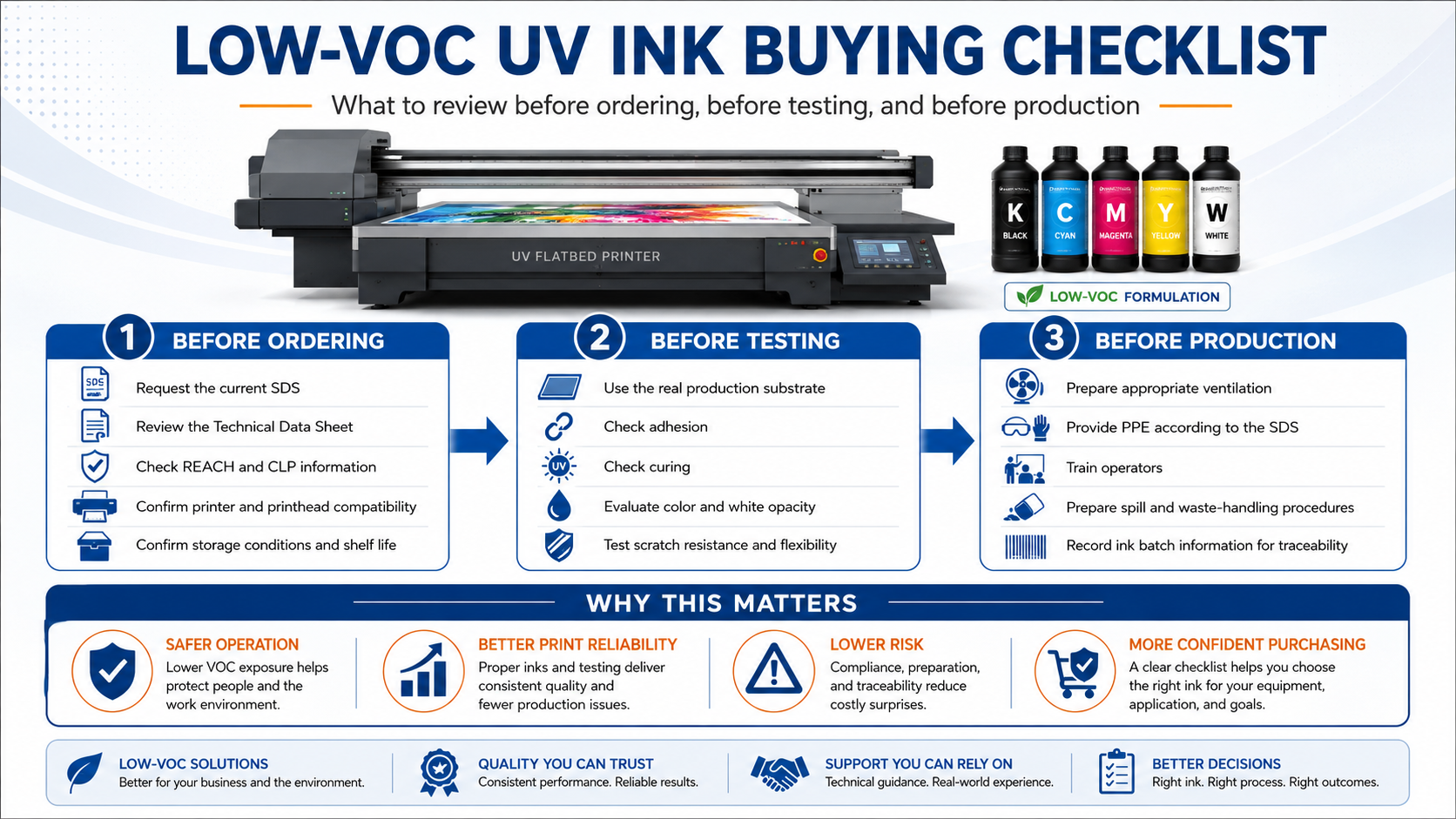
Evaluate documentation before ordering, print performance before approval, and workplace controls before production.
Before Ordering
Request the current SDS.
Review the Technical Data Sheet.
Check REACH- and CLP-related information where applicable.
Confirm printhead and printer compatibility.
Confirm storage conditions and shelf life.
Before Testing
Use the real production substrate.
Check adhesion.
Check curing.
Evaluate color and white opacity.
Test scratch resistance and flexibility where relevant.
Before Production
Prepare appropriate ventilation.
Provide PPE according to the SDS.
Train operators.
Prepare spill and waste-handling procedures.
Record ink batch information for traceability.
Frequently Asked Questions About Low-VOC UV Ink
Is UV ink VOC-free?
Not necessarily. UV-curable inks generally depend less on solvent evaporation than conventional solvent-based inks, but actual VOC content depends on the formulation. Check product-specific technical data rather than assuming all UV inks are VOC-free.
Is low-VOC UV ink non-toxic?
No. Low VOC describes only one aspect of a formulation. An ink may still have skin, eye, sensitisation, environmental or other hazard classifications. Review the SDS and CLP information where applicable.
Is UV ink environmentally friendly?
UV printing can offer environmental advantages in certain applications, including reduced dependence on solvent evaporation and efficient on-demand production. However, overall environmental performance also depends on ink chemistry, energy use, substrate selection, waste, cleaning materials, curing efficiency and product lifetime.
What is an SDS for UV ink?
A Safety Data Sheet communicates information about a chemical product’s properties, hazards, handling, storage, exposure controls, first aid, firefighting, transport and disposal. It is one of the most important documents for professional ink users.
What does REACH-compliant UV ink mean?
“REACH compliant” is often used as a commercial phrase, but REACH is a broad EU chemicals regulation rather than a single universal ink certification. Buyers should ask what specific REACH-related obligations and supporting documents apply to the exact product.
Does a UV printer need ventilation?
Ventilation requirements depend on the ink, curing technology, room, printing volume, cleaning chemicals and local workplace rules. Good general ventilation and additional engineering controls may be necessary depending on the process.
Is UV ink food-safe?
A general-purpose UV ink should not automatically be considered food-safe. Food-contact suitability depends on the exact ink, substrate, printing structure, curing process, migration behavior and intended application. Obtain application-specific evidence before using UV ink for food-contact products.
How do I choose the right UV ink for my printer?
Check printhead compatibility, viscosity and jetting stability, curing requirements, adhesion, color, white opacity, flexibility, environmental documentation, SDS information, storage conditions, and the intended substrate. Always perform production-relevant testing before a full ink conversion.
Final Thoughts: Choose UV Ink Based on Evidence, Not Marketing Claims
The best low VOC UV ink is not simply the product with the strongest “green” label. It is an ink that combines clear chemical documentation, appropriate workplace controls, reliable curing, printer compatibility, stable jetting, strong adhesion, acceptable environmental characteristics, and proven performance for the intended application.
Before changing UV ink, request the current SDS, Technical Data Sheet, relevant compliance information, printer compatibility data and application-specific evidence for the exact ink series.
If you are selecting a UV printer and want to understand the ink options available for your materials and market, contact our team for printer specifications, ink documentation and application testing information.


 English
  Arabic
  German
  French
  Spanish
  Turkish
  Italian
  Russian
  Persian
  Bengali
  Hebrew
  Persian (Afghanistan)
  Scottish Gaelic
  Panjabi
  Croatian
  Slovenian
  Greek
Greek  Afrikaans
  Czech
Czech  Korean
  Japanese
  Portuguese